

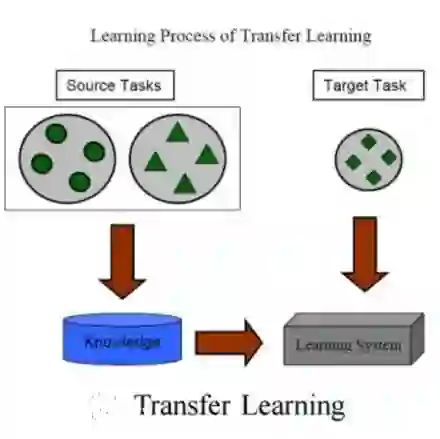
Parameter-efficient fine-tuning (PEFT) has emerged as an effective method for adapting pre-trained language models to various tasks efficiently. Recently, there has been a growing interest in transferring knowledge from one or multiple tasks to the downstream target task to achieve performance improvements. However, current approaches typically either train adapters on individual tasks or distill shared knowledge from source tasks, failing to fully exploit task-specific knowledge and the correlation between source and target tasks. To overcome these limitations, we propose PEMT, a novel parameter-efficient fine-tuning framework based on multi-task transfer learning. PEMT extends the mixture-of-experts (MoE) framework to capture the transferable knowledge as a weighted combination of adapters trained on source tasks. These weights are determined by a gated unit, measuring the correlation between the target and each source task using task description prompt vectors. To fully exploit the task-specific knowledge, we also propose the Task Sparsity Loss to improve the sparsity of the gated unit. We conduct experiments on a broad range of tasks over 17 datasets. The experimental results demonstrate our PEMT yields stable improvements over full fine-tuning, and state-of-the-art PEFT and knowledge transferring methods on various tasks. The results highlight the effectiveness of our method which is capable of sufficiently exploiting the knowledge and correlation features across multiple tasks.
翻译:参数高效微调已成为将预训练语言模型高效适配至各类任务的有效方法。近年来,从单个或多个任务向目标任务迁移知识以提升性能的研究日益受到关注。然而,现有方法通常要么在各任务上独立训练适配器,要么从源任务中提取共享知识,未能充分利用任务特定知识及源任务与目标任务间的关联性。为突破这些局限,我们提出PEMT——一种基于多任务迁移学习的新型参数高效微调框架。PEMT扩展了混合专家框架,将可迁移知识建模为源任务预训练适配器的加权组合,其权重由门控单元通过任务描述提示向量度量目标任务与各源任务间的关联性来确定。为充分挖掘任务特定知识,我们还提出任务稀疏损失以增强门控单元的稀疏性。我们在涵盖17个数据集的广泛任务上开展实验,结果表明PEMT在全量微调、现有最优参数高效微调方法及知识迁移方法上均能取得稳定提升。实验结果凸显了该方法能够充分利用多任务间知识与关联特征的有效性。




相关内容



 微信扫码咨询专知VIP会员