

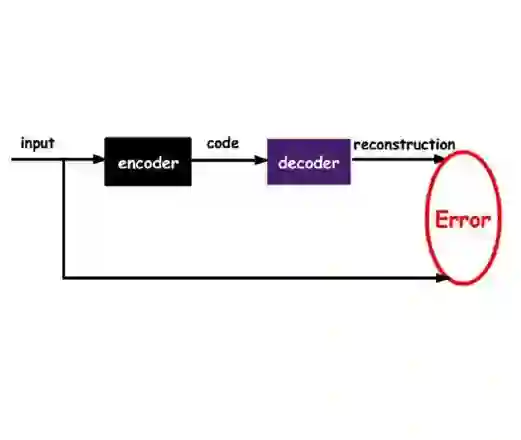
In the autoencoder based anomaly detection paradigm, implementing the autoencoder in edge devices capable of learning in real-time is exceedingly challenging due to limited hardware, energy, and computational resources. We show that these limitations can be addressed by designing an autoencoder with low-resolution non-volatile memory-based synapses and employing an effective quantized neural network learning algorithm. We propose a ferromagnetic racetrack with engineered notches hosting a magnetic domain wall (DW) as the autoencoder synapses, where limited state (5-state) synaptic weights are manipulated by spin orbit torque (SOT) current pulses. The performance of anomaly detection of the proposed autoencoder model is evaluated on the NSL-KDD dataset. Limited resolution and DW device stochasticity aware training of the autoencoder is performed, which yields comparable anomaly detection performance to the autoencoder having floating-point precision weights. While the limited number of quantized states and the inherent stochastic nature of DW synaptic weights in nanoscale devices are known to negatively impact the performance, our hardware-aware training algorithm is shown to leverage these imperfect device characteristics to generate an improvement in anomaly detection accuracy (90.98%) compared to accuracy obtained with floating-point trained weights. Furthermore, our DW-based approach demonstrates a remarkable reduction of at least three orders of magnitude in weight updates during training compared to the floating-point approach, implying substantial energy savings for our method. This work could stimulate the development of extremely energy efficient non-volatile multi-state synapse-based processors that can perform real-time training and inference on the edge with unsupervised data.
翻译:在基于自编码器的异常检测范式中,在具备实时学习能力的边缘设备上实现自编码器因硬件、能量和计算资源受限而极具挑战性。我们证明,通过设计采用低分辨率非易失性存储型突触的自编码器,并结合有效的量化神经网络学习算法,可解决这些局限。我们提出一种带有工程化凹口的铁磁赛道(可容纳磁畴壁)作为自编码器突触,其有限状态(5态)突触权重通过自旋轨道矩(SOT)电流脉冲进行操控。该自编码器模型的异常检测性能在NSL-KDD数据集上进行了评估。对自编码器进行考虑有限分辨率及磁畴壁器件随机性的训练,获得了与采用浮点精度权重的自编码器相当的异常检测性能。尽管已知纳米尺度器件中有限的量化状态数及磁畴壁突触权重的固有随机性会对性能产生负面影响,但我们的硬件感知训练算法能利用这些非理想器件特性,使异常检测准确率(90.98%)相较于浮点训练权重方法得到提升。此外,与浮点方法相比,我们基于磁畴壁的方法在训练期间权重更新次数至少降低了三个数量级,这意味着该方法可大幅节省能耗。这项工作有望推动开发能够利用无监督数据在边缘端进行实时训练与推理的超高能效非易失性多态突触处理器。




相关内容


 微信扫码咨询专知VIP会员