

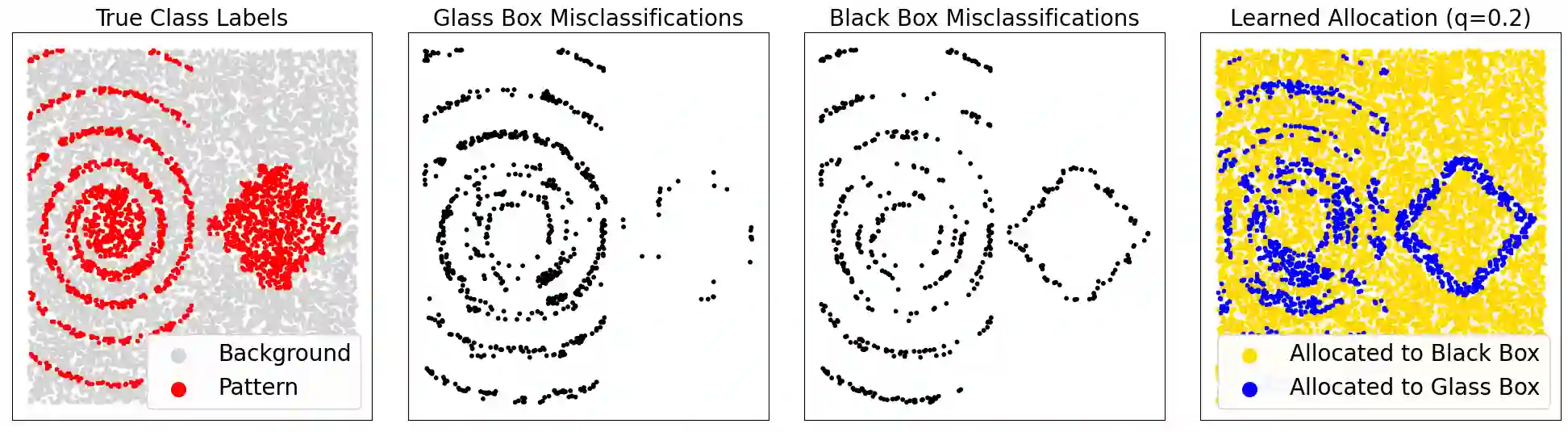
In this paper we propose a method for the optimal allocation of observations between an intrinsically explainable glass box model and a black box model. An optimal allocation being defined as one which, for any given explainability level (i.e. the proportion of observations for which the explainable model is the prediction function), maximizes the performance of the ensemble on the underlying task, and maximizes performance of the explainable model on the observations allocated to it, subject to the maximal ensemble performance condition. The proposed method is shown to produce such explainability optimal allocations on a benchmark suite of tabular datasets across a variety of explainable and black box model types. These learned allocations are found to consistently maintain ensemble performance at very high explainability levels (explaining $74\%$ of observations on average), and in some cases even outperforming both the component explainable and black box models while improving explainability.
翻译:本文提出一种在内在可解释的玻璃箱模型与黑箱模型之间最优分配观测数据的方法。最优分配定义为:对于任意给定的可解释性水平(即采用可解释模型作为预测函数的观测比例),在满足集成模型性能最大化约束条件下,该方法既能最大化集成模型在目标任务上的性能,又能最大化分配给可解释模型的观测数据的预测性能。实验表明,在涵盖多种可解释模型与黑箱模型类型的表格数据集基准套件上,该方法能够生成满足可解释性最优的分配方案。这些学习到的分配方案在极高可解释性水平下(平均解释74%的观测数据)始终能维持集成模型性能,部分情况下甚至能在提升可解释性的同时,超越其组成中的可解释模型与黑箱模型各自的表现。




相关内容




 微信扫码咨询专知VIP会员