

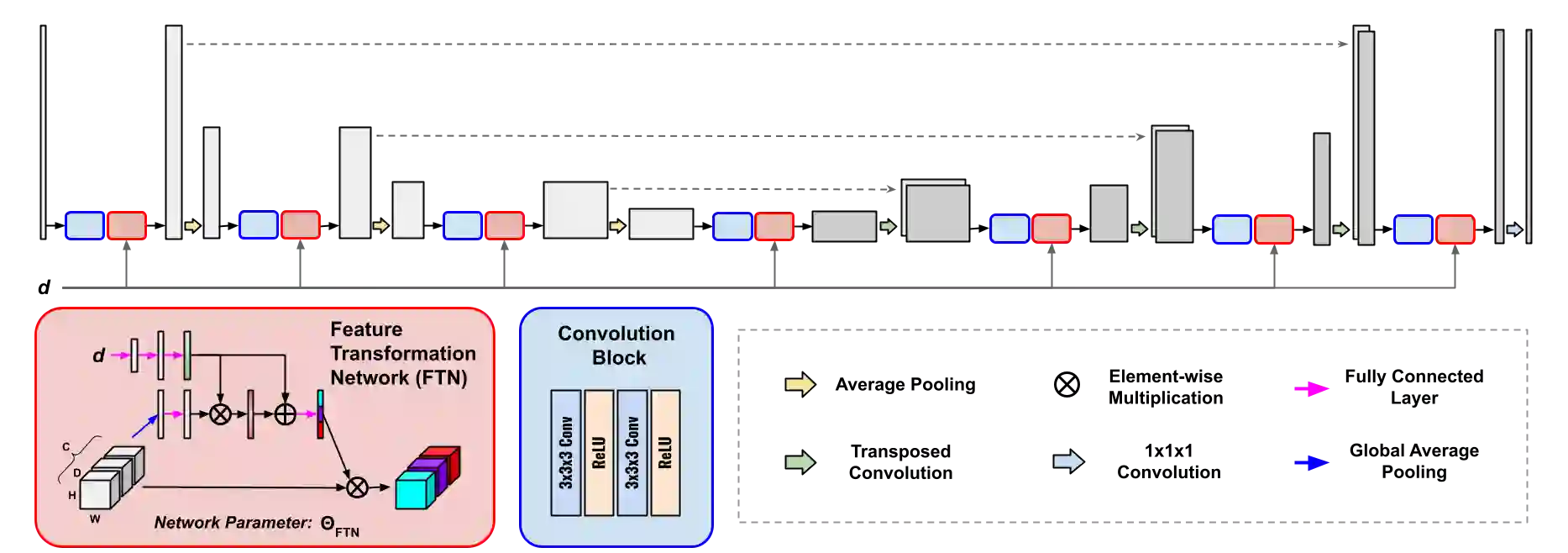
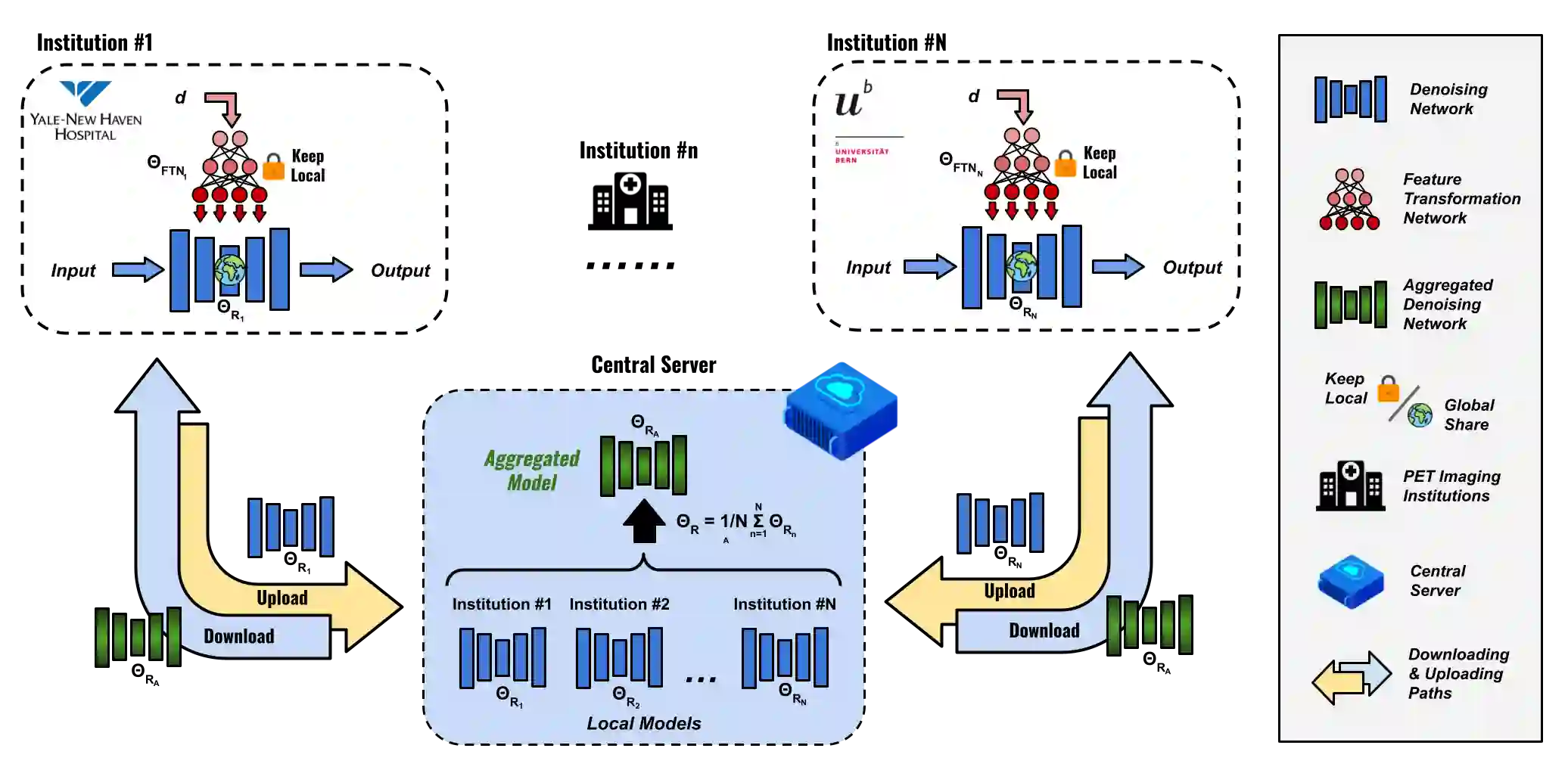
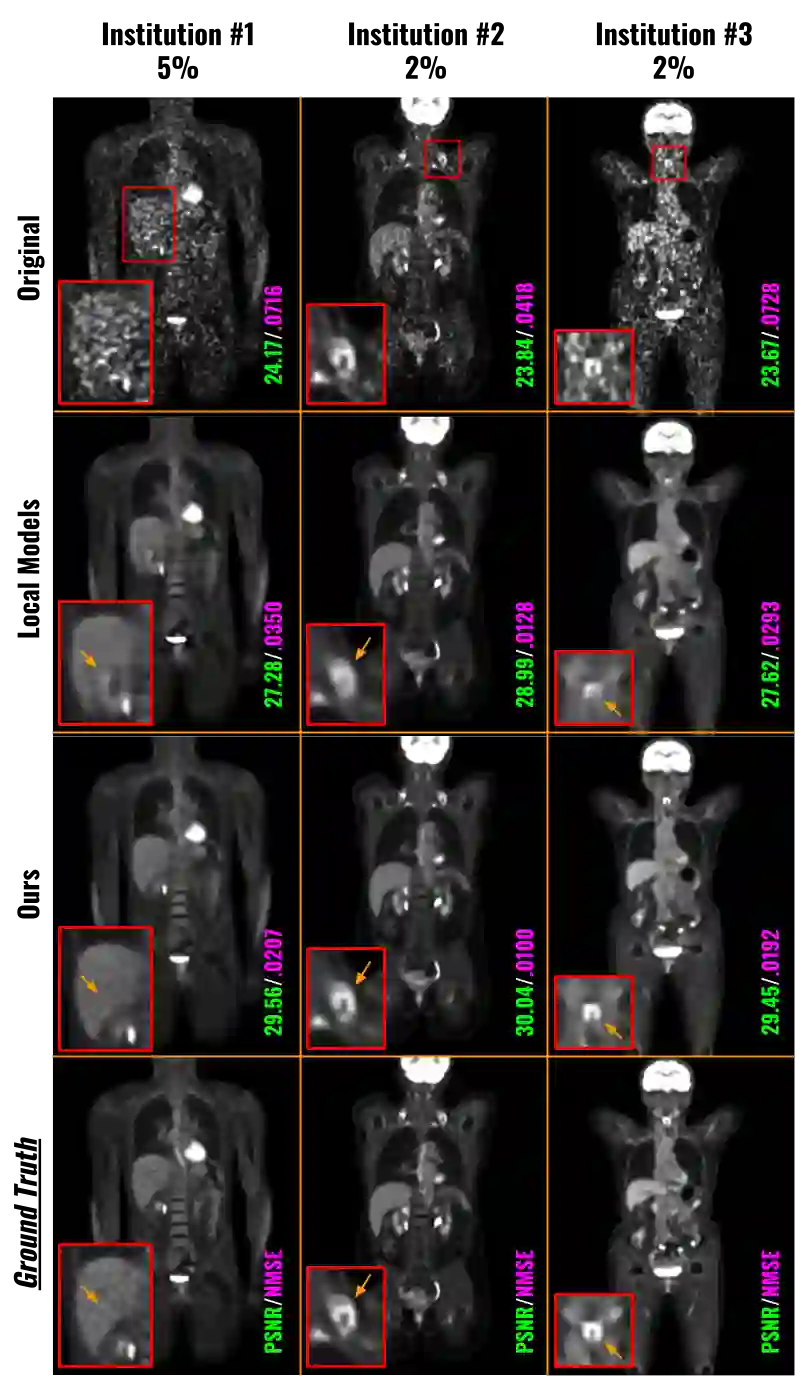
Low-count PET is an efficient way to reduce radiation exposure and acquisition time, but the reconstructed images often suffer from low signal-to-noise ratio (SNR), thus affecting diagnosis and other downstream tasks. Recent advances in deep learning have shown great potential in improving low-count PET image quality, but acquiring a large, centralized, and diverse dataset from multiple institutions for training a robust model is difficult due to privacy and security concerns of patient data. Moreover, low-count PET data at different institutions may have different data distribution, thus requiring personalized models. While previous federated learning (FL) algorithms enable multi-institution collaborative training without the need of aggregating local data, addressing the large domain shift in the application of multi-institutional low-count PET denoising remains a challenge and is still highly under-explored. In this work, we propose FedFTN, a personalized federated learning strategy that addresses these challenges. FedFTN uses a local deep feature transformation network (FTN) to modulate the feature outputs of a globally shared denoising network, enabling personalized low-count PET denoising for each institution. During the federated learning process, only the denoising network's weights are communicated and aggregated, while the FTN remains at the local institutions for feature transformation. We evaluated our method using a large-scale dataset of multi-institutional low-count PET imaging data from three medical centers located across three continents, and showed that FedFTN provides high-quality low-count PET images, outperforming previous baseline FL reconstruction methods across all low-count levels at all three institutions.
翻译:低计数PET是减少辐射暴露和采集时间的有效方式,但重建图像常因低信噪比(SNR)而影响诊断及其他下游任务。深度学习的最新进展已展现出提升低计数PET图像质量的巨大潜力,然而,由于患者数据的隐私和安全问题,从多个机构获取大规模、集中化且多样化的数据集以训练鲁棒模型存在困难。此外,不同机构的低计数PET数据可能具有不同的数据分布,从而需要个性化模型。尽管现有联邦学习(FL)算法无需聚合本地数据即可实现多机构协同训练,但解决多机构低计数PET去噪应用中显著的数据域偏移仍是一项挑战,且相关研究仍十分不足。本文提出FedFTN,一种应对上述挑战的个性化联邦学习策略。FedFTN利用局部深度特征变换网络(FTN)对全局共享去噪网络的特征输出进行调制,从而为每个机构实现个性化的低计数PET去噪。在联邦学习过程中,仅去噪网络的权重参与通信与聚合,而FTN保留在本地机构中用于特征变换。我们利用来自横跨三大洲的医学中心的多机构低计数PET成像大规模数据集评估了该方法,结果表明FedFTN能够生成高质量的低计数PET图像,在所有三个机构的各低计数水平上均优于先前的基线FL重建方法。




相关内容





 微信扫码咨询专知VIP会员