

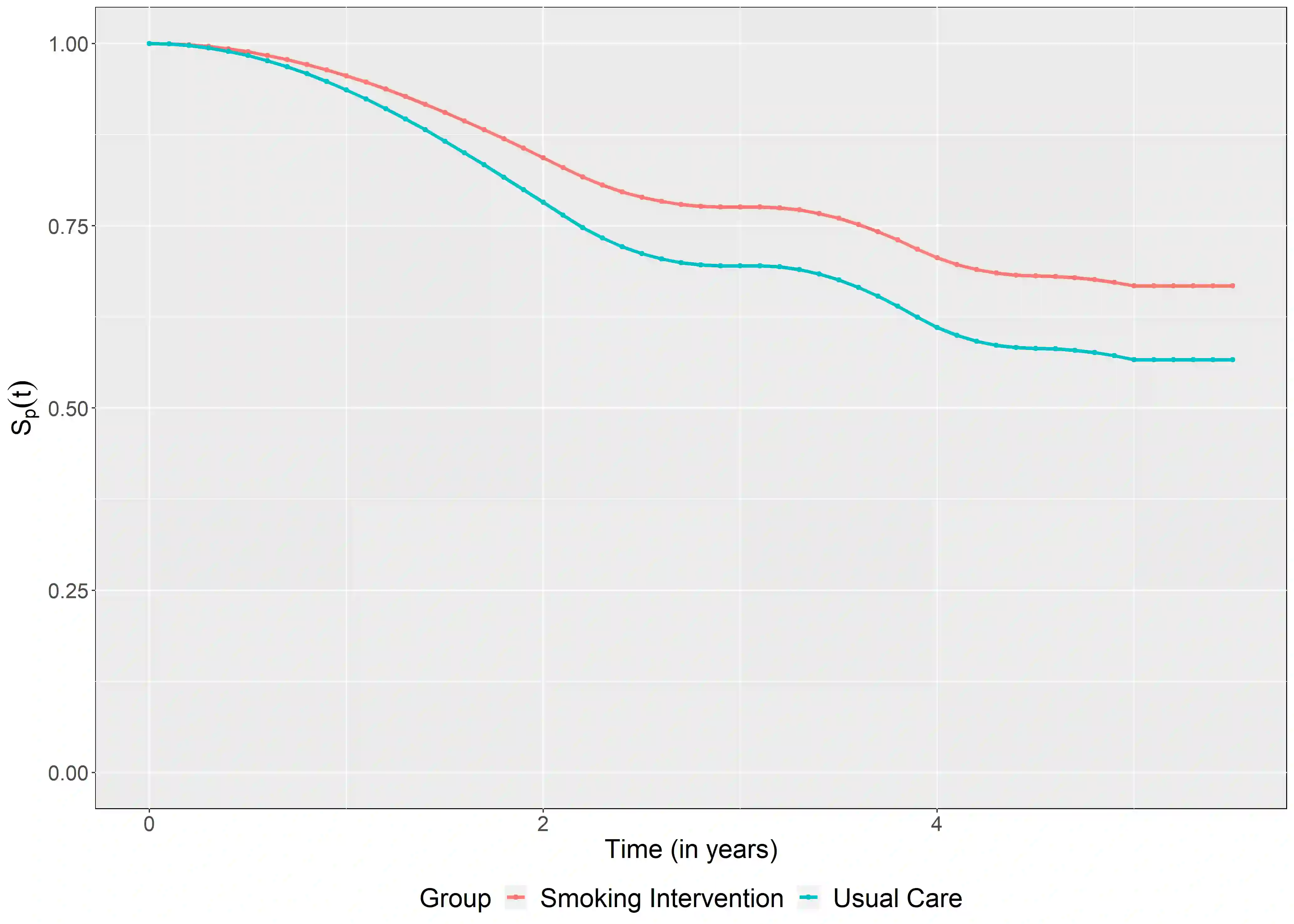
A simple yet effective way of modeling survival data with cure fraction is by considering Box-Cox transformation cure model (BCTM) that unifies mixture and promotion time cure models. In this article, we numerically study the statistical properties of the BCTM when applied to interval censored data. Time-to-events associated with susceptible subjects are modeled through proportional hazards structure that allows for non-homogeneity across subjects, where the baseline hazard function is estimated by distribution-free piecewise linear function with varied degrees of non-parametricity. Due to missing cured statuses for right censored subjects, maximum likelihood estimates of model parameters are obtained by developing an expectation-maximization (EM) algorithm. Under the EM framework, the conditional expectation of the complete data log-likelihood function is maximized by considering all parameters (including the Box-Cox transformation parameter $\alpha$) simultaneously, in contrast to conventional profile-likelihood technique of estimating $\alpha$. The robustness and accuracy of the model and estimation method are established through a detailed simulation study under various parameter settings, and an analysis of real-life data obtained from a smoking cessation study.
翻译:一种简单而有效的处理含有治愈分数的生存数据的方法是采用Box-Cox变换治愈模型(BCTM),该模型统一了混合治愈模型和促进时间治愈模型。本文通过数值方法研究了BCTM应用于区间删失数据时的统计性质。易感个体的失效时间通过比例风险结构建模,该结构允许个体间的异质性,其中基准风险函数通过具有不同非参数自由度的无分布分段线性函数进行估计。由于右删失个体的治愈状态缺失,我们通过开发期望最大化(EM)算法获得模型参数的最大似然估计。在EM框架下,与估计α的常规轮廓似然技术不同,我们通过同时考虑所有参数(包括Box-Cox变换参数α)来最大化完整数据对数似然函数的条件期望。通过在多种参数设置下的详细模拟研究以及对某戒烟研究真实数据的分析,验证了模型及估计方法的稳健性和准确性。




相关内容



 微信扫码咨询专知VIP会员