

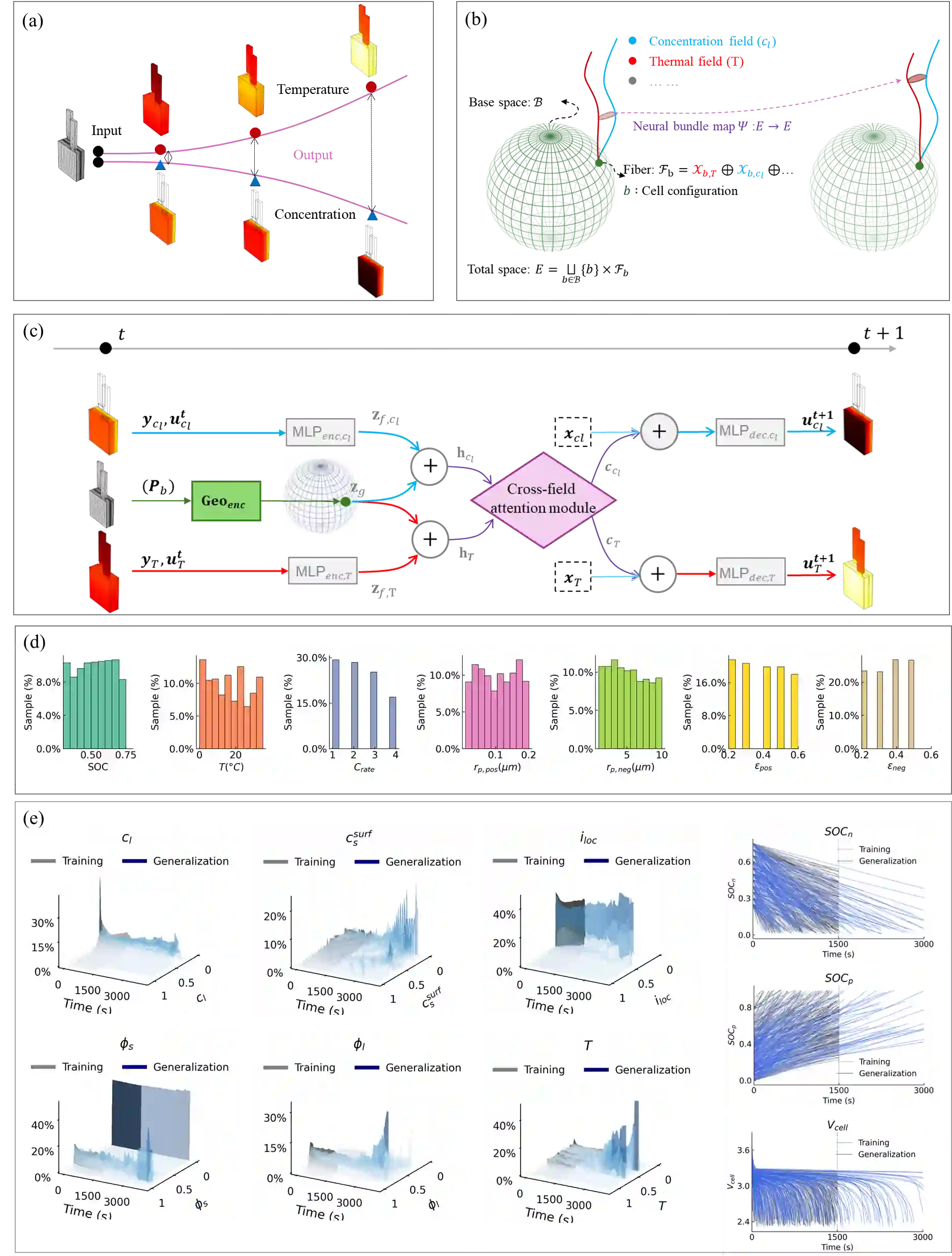
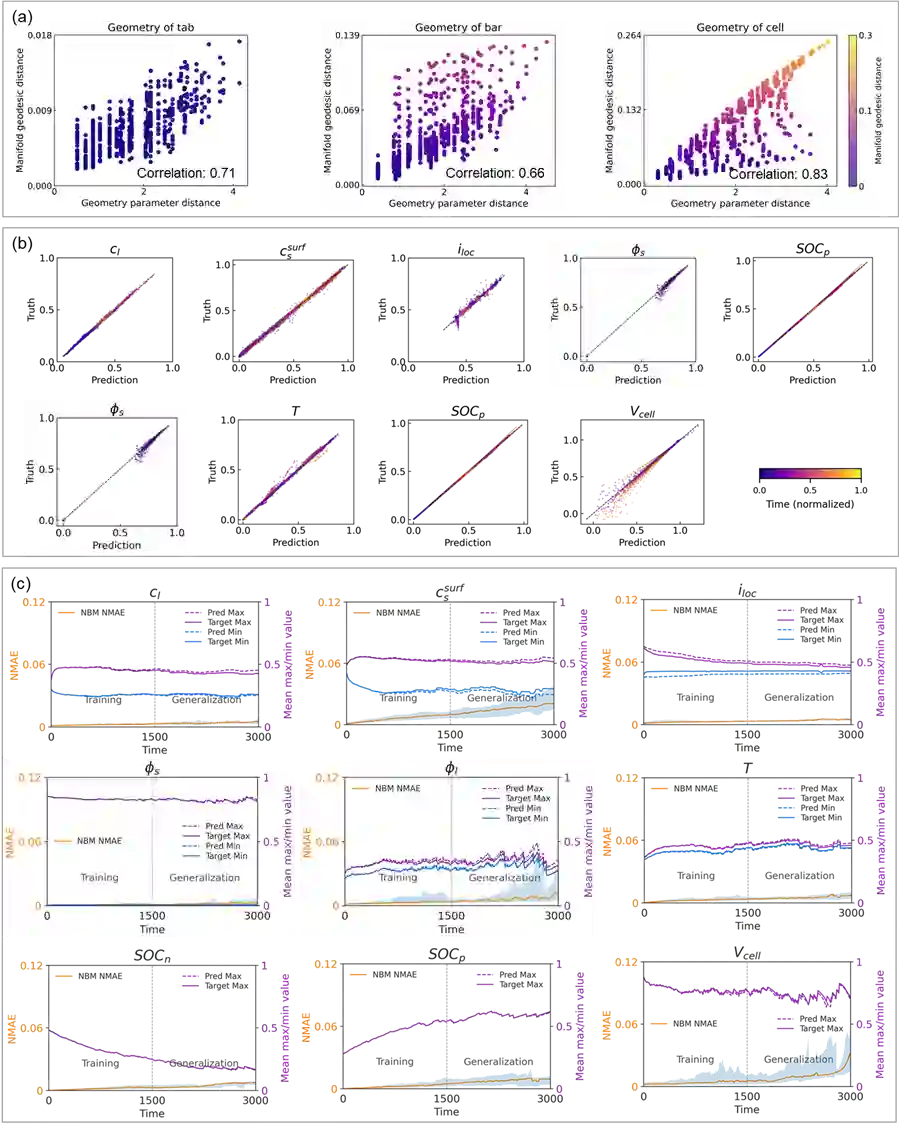
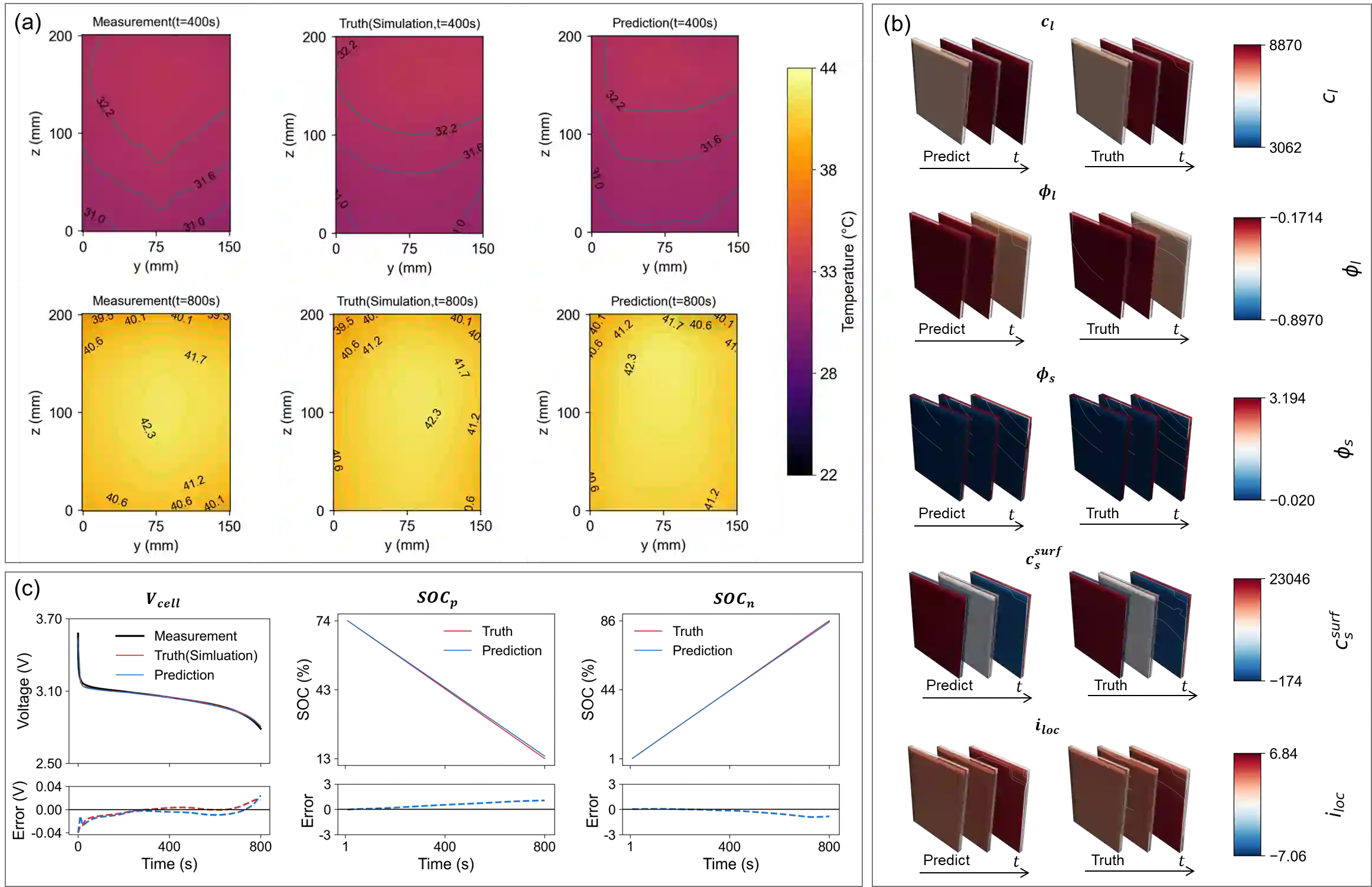
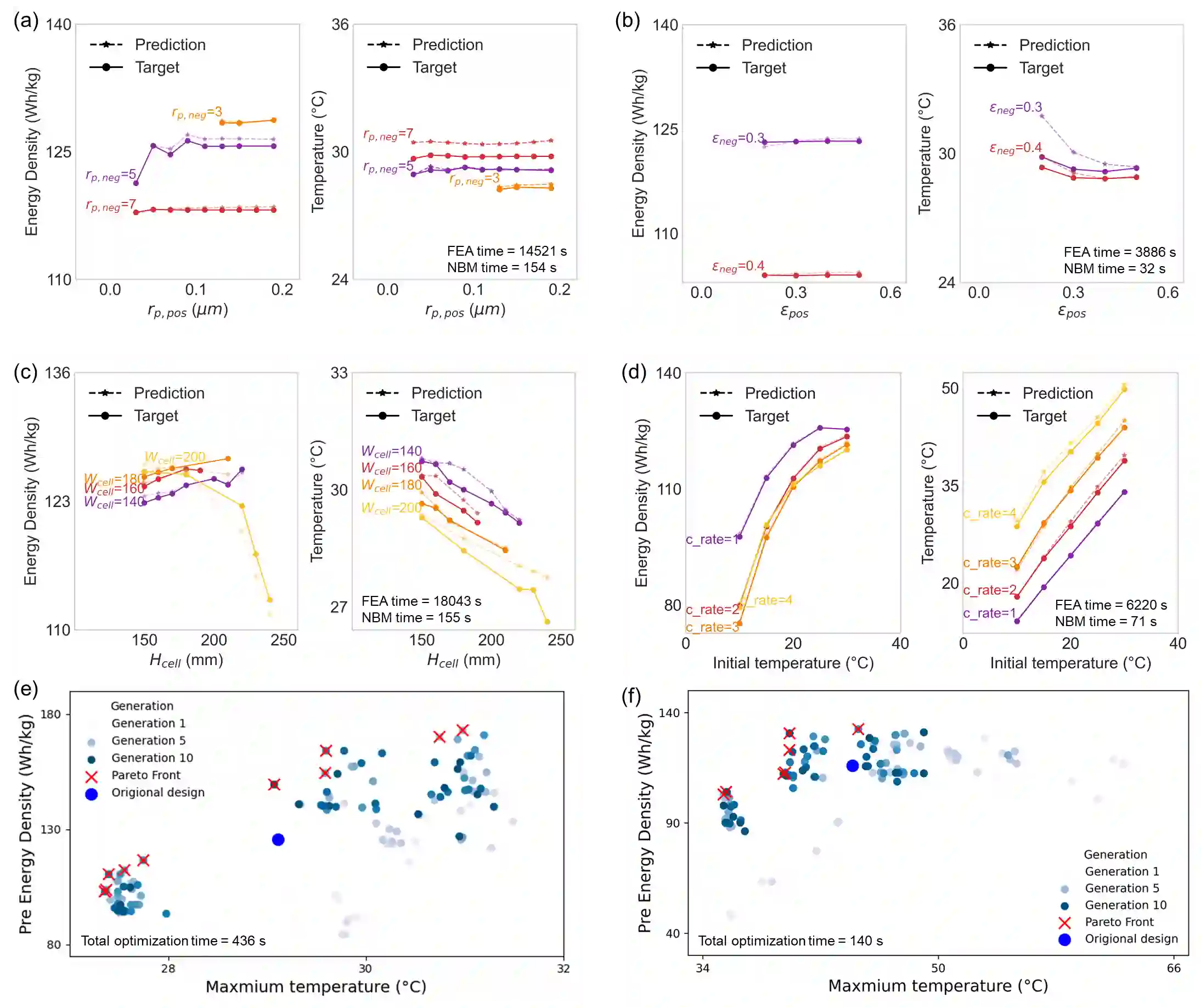
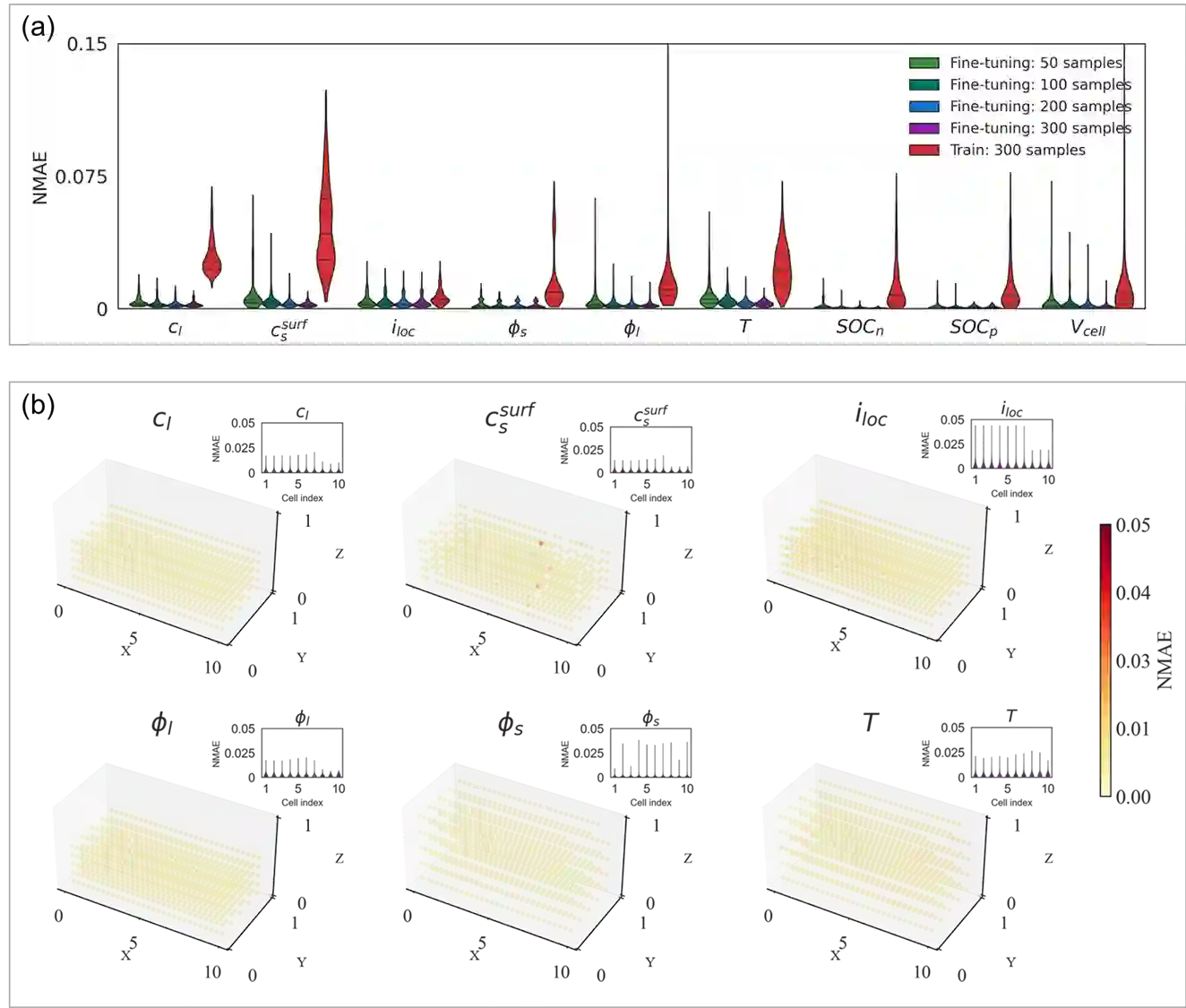
Efficient and accurate prediction of Multiphysics evolution across diverse cell geometries is fundamental to the design, management and safety of lithium-ion batteries. However, existing computational frameworks struggle to capture the coupled electrochemical, thermal, and mechanical dynamics across diverse cell geometries and varying operating conditions. Here, we present a Neural Bundle Map (NBM), a mathematically rigorous framework that reformulates multiphysics evolution as a bundle map over a geometric base manifold. This approach enables the complete decoupling of geometric complexity from underlying physical laws, ensuring strong operator continuity across varying domains. Our framework achieves high-fidelity spatiotemporal predictions with a normalized mean absolute error of less than 1% across varying configurations, while maintaining stability during long-horizon forecasting far beyond the training window and reducing computational costs by two orders of magnitude compared with conventional solvers. Leveraging this capability, we rapidly explored a vast configurational space to identify an optimal battery design that yields a 38% increase in energy density while adhering to thermal safety constraints. Furthermore, the NBM demonstrates remarkable scalability to multi-cell systems through few-shot transfer learning, providing a foundational paradigm for the intelligent design and real-time monitoring of complex energy storage infrastructures.
翻译:高效准确地预测不同电池几何结构中的多物理场演化过程,对于锂离子电池的设计、管理与安全至关重要。然而,现有的计算框架难以捕捉不同电池几何结构和多变运行条件下电化学、热力学与机械力学的耦合动力学行为。本文提出神经丛映射(Neural Bundle Map, NBM),这是一个数学上严谨的框架,将多物理场演化过程重新表述为几何基础流形上的丛映射。该方法实现了几何复杂性与底层物理定律的完全解耦,确保了不同域间强烈的算子连续性。我们的框架在多种配置下实现了高保真度的时空预测,归一化平均绝对误差低于1%,同时在远超训练窗口的长期预测中保持稳定性,并且相比传统求解器将计算成本降低了两个数量级。利用这一能力,我们快速探索了广阔的构型空间,确定了一种在满足热安全约束条件下可将能量密度提升38%的优化电池设计。此外,NBM通过少量样本迁移学习展现出对多电池系统卓越的可扩展性,为复杂储能基础设施的智能设计与实时监控提供了基础范式。




相关内容


 微信扫码咨询专知VIP会员