

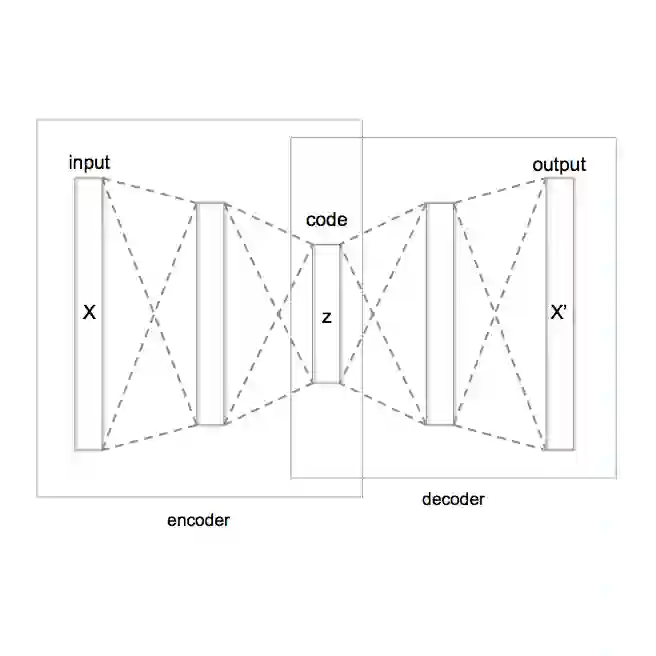
We present a novel approach for the dimensionality reduction of galaxy images by leveraging a combination of variational auto-encoders (VAE) and domain adaptation (DA). We demonstrate the effectiveness of this approach using a sample of low redshift galaxies with detailed morphological type labels from the Galaxy-Zoo DECaLS project. We show that 40-dimensional latent variables can effectively reproduce most morphological features in galaxy images. To further validate the effectiveness of our approach, we utilised a classical random forest (RF) classifier on the 40-dimensional latent variables to make detailed morphology feature classifications. This approach performs similarly to a direct neural network application on galaxy images. We further enhance our model by tuning the VAE network via DA using galaxies in the overlapping footprint of DECaLS and BASS+MzLS, enabling the unbiased application of our model to galaxy images in both surveys. We observed that noise suppression during DA led to even better morphological feature extraction and classification performance. Overall, this combination of VAE and DA can be applied to achieve image dimensionality reduction, defect image identification, and morphology classification in large optical surveys.
翻译:我们提出了一种结合变分自编码器与域自适应的新颖方法,用于实现星系图像的降维。通过使用来自Galaxy-Zoo DECaLS项目的具有详细形态类型标签的低红移星系样本,我们验证了该方法的有效性。研究表明,40维潜变量能够有效还原星系图像中的大多数形态特征。为进一步验证方法有效性,我们在40维潜变量上采用经典随机森林分类器进行精细形态特征分类,其性能与直接对星系图像应用神经网络的方法相当。通过利用DECaLS与BASS+MzLS重叠天区中的星系图像进行域自适应调优VAE网络,我们进一步提升了模型性能,使模型能够无偏地应用于两个巡天项目的星系图像。研究发现,域自适应过程中的噪声抑制有助于获得更优的形态特征提取与分类效果。总体而言,这种VAE与DA的结合可应用于大型光学巡天中的图像降维、缺陷图像识别及形态分类任务。




相关内容




 微信扫码咨询专知VIP会员