

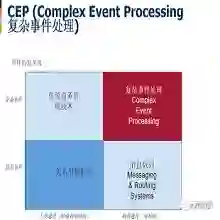
In recent years, smart city-based development has gained momentum due to its versatile nature in architecture and planning for the systematic habitation of human beings. According to World Health Organization (WHO) report, air pollution causes serious respiratory diseases. Hence, it becomes necessary to real-time monitoring of air quality to minimize effect by taking time-bound decisions by the stakeholders. The air pollution comprises various compositions such as NH3, O3, SO2, NO2, etc., and their concentrations vary from location to location.The research work proposes an integrated framework for monitoring air quality using rule-based Complex Event Processing (CEP) and SPARQL queries. CEP works with the data stream based on predefined rules to detect the complex pattern, which helps in decision support for stakeholders. Initially, the dataset was collected from the Central Pollution Control Board (CPCB) of India and this data was then preprocessed and passed through Apache Kafka. Then a knowledge graph developed based on the air quality paradigm. Consequently, convert preprocessed data into Resource Description Framework (RDF) data, and integrate with Knowledge graph which is ingested to CEP engine using Apache Jena for enhancing the decision support . Simultaneously, rules are extracted using a decision tree, and some ground truth parameters of CPCB are added and ingested to the CEP engine to determine the complex patterns. Consequently, the SPARQL query is used on real-time RDF dataset for fetching the condition of air quality as good, poor, severe, hazardous etc based on complex events detection. For validating the proposed approach various chunks of RDF are used for the deployment of events to the CEP engine, and its performance is examined over time while performing simple and complex queries.
翻译:近年来,基于智能城市的开发因其在人类系统化居住的建筑与规划中的多功能特性而发展迅速。根据世界卫生组织(WHO)报告,空气污染会导致严重的呼吸系统疾病。因此,为通过利益相关者及时决策来最小化影响,实时监测空气质量变得至关重要。空气污染包含NH3、O3、SO2、NO2等多种成分,且其浓度因地理位置而异。本研究提出了一种利用基于规则的复杂事件处理(CEP)和SPARQL查询来监测空气质量的集成框架。CEP基于预定义规则对数据流进行处理,以检测复杂模式,从而为利益相关者提供决策支持。首先,从印度中央污染控制委员会(CPCB)收集数据集,随后对该数据进行预处理并通过Apache Kafka传输。然后,基于空气质量范式构建知识图谱。接着,将预处理数据转换为资源描述框架(RDF)数据,并与知识图谱集成,通过Apache Jena输入至CEP引擎以增强决策支持。同时,利用决策树提取规则,并加入CPCB的部分地面真实参数输入至CEP引擎,以确定复杂模式。最后,在实时RDF数据集上使用SPARQL查询,基于复杂事件检测,获取空气质量状况(如良好、较差、严重、有害等)。为验证所提方法,使用不同RDF数据块将事件部署至CEP引擎,并考察其在执行简单与复杂查询时的性能随时间变化情况。




相关内容


 微信扫码咨询专知VIP会员