

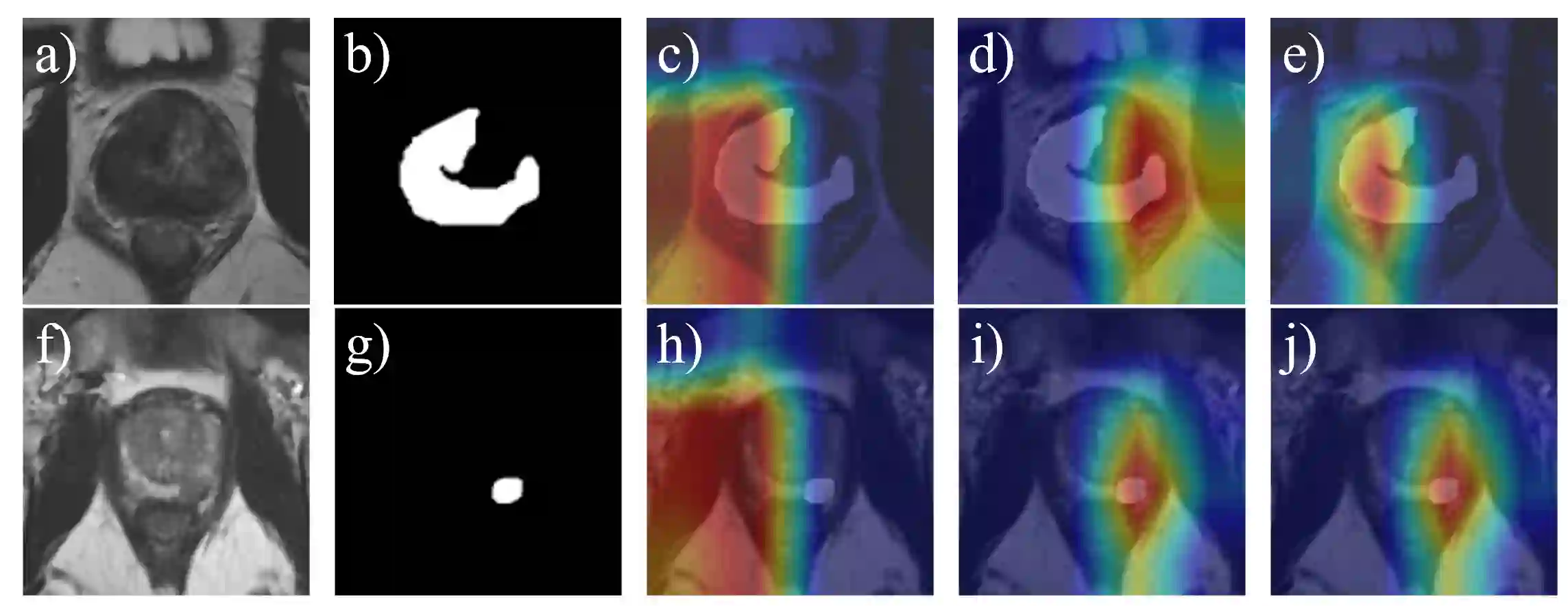
In this paper, we present a novel method to automatically classify medical images that learns and leverages weak causal signals in the image. Our framework consists of a convolutional neural network backbone and a causality-extractor module that extracts cause-effect relationships between feature maps that can inform the model on the appearance of a feature in one place of the image, given the presence of another feature within some other place of the image. To evaluate the effectiveness of our approach in low-data scenarios, we train our causality-driven architecture in a One-shot learning scheme, where we propose a new meta-learning procedure entailing meta-training and meta-testing tasks that are designed using related classes but at different levels of granularity. We conduct binary and multi-class classification experiments on a publicly available dataset of prostate MRI images. To validate the effectiveness of the proposed causality-driven module, we perform an ablation study and conduct qualitative assessments using class activation maps to highlight regions strongly influencing the network's decision-making process. Our findings show that causal relationships among features play a crucial role in enhancing the model's ability to discern relevant information and yielding more reliable and interpretable predictions. This would make it a promising approach for medical image classification tasks.
翻译:本文提出了一种新颖的自动医学图像分类方法,该方法能够学习并利用图像中微弱的因果信号。我们的框架由卷积神经网络主干网络和因果提取器模块组成,该模块提取特征图之间的因果关系,使得模型能够根据图像某区域中某一特征的存在,推断另一区域中另一特征的出现模式。为评估该方法在低数据场景下的有效性,我们采用一次性学习方案训练因果驱动架构,并提出了一种新的元学习流程,该流程包含使用相关类别但不同粒度层级设计的元训练与元测试任务。我们在公开的前列腺MRI图像数据集上进行了二分类与多分类实验。通过消融研究验证因果驱动模块的有效性,并利用类激活图定性评估显著影响网络决策过程的区域。研究结果表明,特征间的因果关系在增强模型鉴别相关信息能力、生成更可靠且可解释的预测中发挥关键作用,这使其成为医学图像分类任务中一种具有前景的方法。





相关内容




 微信扫码咨询专知VIP会员