

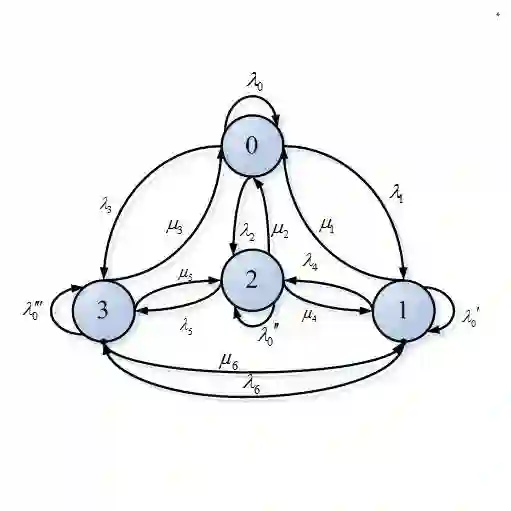
We consider the diffusion of two alternatives in social networks using a game-theoretic approach. Each individual plays a coordination game with its neighbors repeatedly and decides which to adopt. As products are used in conjunction with others and through repeated interactions, individuals are more interested in their long-term benefits and tend to show trust to others to maximize their long-term utility by choosing a suboptimal option with respect to instantaneous payoff. To capture such trust behavior, we deploy limited-trust equilibrium (LTE) in diffusion process. We analyze the convergence of emerging dynamics to equilibrium points using mean-field approximation and study the equilibrium state and the convergence rate of diffusion using absorption probability and expected absorption time of a reduced-size absorbing Markov chain. We also show that the diffusion model on LTE under the best-response strategy can be converted to the well-known linear threshold model. Simulation results show that when agents behave trustworthy, their long-term utility will increase significantly compared to the case when they are solely self-interested. Moreover, the Markov chain analysis provides a good estimate of convergence properties over random networks.
翻译:我们采用博弈论方法研究社交网络中两种替代品的扩散过程。每个个体与邻居重复进行协调博弈,并决定采用哪种替代品。由于产品需与他人配合使用且通过重复互动,个体更关注长期收益,倾向于通过选择当前收益次优策略来展现对他人的信任,从而最大化长期效用。为捕捉这种信任行为,我们在扩散过程中引入有限信任均衡(LTE)。利用平均场近似分析新兴动力学向均衡点的收敛性,通过简化吸收马尔可夫链的吸收概率和期望吸收时间研究均衡状态与扩散收敛速度。同时证明最佳响应策略下的LTE扩散模型可转化为著名的线性阈值模型。仿真结果表明,当智能体表现出信任行为时,其长期效用相比纯粹自利情况显著提升。此外,马尔可夫链分析为随机网络上的收敛特性提供了良好估计。




相关内容



 微信扫码咨询专知VIP会员