

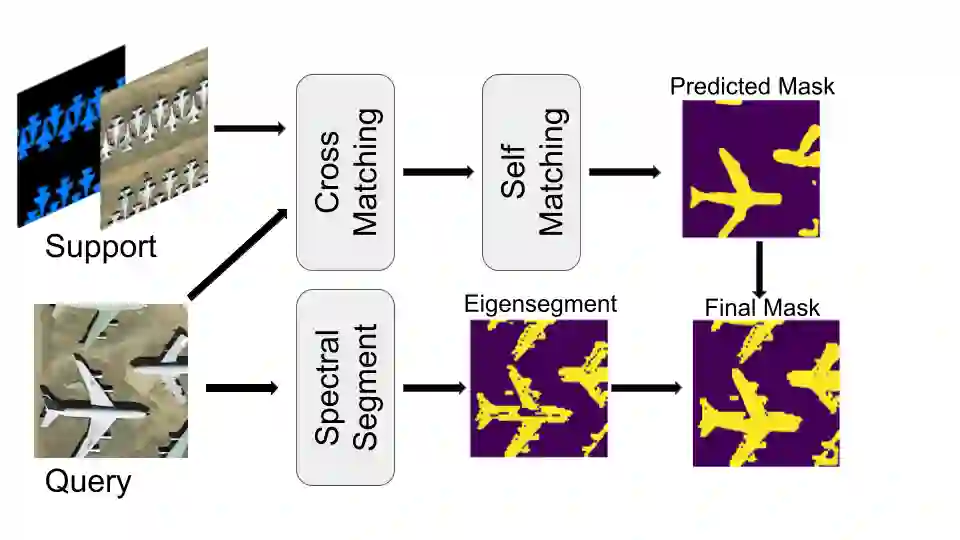
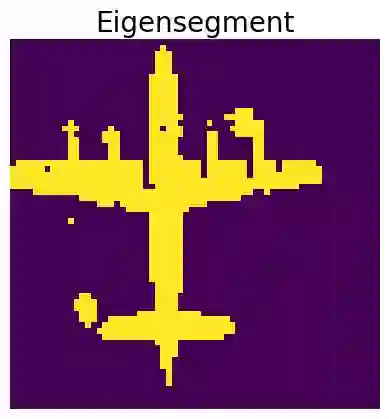
Remote sensing image semantic segmentation is an important problem for remote sensing image interpretation. Although remarkable progress has been achieved, existing deep neural network methods suffer from the reliance on massive training data. Few-shot remote sensing semantic segmentation aims at learning to segment target objects from a query image using only a few annotated support images of the target class. Most existing few-shot learning methods stem primarily from their sole focus on extracting information from support images, thereby failing to effectively address the large variance in appearance and scales of geographic objects. To tackle these challenges, we propose a Self-Correlation and Cross-Correlation Learning Network for the few-shot remote sensing image semantic segmentation. Our model enhances the generalization by considering both self-correlation and cross-correlation between support and query images to make segmentation predictions. To further explore the self-correlation with the query image, we propose to adopt a classical spectral method to produce a class-agnostic segmentation mask based on the basic visual information of the image. Extensive experiments on two remote sensing image datasets demonstrate the effectiveness and superiority of our model in few-shot remote sensing image semantic segmentation. Code and models will be accessed at https://github.com/linhanwang/SCCNet.
翻译:遥感图像语义分割是遥感图像解译中的一个重要问题。尽管已有显著进展,但现有深度神经网络方法仍依赖大量训练数据。小样本遥感图像语义分割旨在仅使用目标类别的少量标注支持图像,从查询图像中学习分割目标对象。现有大多数小样本学习方法主要关注从支持图像中提取信息,未能有效应对地理对象在视觉外观和尺度上的巨大差异。为解决这些挑战,我们提出了一种用于小样本遥感图像语义分割的自相关与互相关学习网络。该模型通过同时考虑支持图像与查询图像之间的自相关和互相关特性来增强泛化能力,进而进行分割预测。为进一步挖掘查询图像中的自相关信息,我们提出采用经典谱方法,基于图像的基本视觉信息生成类别无关的分割掩码。在两个遥感图像数据集上的大量实验表明,该模型在小样本遥感图像语义分割任务中具有有效性和优越性。代码与模型将公布于 https://github.com/linhanwang/SCCNet。







相关内容





 微信扫码咨询专知VIP会员