

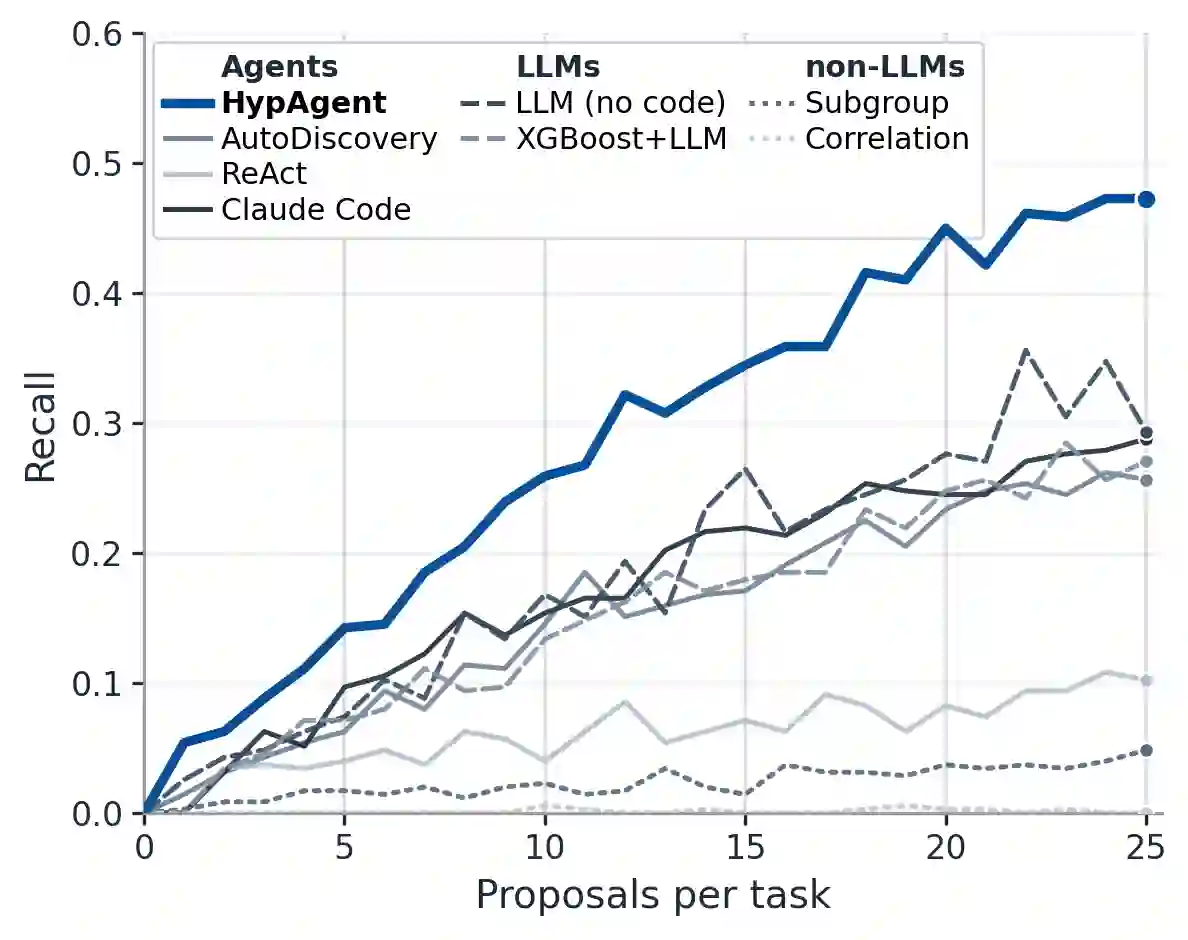
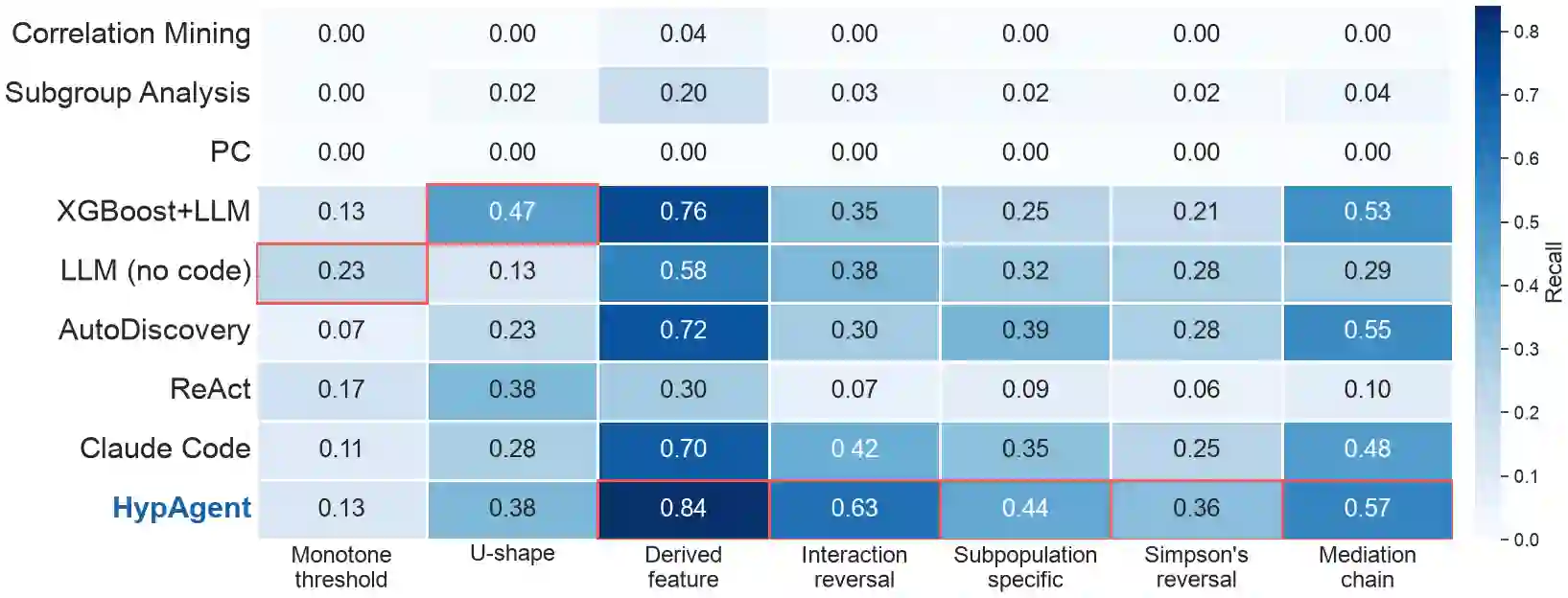
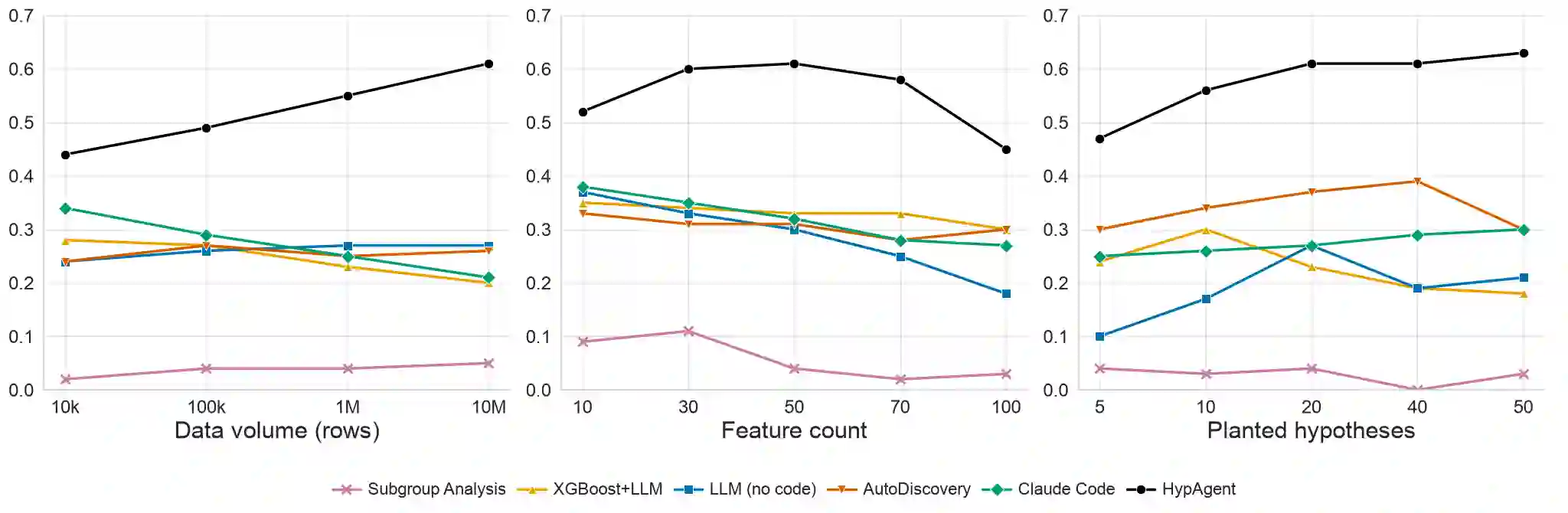
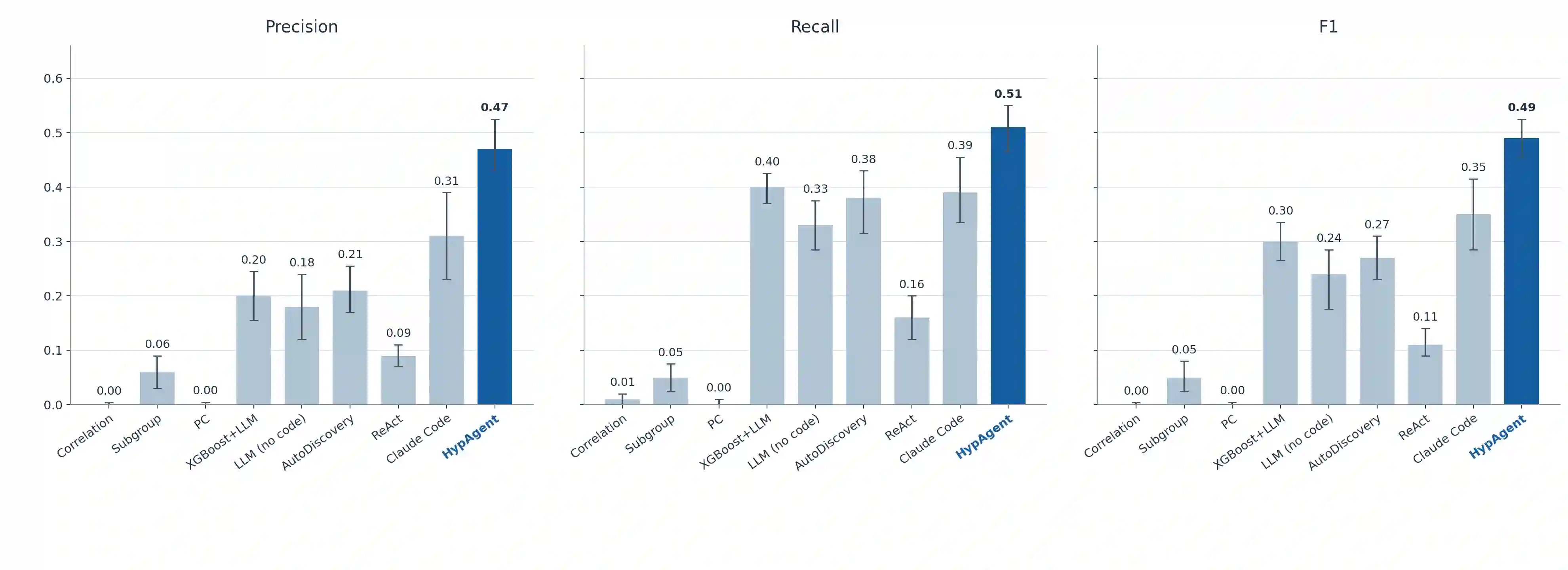
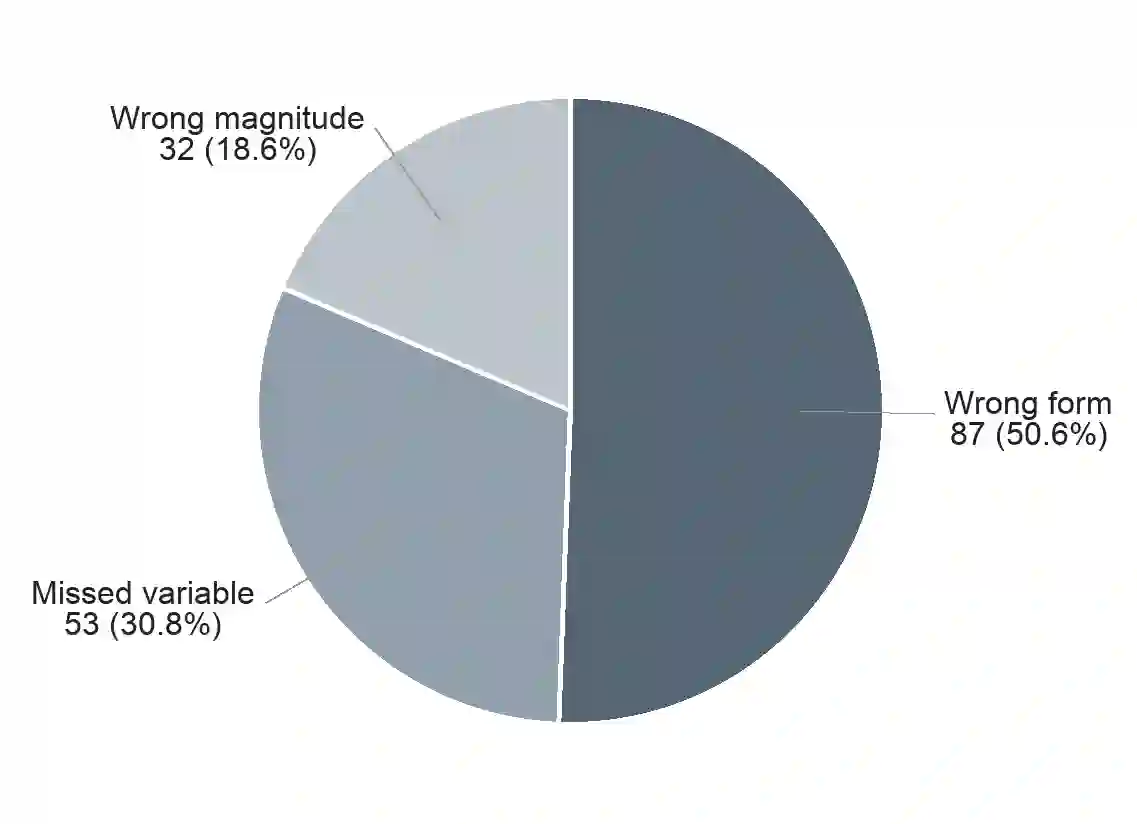
Discovering what drives an outcome from data is central to science and often requires deciding what is worth investigating before a specific hypothesis is known. Yet most existing hypothesis generation settings substantially narrow this search by providing a research question, target relationship, or curated context. We introduce open-ended multiple hypothesis discovery, where a system receives only a large tabular dataset and an outcome and must discover multiple data-supported hypotheses without knowing in advance the relevant variables, functional forms, conditions, or number of underlying mechanisms. To study this problem, we introduce a benchmark built from structural causal models grounded in real-world data schemas, containing 351 planted hypotheses across 15 tasks and five domains, with 53--65 variables and 1M--10M rows per task. The causal model is hidden from the discovery method and retained only by the evaluator, allowing proposed hypotheses to be tested through interventions and separating observational discovery from causal validation. We further propose HypAgent, which treats the dataset as an interactive environment and performs iterative search by proposing candidate directions, triaging and refining promising hypotheses, and removing explained signal so that each accepted discovery redirects subsequent search. HypAgent achieves 0.47 precision, 0.51 recall, and 0.49 F1, compared with 0.35 F1 for the strongest baseline. Our analysis shows that many failures occur after a relevant variable has already been surfaced, suggesting that correctly characterizing a mechanism's functional form and conditions, rather than merely identifying relevant variables, remains a key challenge in open-ended discovery.
翻译:暂无翻译




相关内容





 微信扫码咨询专知VIP会员