

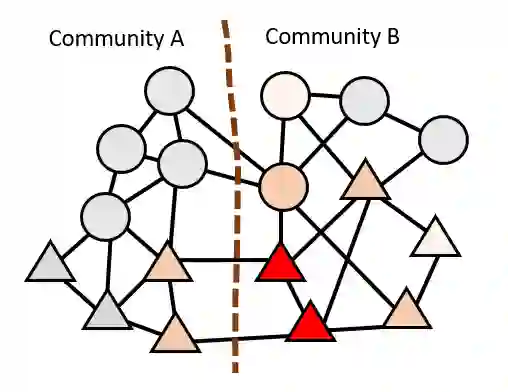
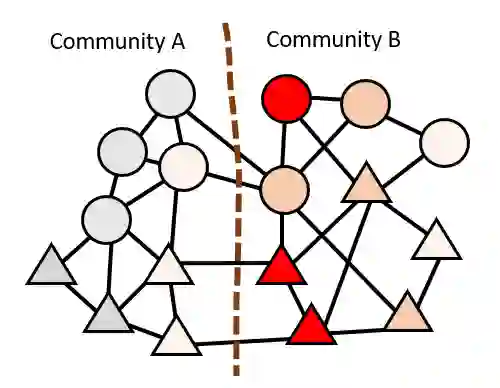
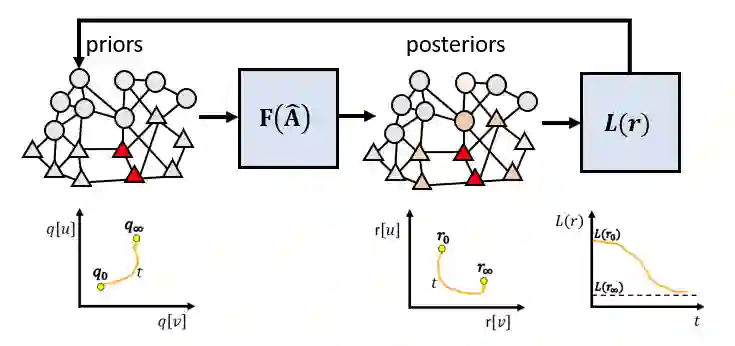
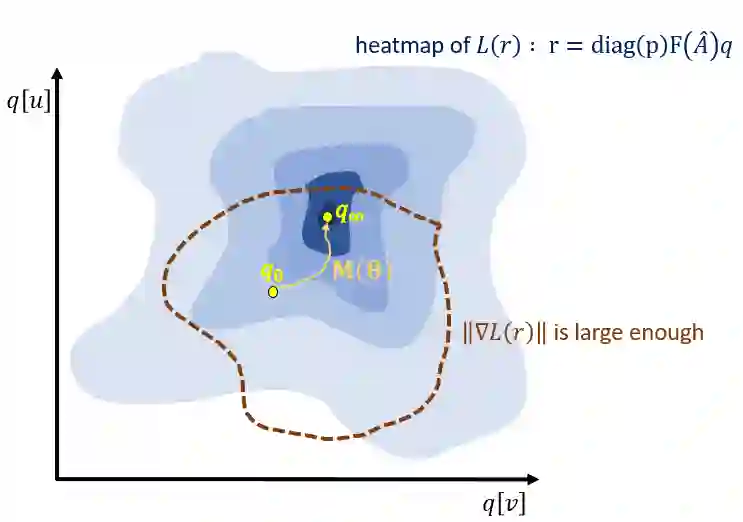
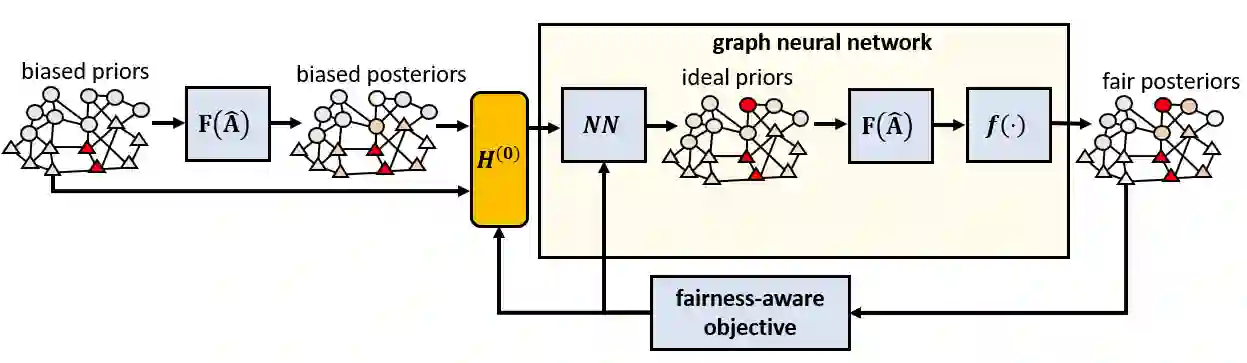
Graph filters that transform prior node values to posterior scores via edge propagation often support graph mining tasks affecting humans, such as recommendation and ranking. Thus, it is important to make them fair in terms of satisfying statistical parity constraints between groups of nodes (e.g., distribute score mass between genders proportionally to their representation). To achieve this while minimally perturbing the original posteriors, we introduce a filter-aware universal approximation framework for posterior objectives. This defines appropriate graph neural networks trained at runtime to be similar to filters but also locally optimize a large class of objectives, including fairness-aware ones. Experiments on a collection of 8 filters and 5 graphs show that our approach performs equally well or better than alternatives in meeting parity constraints while preserving the AUC of score-based community member recommendation and creating minimal utility loss in prior diffusion.
翻译:图滤波器通过边传播将先验节点值转换为后验得分,常支撑影响人类的图挖掘任务(如推荐与排序)。因此,在满足节点组间统计平价约束(例如,依据群体代表性比例分配性别间的得分质量)的前提下实现公平性至关重要。为在最小程度扰动原始后验的同时达成此目标,我们引入一种面向后验目标且具滤波器感知能力的通用近似框架。该框架定义了可在运行时训练的特定图神经网络,使其既能逼近滤波器行为,又能局部优化包括公平性目标在内的大类目标函数。基于8种滤波器与5类图的实验表明:在满足平价约束、保持基于得分的社区成员推荐AUC值,以及最小化先验扩散效用损失方面,本方法表现与现有方案相当或更优。




相关内容




 微信扫码咨询专知VIP会员