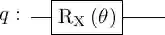
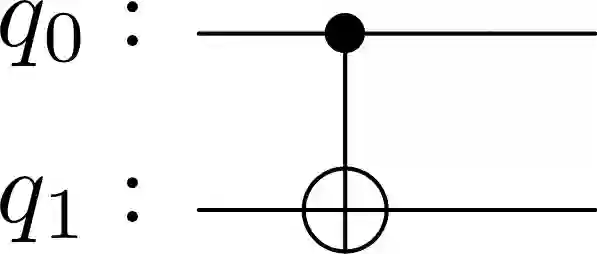
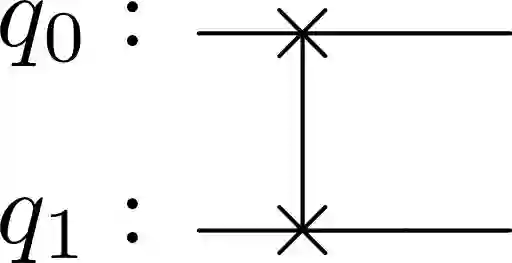
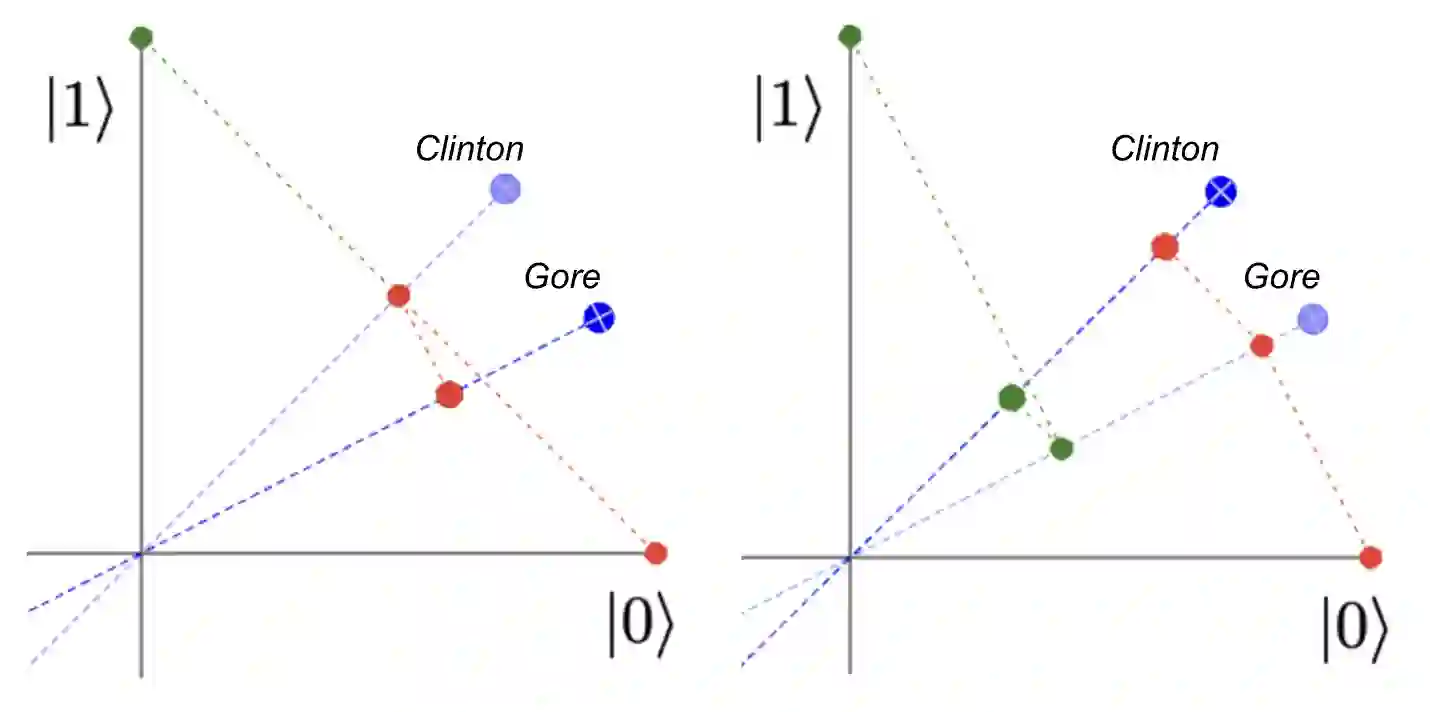
This paper demonstrates that some nonclassical models of human decision-making can be run successfully as circuits on quantum computers. Since the 1960s, many observed cognitive behaviors have been shown to violate rules based on classical probability and set theory. For example, the order in which questions are posed affects whether participants answer 'yes' or 'no', so the population that answers `yes' to both questions cannot be modeled as the intersection of two fixed sets. It can however be modeled as a sequence of projections carried out in different orders. This and other examples have been described successfully using quantum probability, which relies on comparing angles between subspaces rather than volumes between subsets. Now in the early 2020s, quantum computers have reached the point where some of these quantum cognitive models can be implemented and investigated on quantum hardware, representing the mental states in qubit registers, and the cognitive operations and decisions using different gates and measurements. This paper develops such quantum circuit representations for quantum cognitive models, focusing particularly on modeling order effects and decision-making under uncertainty. The claim is not that the human brain uses qubits and quantum circuits explicitly (just like the use of Boolean set theory does not require the brain to be using classical bits), but that the mathematics shared between quantum cognition and quantum computing motivates the exploration of quantum computers for cognition modelling. Key quantum properties include superposition, entanglement, and collapse, as these mathematical elements provide a common language between cognitive models, quantum hardware, and circuit implementations.


翻译:本文证明,一些非经典的人类决策模型可以成功地在量子计算机上作为电路运行。自20世纪60年代以来,许多观察到的认知行为已被证明违反了基于经典概率和集合论的规则。例如,提问的顺序会影响参与者回答“是”或“否”的方式,因此对两个问题都回答“是”的人群无法被建模为两个固定集合的交集。然而,它可以被建模为按不同顺序进行的投影序列。这一例子及其他类似现象已通过量子概率成功描述,量子概率依赖于比较子空间之间的角度而非子集之间的体积。如今在21世纪20年代初,量子计算机已发展到足以在量子硬件上实现并研究部分量子认知模型的阶段,即将心理状态表示在量子比特寄存器中,并使用不同的量子门与测量操作来表征认知操作与决策。本文针对量子认知模型开发了此类量子电路表示,特别关注对顺序效应和不确定性下的决策进行建模。我们的主张并非人类大脑显式地使用量子比特和量子电路(正如布尔集合论的使用并不要求大脑基于经典比特工作),而是量子认知与量子计算之间共享的数学结构激发了利用量子计算机进行认知建模的探索。关键的量子特性包括叠加、纠缠和坍缩,这些数学元素为认知模型、量子硬件和电路实现提供了共同语言。
0
下载
关闭预览

相关内容

Cognition:Cognition:International Journal of Cognitive Science Explanation:认知:国际认知科学杂志。 Publisher:Elsevier。 SIT: http://www.journals.elsevier.com/cognition/
不可错过!《机器学习100讲》课程,UBC Mark Schmidt讲授
专知会员服务
76+阅读 · 2022年6月28日
专知会员服务
124+阅读 · 2020年9月8日
专知会员服务
19+阅读 · 2020年9月6日
强化学习最新教程,17页pdf
专知会员服务
182+阅读 · 2019年10月11日
机器学习入门的经验与建议
专知会员服务
94+阅读 · 2019年10月10日
【哈佛大学商学院课程Fall 2019】机器学习可解释性
专知会员服务
105+阅读 · 2019年10月9日
VCIP 2022 Call for Demos
CCF多媒体专委会
1+阅读 · 2022年6月6日
灾难性遗忘问题新视角:迁移-干扰平衡
CreateAMind
17+阅读 · 2019年7月6日
Hierarchically Structured Meta-learning
CreateAMind
27+阅读 · 2019年5月22日
Transferring Knowledge across Learning Processes
CreateAMind
29+阅读 · 2019年5月18日
逆强化学习-学习人先验的动机
CreateAMind
16+阅读 · 2019年1月18日
无监督元学习表示学习
CreateAMind
27+阅读 · 2019年1月4日
A Technical Overview of AI & ML in 2018 & Trends for 2019
待字闺中
18+阅读 · 2018年12月24日
disentangled-representation-papers
CreateAMind
26+阅读 · 2018年9月12日
【论文】变分推断(Variational inference)的总结
机器学习研究会
39+阅读 · 2017年11月16日
国家自然科学基金
0+阅读 · 2016年12月31日
国家自然科学基金
1+阅读 · 2013年12月31日
国家自然科学基金
0+阅读 · 2013年12月31日
国家自然科学基金
0+阅读 · 2012年12月31日
国家自然科学基金
0+阅读 · 2012年12月31日
国家自然科学基金
0+阅读 · 2012年12月31日
国家自然科学基金
0+阅读 · 2011年12月31日
国家自然科学基金
1+阅读 · 2009年12月31日
国家自然科学基金
0+阅读 · 2009年12月31日
Arxiv
0+阅读 · 2023年5月3日
Arxiv
14+阅读 · 2022年10月15日
VIP会员
最新内容
《多域战场上反制小型无人机系统》150页
专知会员服务
14+阅读 · 今天7:47
战场人工智能:增强陆地作战能力的发现与要求
专知会员服务
3+阅读 · 今天7:37
以人工智能为中心的指挥控制
专知会员服务
3+阅读 · 今天7:14
《基于深度强化学习的反无人机技术研究》178页
专知会员服务
13+阅读 · 6月10日
“史诗怒火”行动与“AI中心战”模式的浮现
专知会员服务
14+阅读 · 6月10日
【CVPR2026教程】扩散模型的解析理解
专知会员服务
6+阅读 · 6月10日
相关VIP内容
不可错过!《机器学习100讲》课程,UBC Mark Schmidt讲授
专知会员服务
76+阅读 · 2022年6月28日
专知会员服务
124+阅读 · 2020年9月8日
专知会员服务
19+阅读 · 2020年9月6日
强化学习最新教程,17页pdf
专知会员服务
182+阅读 · 2019年10月11日
机器学习入门的经验与建议
专知会员服务
94+阅读 · 2019年10月10日
【哈佛大学商学院课程Fall 2019】机器学习可解释性
专知会员服务
105+阅读 · 2019年10月9日
相关资讯
VCIP 2022 Call for Demos
CCF多媒体专委会
1+阅读 · 2022年6月6日
灾难性遗忘问题新视角:迁移-干扰平衡
CreateAMind
17+阅读 · 2019年7月6日
Hierarchically Structured Meta-learning
CreateAMind
27+阅读 · 2019年5月22日
Transferring Knowledge across Learning Processes
CreateAMind
29+阅读 · 2019年5月18日
逆强化学习-学习人先验的动机
CreateAMind
16+阅读 · 2019年1月18日
无监督元学习表示学习
CreateAMind
27+阅读 · 2019年1月4日
A Technical Overview of AI & ML in 2018 & Trends for 2019
待字闺中
18+阅读 · 2018年12月24日
disentangled-representation-papers
CreateAMind
26+阅读 · 2018年9月12日
【论文】变分推断(Variational inference)的总结
机器学习研究会
39+阅读 · 2017年11月16日
相关基金
国家自然科学基金
0+阅读 · 2016年12月31日
国家自然科学基金
1+阅读 · 2013年12月31日
国家自然科学基金
0+阅读 · 2013年12月31日
国家自然科学基金
0+阅读 · 2012年12月31日
国家自然科学基金
0+阅读 · 2012年12月31日
国家自然科学基金
0+阅读 · 2012年12月31日
国家自然科学基金
0+阅读 · 2011年12月31日
国家自然科学基金
1+阅读 · 2009年12月31日
国家自然科学基金
0+阅读 · 2009年12月31日
Top
微信扫码咨询专知VIP会员