

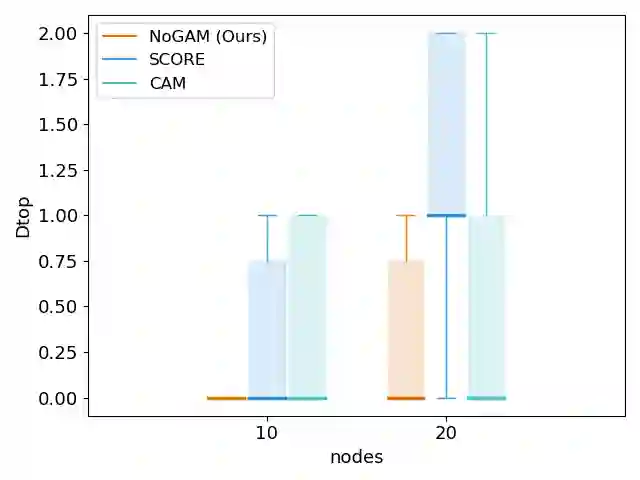
Causal discovery methods are intrinsically constrained by the set of assumptions needed to ensure structure identifiability. Moreover additional restrictions are often imposed in order to simplify the inference task: this is the case for the Gaussian noise assumption on additive non-linear models, which is common to many causal discovery approaches. In this paper we show the shortcomings of inference under this hypothesis, analyzing the risk of edge inversion under violation of Gaussianity of the noise terms. Then, we propose a novel method for inferring the topological ordering of the variables in the causal graph, from data generated according to an additive non-linear model with a generic noise distribution. This leads to NoGAM (Not only Gaussian Additive noise Models), a causal discovery algorithm with a minimal set of assumptions and state of the art performance, experimentally benchmarked on synthetic data.
翻译:因果发现方法本质上受限于可确保结构可识别性所需的一套假设。此外,为了简化推理任务,往往会施加额外的限制:例如加法非线性模型中的高斯噪声假设,这在许多因果发现方法中非常常见。在本文中,我们展示了在此假设下进行推理的局限性,分析了在噪声项违反高斯性条件下边反向的风险。然后,我们提出了一种新方法,用于从根据具有一般噪声分布的加法非线性模型生成的数据中,推断因果图中变量的拓扑排序。由此产生了NoGAM(不仅是高斯加法噪声模型),一种具有最少假设集和当前最优性能的因果发现算法,并在合成数据上进行了实验基准测试。




相关内容



 微信扫码咨询专知VIP会员