

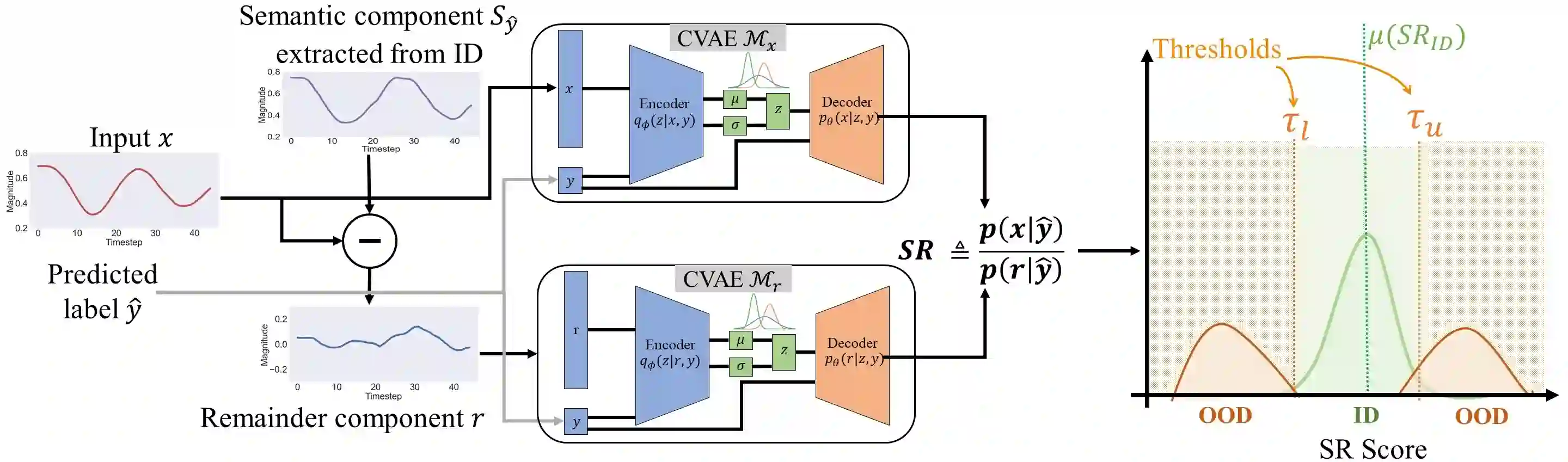
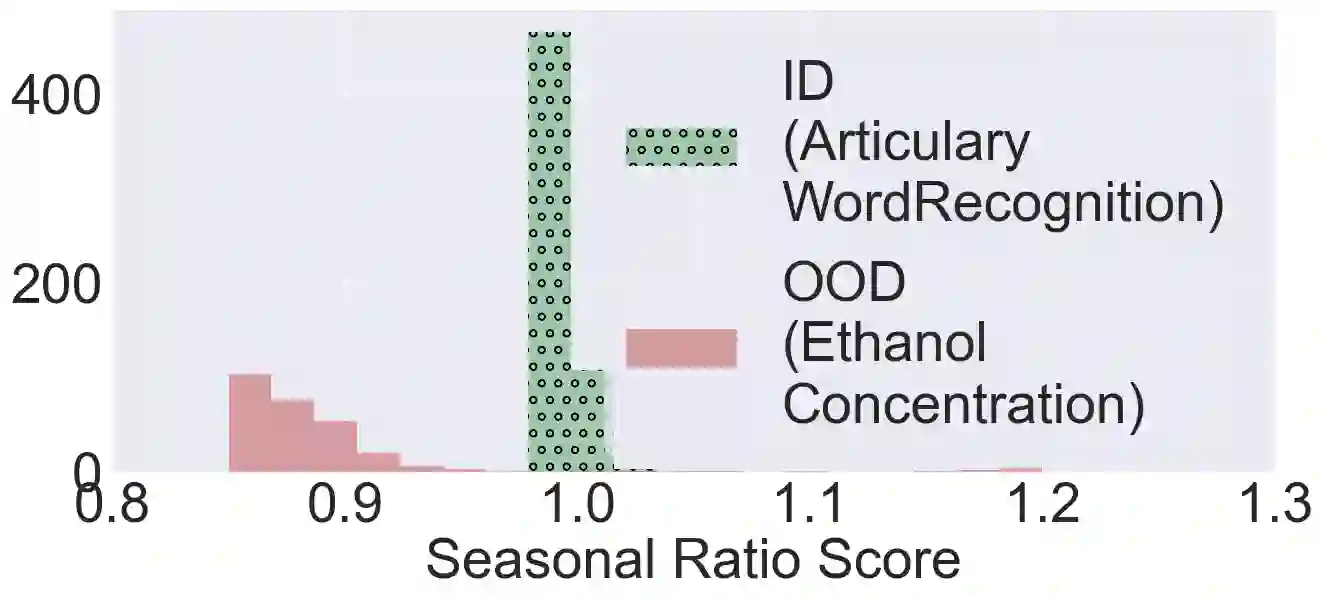
Safe deployment of time-series classifiers for real-world applications relies on the ability to detect the data which is not generated from the same distribution as training data. This task is referred to as out-of-distribution (OOD) detection. We consider the novel problem of OOD detection for the time-series domain. We discuss the unique challenges posed by time-series data and explain why prior methods from the image domain will perform poorly. Motivated by these challenges, this paper proposes a novel {\em Seasonal Ratio Scoring (SRS)} approach. SRS consists of three key algorithmic steps. First, each input is decomposed into class-wise semantic component and remainder. Second, this decomposition is employed to estimate the class-wise conditional likelihoods of the input and remainder using deep generative models. The seasonal ratio score is computed from these estimates. Third, a threshold interval is identified from the in-distribution data to detect OOD examples. Experiments on diverse real-world benchmarks demonstrate that the SRS method is well-suited for time-series OOD detection when compared to baseline methods. Open-source code for SRS method is provided at https://github.com/tahabelkhouja/SRS
翻译:时间序列分类器在实际应用中的安全部署依赖于检测那些并非与训练数据同分布的数据的能力。这一任务被称为分布外(OOD)检测。我们针对时间序列域中的分布外检测问题提出了一种新颖的解决方案。我们讨论了时间序列数据所带来的独特挑战,并解释了为何来自图像域的先前方法表现不佳。受这些挑战的启发,本文提出了一种新颖的“季节性比率评分(SRS)”方法。SRS包含三个关键算法步骤:首先,每个输入被分解为类级语义分量和剩余分量;其次,利用这种分解,通过深度生成模型估计输入和剩余分量的类级条件似然,并从中计算出季节性比率评分;最后,从分布内数据中确定一个阈值区间以检测分布外样本。在多种真实世界基准上的实验表明,与基线方法相比,SRS方法非常适合时间序列分布外检测。SRS方法的开源代码可在https://github.com/tahabelkhouja/SRS获取。




相关内容




 微信扫码咨询专知VIP会员