

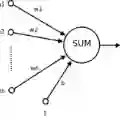
Artificial Intelligence and Machine learning have been widely used in various fields of mathematical computing, physical modeling, computational science, communication science, and stochastic analysis. Approaches based on Deep Artificial Neural Networks (DANN) are very popular in our days. Depending on the learning task, the exact form of DANNs is determined via their multi-layer architecture, activation functions and the so-called loss function. However, for a majority of deep learning approaches based on DANNs, the kernel structure of neural signal processing remains the same, where the node response is encoded as a linear superposition of neural activity, while the non-linearity is triggered by the activation functions. In the current paper, we suggest to analyze the neural signal processing in DANNs from the point of view of homogeneous chaos theory as known from polynomial chaos expansion (PCE). From the PCE perspective, the (linear) response on each node of a DANN could be seen as a $1^{st}$ degree multi-variate polynomial of single neurons from the previous layer, i.e. linear weighted sum of monomials. From this point of view, the conventional DANN structure relies implicitly (but erroneously) on a Gaussian distribution of neural signals. Additionally, this view revels that by design DANNs do not necessarily fulfill any orthogonality or orthonormality condition for a majority of data-driven applications. Therefore, the prevailing handling of neural signals in DANNs could lead to redundant representation as any neural signal could contain some partial information from other neural signals. To tackle that challenge, we suggest to employ the data-driven generalization of PCE theory known as arbitrary polynomial chaos (aPC) to construct a corresponding multi-variate orthonormal representations on each node of a DANN to obtain Deep arbitrary polynomial chaos neural networks.
翻译:人工智能与机器学习已广泛应用于数学计算、物理建模、计算科学、通信科学及随机分析等多个领域。基于深度人工神经网络的方法在当今非常流行。根据学习任务的不同,深度人工神经网络的具体形式由其多层架构、激活函数以及所谓的损失函数决定。然而,对于大多数基于深度人工神经网络的方法,神经信号处理的核结构保持不变:节点响应被编码为神经活动的线性叠加,而非线性则由激活函数触发。本文提出从齐次混沌理论的角度分析深度人工神经网络中的神经信号处理,该理论源自多项式混沌展开。从多项式混沌展开的视角看,深度人工神经网络每个节点上的(线性)响应可被视为上一层单个神经元的$1$阶多元多项式,即单项式的线性加权和。这一观点揭示了传统深度人工神经网络结构隐式地(且错误地)依赖于神经信号的高斯分布。此外,该视角还表明,在大多数数据驱动应用中,深度人工神经网络的设计并未必然满足正交性或标准正交性条件。因此,深度人工神经网络中神经信号的常规处理可能导致冗余表示,因为任何神经信号都可能包含来自其他神经信号的部分信息。为解决这一挑战,我们建议采用多项式混沌理论的推广形式——任意多项式混沌,以构建深度人工神经网络每个节点上对应的多元标准正交表示,从而得到深度任意多项式混沌神经网络。




相关内容



 微信扫码咨询专知VIP会员