

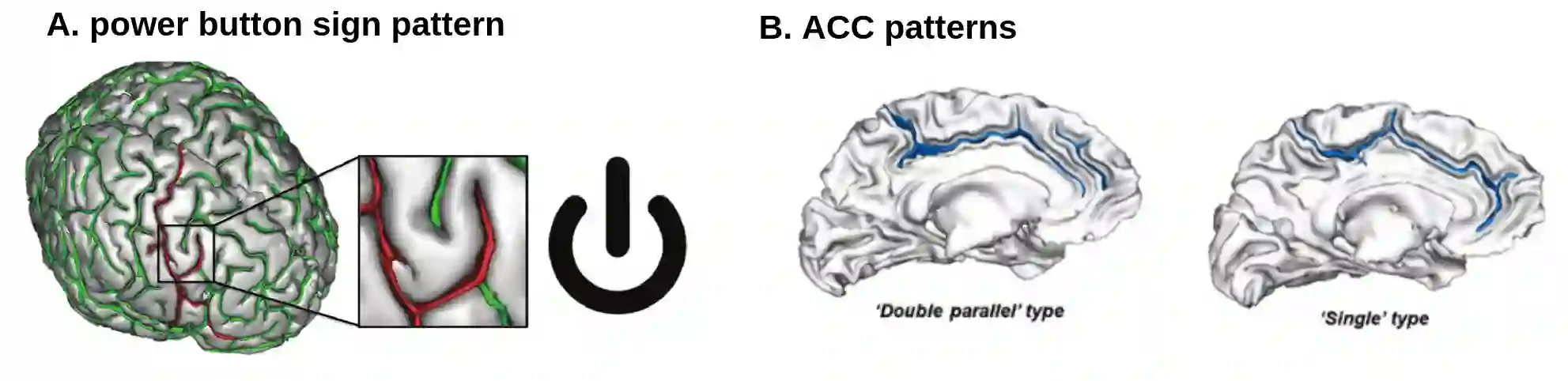
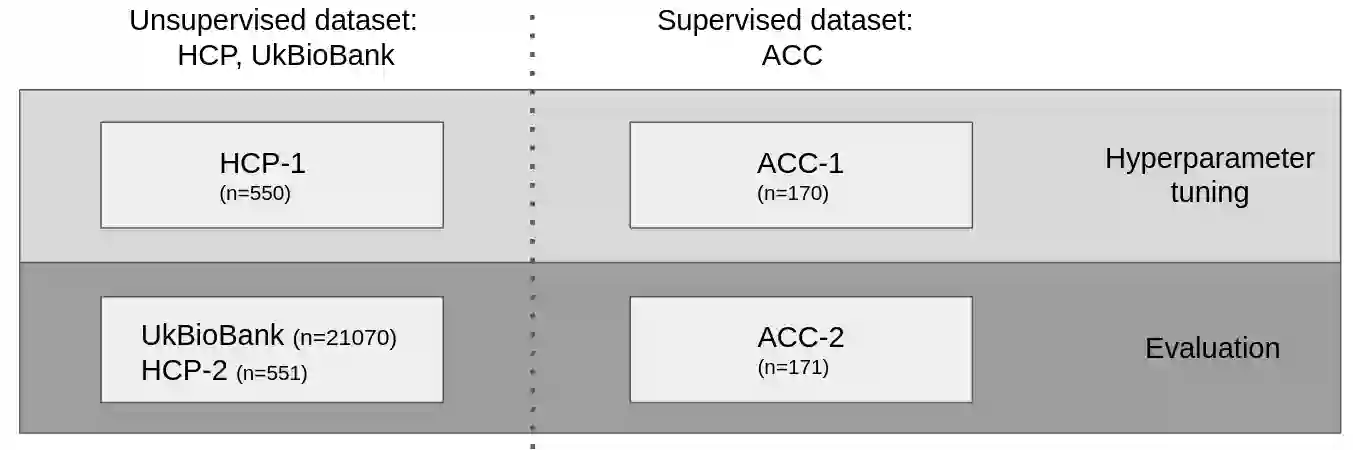
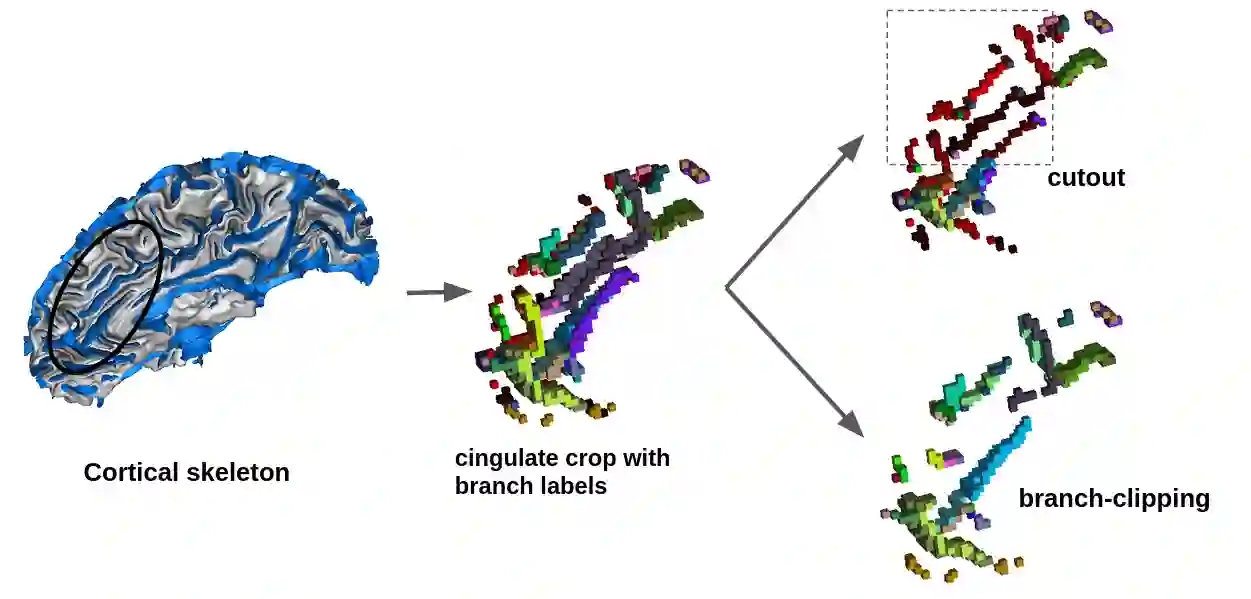
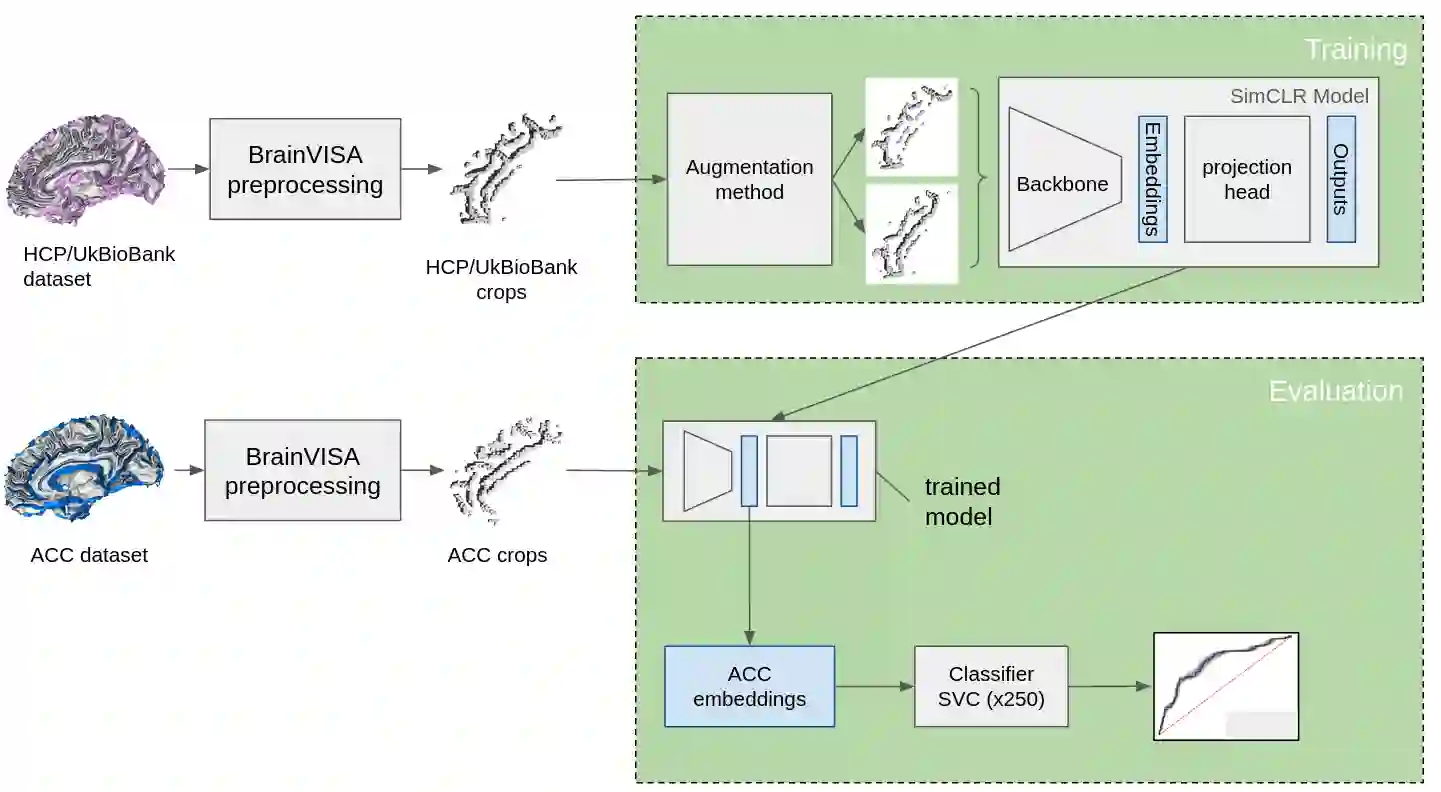
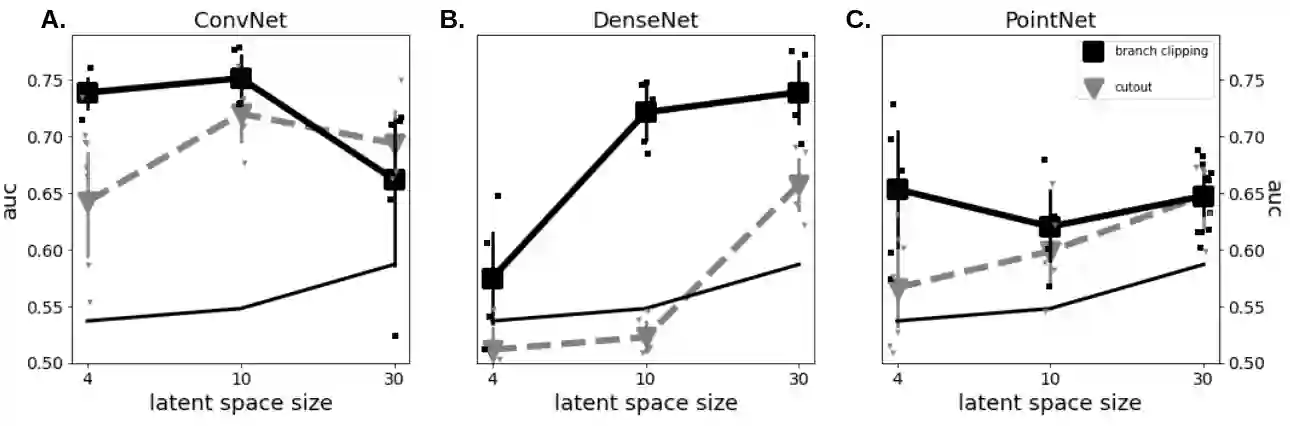
The human cerebral cortex has many bumps and grooves called gyri and sulci. Even though there is a high inter-individual consistency for the main cortical folds, this is not the case when we examine the exact shapes and details of the folding patterns. Because of this complexity, characterizing the cortical folding variability and relating them to subjects' behavioral characteristics or pathologies is still an open scientific problem. Classical approaches include labeling a few specific patterns, either manually or semi-automatically, based on geometric distances, but the recent availability of MRI image datasets of tens of thousands of subjects makes modern deep-learning techniques particularly attractive. Here, we build a self-supervised deep-learning model to detect folding patterns in the cingulate region. We train a contrastive self-supervised model (SimCLR) on both Human Connectome Project (1101 subjects) and UKBioBank (21070 subjects) datasets with topological-based augmentations on the cortical skeletons, which are topological objects that capture the shape of the folds. We explore several backbone architectures (convolutional network, DenseNet, and PointNet) for the SimCLR. For evaluation and testing, we perform a linear classification task on a database manually labeled for the presence of the "double-parallel" folding pattern in the cingulate region, which is related to schizophrenia characteristics. The best model, giving a test AUC of 0.76, is a convolutional network with 6 layers, a 10-dimensional latent space, a linear projection head, and using the branch-clipping augmentation. This is the first time that a self-supervised deep learning model has been applied to cortical skeletons on such a large dataset and quantitatively evaluated. We can now envisage the next step: applying it to other brain regions to detect other biomarkers.
翻译:人类大脑皮层有许多凸起和凹陷,分别称为脑回和脑沟。尽管主要皮层折叠在个体间具有较高的一致性,但当我们考察折叠模式的确切形状和细节时,情况却并非如此。由于这种复杂性,表征皮层折叠变异性并将其与受试者的行为特征或病理相关联,仍然是一个悬而未决的科学问题。经典方法包括基于几何距离手动或半自动标记少数特定模式,但最近数万名受试者的MRI图像数据集的出现,使得现代深度学习技术变得尤为吸引人。在此,我们构建了一个自监督深度学习模型,用于检测扣带回区域的折叠模式。我们在Human Connectome Project(1101名受试者)和UKBioBank(21070名受试者)数据集上训练对比自监督模型(SimCLR),并对皮层骨架进行基于拓扑的增强——皮层骨架是捕捉折叠形状的拓扑对象。我们为SimCLR探索了多种骨干架构(卷积网络、DenseNet和PointNet)。为进行评估和测试,我们在一个手动标记扣带回区域是否存在"双平行"折叠模式(该模式与精神分裂症特征相关)的数据库上执行线性分类任务。最佳模型在测试集上达到0.76的AUC,该模型采用6层卷积网络、10维潜在空间、线性投影头,并使用分支裁剪增强。这是首次将自监督深度学习模型应用于如此大规模数据集的皮层骨架,并进行了定量评估。现在我们可以设想下一步:将其应用于其他脑区以检测其他生物标志物。




相关内容



 微信扫码咨询专知VIP会员