

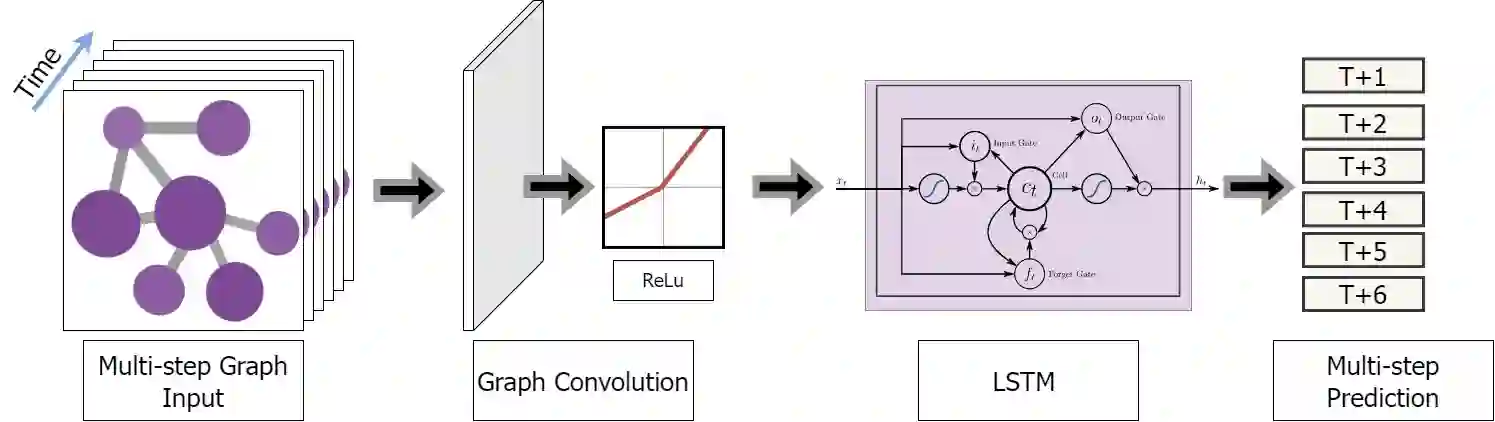
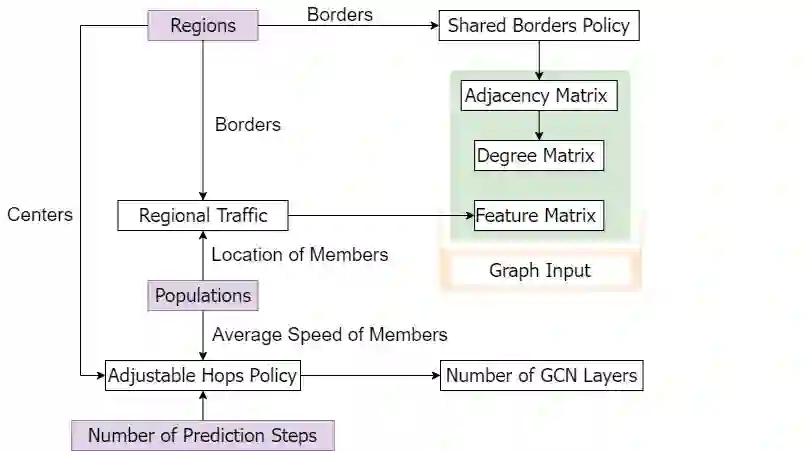
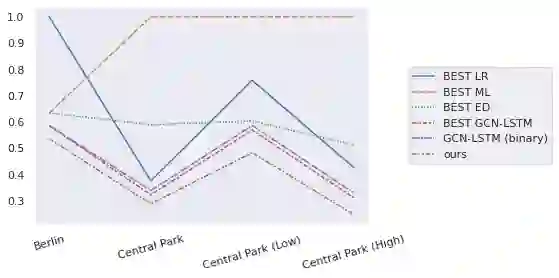
Regional traffic forecasting is a critical challenge in urban mobility, with applications to various fields such as the Internet of Everything. In recent years, spatio-temporal graph neural networks have achieved state-of-the-art results in the context of numerous traffic forecasting challenges. This work aims at expanding upon the conventional spatio-temporal graph neural network architectures in a manner that may facilitate the inclusion of information regarding the examined regions, as well as the populations that traverse them, in order to establish a more efficient prediction model. The end-product of this scientific endeavour is a novel spatio-temporal graph neural network architecture that is referred to as WEST (WEighted STacked) GCN-LSTM. Furthermore, the inclusion of the aforementioned information is conducted via the use of two novel dedicated algorithms that are referred to as the Shared Borders Policy and the Adjustable Hops Policy. Through information fusion and distillation, the proposed solution manages to significantly outperform its competitors in the frame of an experimental evaluation that consists of 19 forecasting models, across several datasets. Finally, an additional ablation study determined that each of the components of the proposed solution contributes towards enhancing its overall performance.
翻译:区域交通预测是城市移动性中的关键挑战,其应用涵盖万物互联等多个领域。近年来,时空图神经网络在诸多交通预测挑战中取得了最先进成果。本研究旨在扩展传统时空图神经网络架构,以便纳入与所研究区域及其流动人口相关的信息,从而构建更高效的预测模型。该科研工作的最终产物是一种新型时空图神经网络架构,称为WEST(加权堆叠)GCN-LSTM。此外,上述信息的纳入通过两种新颖的专用算法实现,分别称为共享边界策略和可调节跳数策略。通过信息融合与蒸馏,所提方案在包含19个预测模型的多数据集实验评估中显著优于竞争对手。最后,额外的消融研究确定,所提解决方案的每个组成部分均有助于提升其整体性能。




相关内容




 微信扫码咨询专知VIP会员