

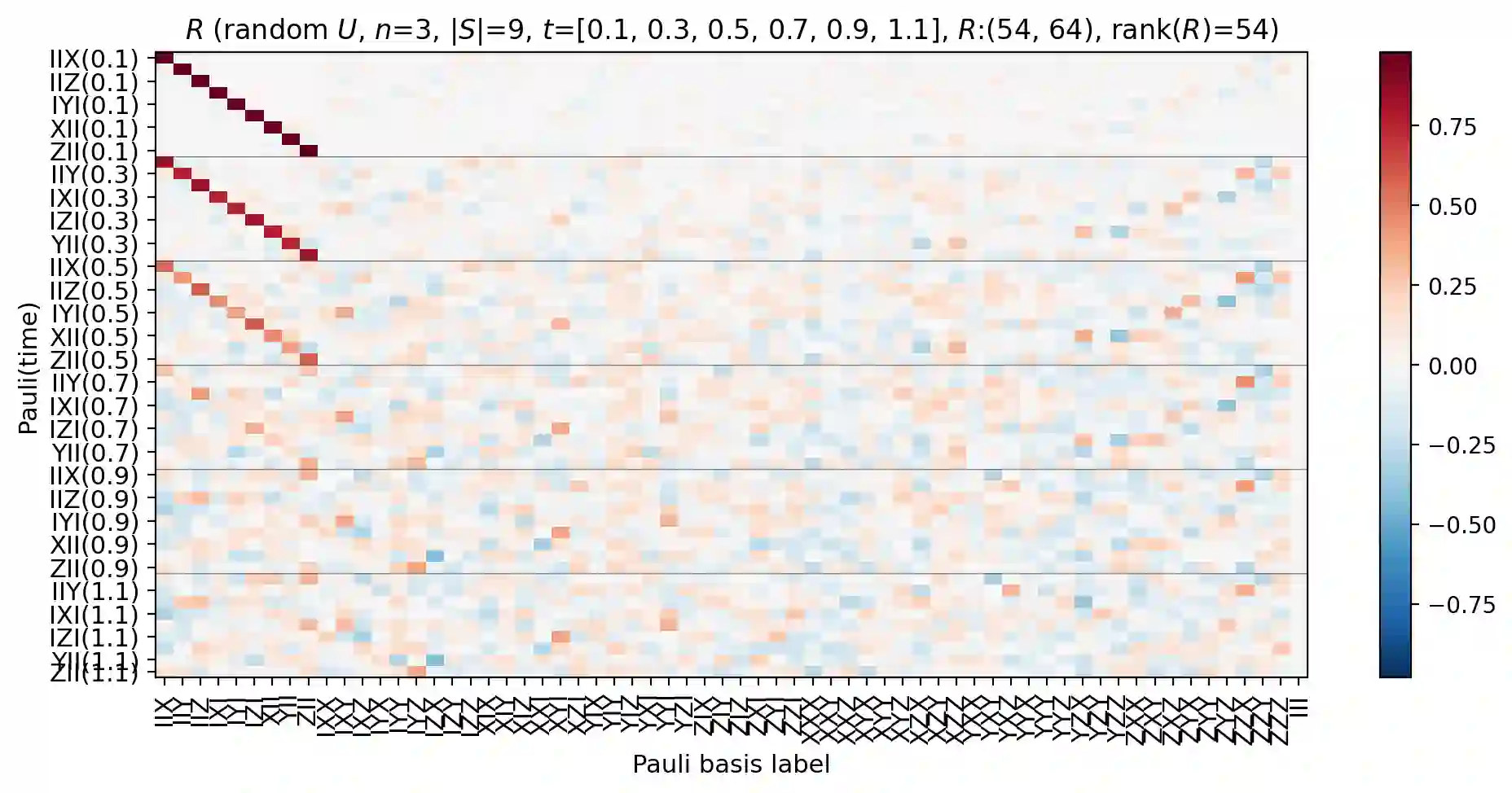
Quantum reservoir computers (QRCs) have emerged as a promising approach to quantum machine learning, since they utilize the natural dynamics of quantum systems for data processing and are simple to train. Here, we consider $n$-qubit quantum extreme learning machines (QELMs) with initial-state encoding and continuous-time reservoir dynamics. Applying the Pauli transfer matrix (PTM) formalism reveals the encoding-generated features and their linear transformation by quantum channels, and thereby provides a nonlinear vector autoregression model as an interpretable classical representation of a QELM. We show that the nonlinear information processing capacity of a QELM factorizes into the ability of the encoding to represent a given target function and the decodability of the relevant Pauli features after the effective PTM. Comparing geometric and statistical decodability reveals features that are algebraically hidden yet recoverable through data correlations. We relate the decodability of Pauli features to the spreading of measurement operators under Heisenberg evolution (Krylov growth). Focusing on the unitary channel, we discuss how structured Hamiltonians, when paired with certain observables, can impair model performance, as reflected in a low rank of the readout and the effective PTMs. We trace this effect to Hamiltonian symmetries and derive asymptotic rank estimates for symmetry-resolved observable families. Our decodability analysis disentangles the contributions of encoding, reservoir dynamics, and measurement observables, and thus provides interpretable diagnostics that can inform the design of QELMs and reduce reliance on exhaustive hyperparameter search. As a specific application, we consider forecasting nonlinear dynamical systems and show that the readout of a trained QELM closely matches the expression of the underlying flow map at leading orders.
翻译:暂无翻译


相关内容




 微信扫码咨询专知VIP会员