

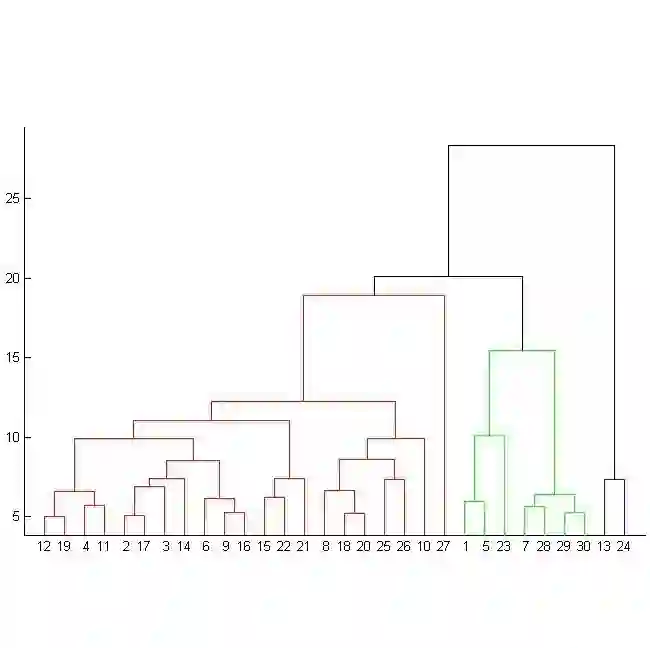
High-dimensional feature selection is a central problem in a variety of application domains such as machine learning, image analysis, and genomics. In this paper, we propose graph-based tests as a useful basis for feature selection. We describe an algorithm for selecting informative features in high-dimensional data, where each observation comes from one of $K$ different distributions. Our algorithm can be applied in a completely nonparametric setup without any distributional assumptions on the data, and it aims at outputting those features in the data, that contribute the most to the overall distributional variation. At the heart of our method is the recursive application of distribution-free graph-based tests on subsets of the feature set, located at different depths of a hierarchical clustering tree constructed from the data. Our algorithm recovers all truly contributing features with high probability, while ensuring optimal control on false-discovery. Finally, we show the superior performance of our method over other existing ones through synthetic data, and also demonstrate the utility of the method on two real-life datasets from the domains of climate change and single cell transcriptomics.
翻译:高维特征选择是机器学习、图像分析和基因组学等多个应用领域的核心问题。本文提出将基于图的检验作为特征选择的有效基础。我们描述了一种用于从高维数据中选取信息性特征的算法,其中每个观测值来自$K$个不同分布之一。该算法可在完全非参数框架下应用,无需对数据作任何分布假设,其目标是输出数据中对整体分布变异贡献最大的那些特征。该方法的核心是在不同层级的特征子集上递归应用无分布假设的图检验——这些子集位于从数据构建的层次聚类树的不同深度。我们的算法能以高概率恢复所有真正具有贡献性的特征,同时实现对错误发现率的最优控制。最后,通过合成数据展示了该方法相较于现有其他方法的优越性能,并分别在气候变化和单细胞转录组学领域的两个真实数据集上验证了其实用性。




相关内容



 微信扫码咨询专知VIP会员