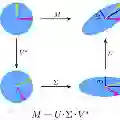
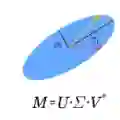
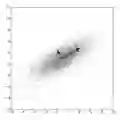
The randomized singular value decomposition (R-SVD) is a popular sketching-based algorithm for efficiently computing the partial SVD of a large matrix. When the matrix is low-rank, the R-SVD produces its partial SVD exactly; but when the rank is large, it only yields an approximation. Motivated by applications in data science and principal component analysis (PCA), we analyze the R-SVD under a low-rank signal plus noise measurement model; specifically, when its input is a spiked random matrix. The singular values produced by the R-SVD are shown to exhibit a BBP-like phase transition: when the SNR exceeds a certain detectability threshold, that depends on the dimension reduction factor, the largest singular value is an outlier; below the threshold, no outlier emerges from the bulk of singular values. We further compute asymptotic formulas for the overlap between the ground truth signal singular vectors and the approximations produced by the R-SVD. Dimensionality reduction has the adverse affect of amplifying the noise in a highly nonlinear manner. Our results demonstrate the statistical advantage -- in both signal detection and estimation -- of the R-SVD over more naive sketched PCA variants; the advantage is especially dramatic when the sketching dimension is small. Our analysis is asymptotically exact, and substantially more fine-grained than existing operator-norm error bounds for the R-SVD, which largely fail to give meaningful error estimates in the moderate SNR regime. It applies for a broad family of sketching matrices previously considered in the literature, including Gaussian i.i.d. sketches, random projections, and the sub-sampled Hadamard transform, among others. Lastly, we derive an optimal singular value shrinker for singular values and vectors obtained through the R-SVD, which may be useful for applications in matrix denoising.


翻译:随机化奇异值分解(R-SVD)是一种基于草图化的流行算法,用于高效计算大型矩阵的部分SVD。当矩阵低秩时,R-SVD能精确计算其部分SVD;但秩较大时,只能提供近似结果。受数据科学与主成分分析(PCA)应用启发,我们在低秩信号加噪声测量模型(即输入为尖峰随机矩阵)下分析R-SVD。研究表明,R-SVD产生的奇异值呈现类似BBP的相变:当信噪比超过依赖于降维因子的可检测阈值时,最大奇异值成为离群值;低于阈值时,奇异值主体中无离群值出现。我们进一步推导了真实信号奇异向量与R-SVD近似结果之间重叠度的渐近公式。降维会以高度非线性的方式放大噪声,产生不利影响。我们的结果表明,相较于更朴素的草图化PCA变体,R-SVD在信号检测与估计两方面均具有统计优势——当草图化维度较小时优势尤为显著。该分析在渐近意义上精确,且比现有R-SVD的算子范数误差界(在中信噪比区间内往往无法给出有效误差估计)更为精细。它适用于文献中先前研究的广泛草图化矩阵族,包括高斯独立同分布草图、随机投影与子采样哈达玛变换等。最后,我们推导了针对R-SVD所获奇异值与奇异向量的最优奇异值收缩器,这或可用于矩阵去噪应用。


0
下载
关闭预览

相关内容

不可错过!《机器学习100讲》课程,UBC Mark Schmidt讲授
专知会员服务
76+阅读 · 2022年6月28日
专知会员服务
78+阅读 · 2021年3月16日
专知会员服务
52+阅读 · 2020年12月14日
【干货书】机器学习速查手册,135页pdf
专知会员服务
127+阅读 · 2020年11月20日
强化学习最新教程,17页pdf
专知会员服务
182+阅读 · 2019年10月11日
【哈佛大学商学院课程Fall 2019】机器学习可解释性
专知会员服务
105+阅读 · 2019年10月9日
【SIGGRAPH2019】TensorFlow 2.0深度学习计算机图形学应用
专知会员服务
41+阅读 · 2019年10月9日
【泡泡汇总】CVPR2019 SLAM Paperlist
泡泡机器人SLAM
14+阅读 · 2019年6月12日
Hierarchically Structured Meta-learning
CreateAMind
27+阅读 · 2019年5月22日
Transferring Knowledge across Learning Processes
CreateAMind
29+阅读 · 2019年5月18日
深度自进化聚类:Deep Self-Evolution Clustering
我爱读PAMI
15+阅读 · 2019年4月13日
IEEE | DSC 2019诚邀稿件 (EI检索)
Call4Papers
10+阅读 · 2019年2月25日
逆强化学习-学习人先验的动机
CreateAMind
16+阅读 · 2019年1月18日
强化学习的Unsupervised Meta-Learning
CreateAMind
18+阅读 · 2019年1月7日
Unsupervised Learning via Meta-Learning
CreateAMind
44+阅读 · 2019年1月3日
A Technical Overview of AI & ML in 2018 & Trends for 2019
待字闺中
18+阅读 · 2018年12月24日
可解释的CNN
CreateAMind
18+阅读 · 2017年10月5日
国家自然科学基金
0+阅读 · 2014年12月31日
国家自然科学基金
1+阅读 · 2014年12月31日
国家自然科学基金
0+阅读 · 2013年12月31日
国家自然科学基金
1+阅读 · 2013年12月31日
国家自然科学基金
2+阅读 · 2013年12月31日
国家自然科学基金
1+阅读 · 2012年12月31日
国家自然科学基金
0+阅读 · 2012年12月31日
国家自然科学基金
1+阅读 · 2011年12月31日
国家自然科学基金
0+阅读 · 2009年12月31日
Arxiv
0+阅读 · 2023年7月16日
VIP会员
最新内容
ICML 2026 | Sheaf-ADMM:用可微优化学习多智能体协调
专知会员服务
1+阅读 · 56分钟前
综述 | OPSD:大语言模型的在线策略自蒸馏
专知会员服务
1+阅读 · 刚刚
算法化战争:人工智能时代的新范式(万字长文)
帕兰蒂尔Maven:军事人工智能的新纪元
专知会员服务
2+阅读 · 今天14:00
超越网格:作战环境对炮兵的影响
专知会员服务
3+阅读 · 5月31日
BES:让语言模型通过双向进化搜索自我改进
专知会员服务
6+阅读 · 5月30日
以色列-美国-伊朗战争中的无人机:关键要点
专知会员服务
7+阅读 · 5月30日
相关VIP内容
不可错过!《机器学习100讲》课程,UBC Mark Schmidt讲授
专知会员服务
76+阅读 · 2022年6月28日
专知会员服务
78+阅读 · 2021年3月16日
专知会员服务
52+阅读 · 2020年12月14日
【干货书】机器学习速查手册,135页pdf
专知会员服务
127+阅读 · 2020年11月20日
强化学习最新教程,17页pdf
专知会员服务
182+阅读 · 2019年10月11日
【哈佛大学商学院课程Fall 2019】机器学习可解释性
专知会员服务
105+阅读 · 2019年10月9日
【SIGGRAPH2019】TensorFlow 2.0深度学习计算机图形学应用
专知会员服务
41+阅读 · 2019年10月9日
相关资讯
【泡泡汇总】CVPR2019 SLAM Paperlist
泡泡机器人SLAM
14+阅读 · 2019年6月12日
Hierarchically Structured Meta-learning
CreateAMind
27+阅读 · 2019年5月22日
Transferring Knowledge across Learning Processes
CreateAMind
29+阅读 · 2019年5月18日
深度自进化聚类:Deep Self-Evolution Clustering
我爱读PAMI
15+阅读 · 2019年4月13日
IEEE | DSC 2019诚邀稿件 (EI检索)
Call4Papers
10+阅读 · 2019年2月25日
逆强化学习-学习人先验的动机
CreateAMind
16+阅读 · 2019年1月18日
强化学习的Unsupervised Meta-Learning
CreateAMind
18+阅读 · 2019年1月7日
Unsupervised Learning via Meta-Learning
CreateAMind
44+阅读 · 2019年1月3日
A Technical Overview of AI & ML in 2018 & Trends for 2019
待字闺中
18+阅读 · 2018年12月24日
可解释的CNN
CreateAMind
18+阅读 · 2017年10月5日
相关基金
国家自然科学基金
0+阅读 · 2014年12月31日
国家自然科学基金
1+阅读 · 2014年12月31日
国家自然科学基金
0+阅读 · 2013年12月31日
国家自然科学基金
1+阅读 · 2013年12月31日
国家自然科学基金
2+阅读 · 2013年12月31日
国家自然科学基金
1+阅读 · 2012年12月31日
国家自然科学基金
0+阅读 · 2012年12月31日
国家自然科学基金
1+阅读 · 2011年12月31日
国家自然科学基金
0+阅读 · 2009年12月31日
Top
微信扫码咨询专知VIP会员