

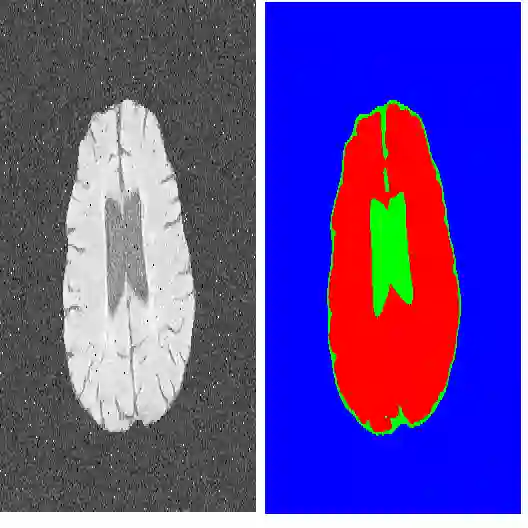
For medical image segmentation, contrastive learning is the dominant practice to improve the quality of visual representations by contrasting semantically similar and dissimilar pairs of samples. This is enabled by the observation that without accessing ground truth labels, negative examples with truly dissimilar anatomical features, if sampled, can significantly improve the performance. In reality, however, these samples may come from similar anatomical regions and the models may struggle to distinguish the minority tail-class samples, making the tail classes more prone to misclassification, both of which typically lead to model collapse. In this paper, we propose ARCO, a semi-supervised contrastive learning (CL) framework with stratified group theory for medical image segmentation. In particular, we first propose building ARCO through the concept of variance-reduced estimation and show that certain variance-reduction techniques are particularly beneficial in pixel/voxel-level segmentation tasks with extremely limited labels. Furthermore, we theoretically prove these sampling techniques are universal in variance reduction. Finally, we experimentally validate our approaches on eight benchmarks, i.e., five 2D/3D medical and three semantic segmentation datasets, with different label settings, and our methods consistently outperform state-of-the-art semi-supervised methods. Additionally, we augment the CL frameworks with these sampling techniques and demonstrate significant gains over previous methods. We believe our work is an important step towards semi-supervised medical image segmentation by quantifying the limitation of current self-supervision objectives for accomplishing such challenging safety-critical tasks.
翻译:对于医学图像分割而言,对比学习是通过对比语义相似与不相似的样本对来提升视觉表征质量的主流方法。其原理在于,无需访问真实标签,若能采样到具有真正不相似解剖特征的负样本,便可显著提升性能。然而在实际应用中,这些样本可能来自相似解剖区域,且模型难以区分少数类别(尾类)样本,导致尾类更易出现误分类——这两种情况通常都会引发模型崩溃。本文提出ARCO——一种基于分层组理论的半监督对比学习框架,用于医学图像分割。具体而言,我们首先通过方差缩减估计的概念构建ARCO,并证明某些方差缩减技术对于标签极度有限的像素/体素级分割任务尤为有效。进一步地,我们从理论上证明这些采样技术在方差缩减方面具有普适性。最后,我们在八个基准数据集(包括五个2D/3D医学分割数据集和三个语义分割数据集)上,采用不同标签设置进行实验验证,结果显示我们的方法始终优于最先进的半监督方法。此外,我们将这些采样技术融入对比学习框架,相较于先前方法展现出显著性能提升。我们相信,通过量化当前自监督目标在完成此类关键安全任务中的局限性,本工作为半监督医学图像分割迈出了重要一步。




相关内容


 微信扫码咨询专知VIP会员