

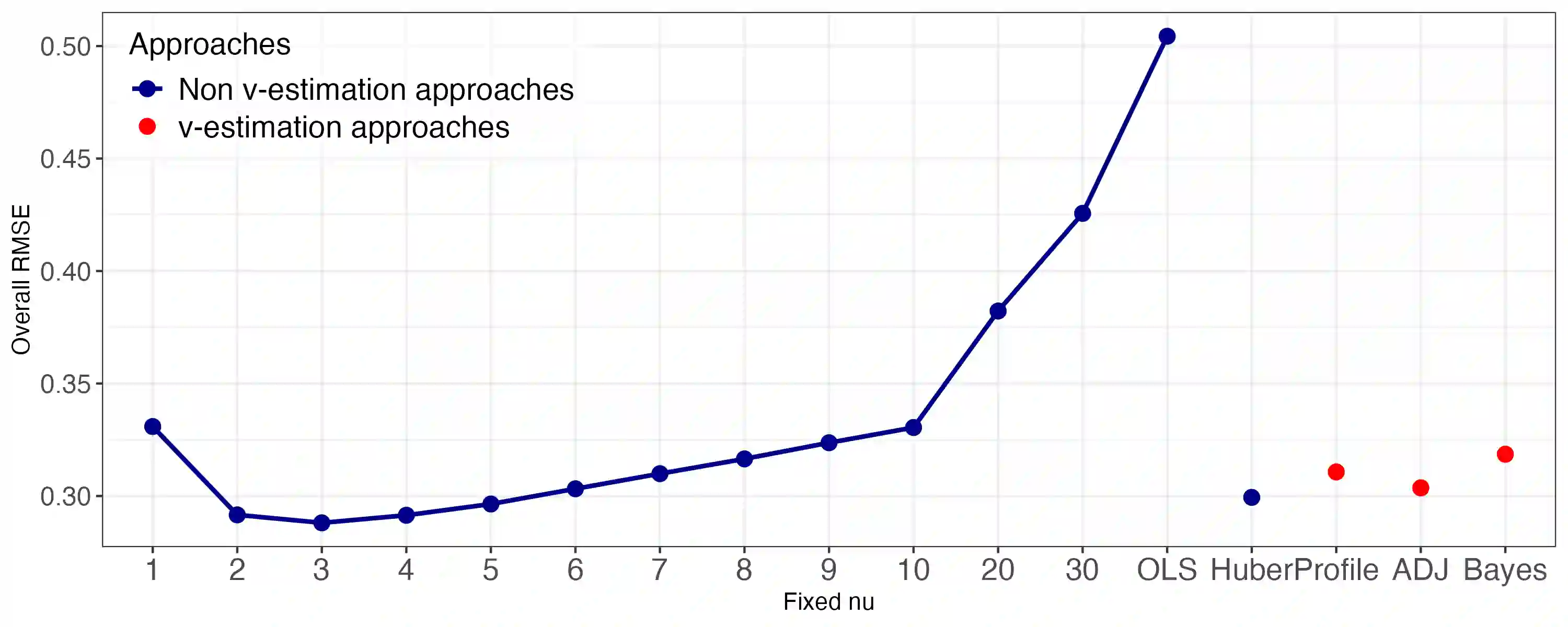
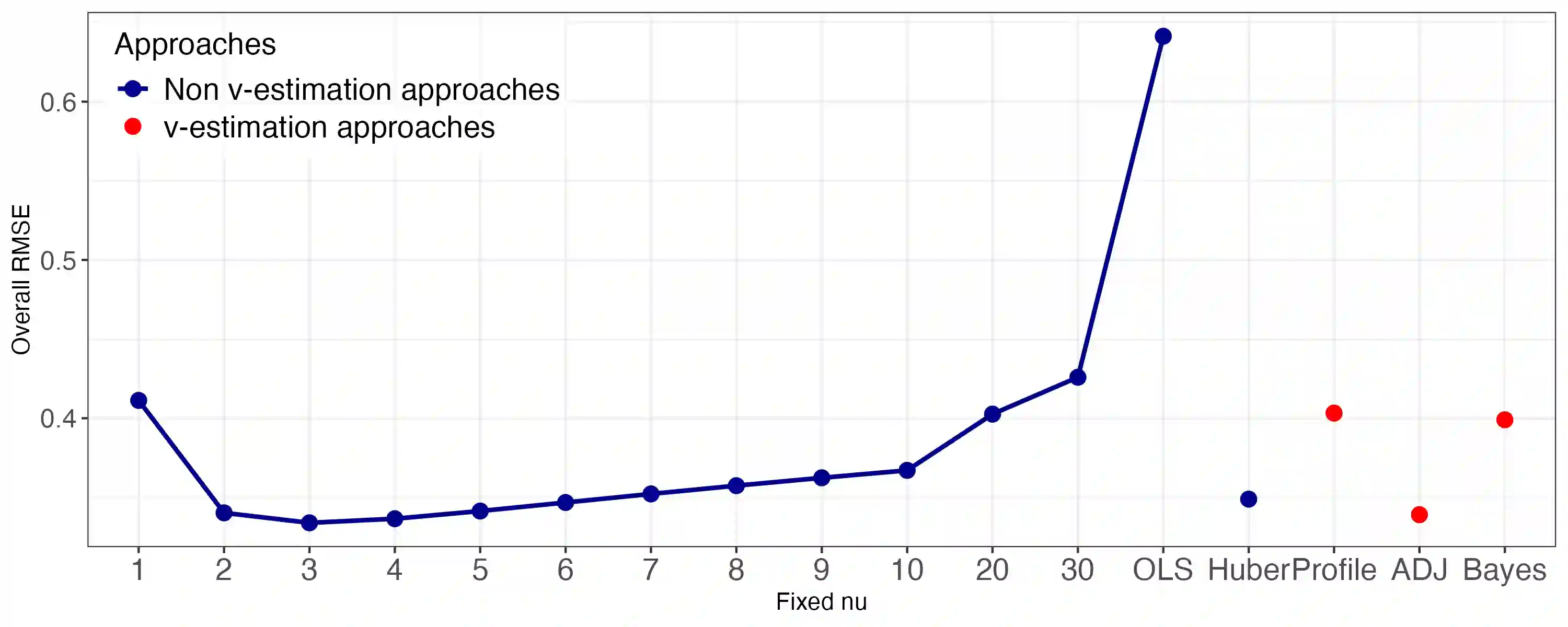
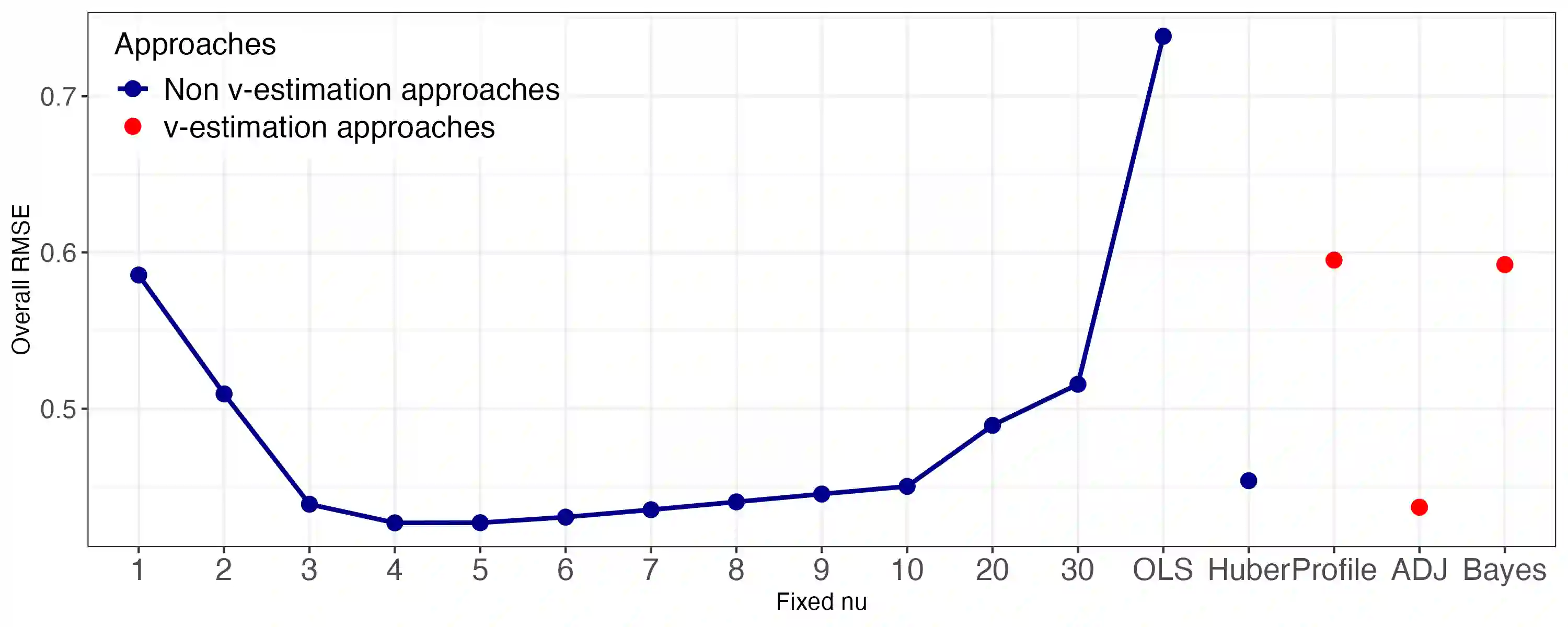
Linear regression estimators are known to be sensitive to outliers, and one alternative to obtain a robust and efficient estimator of the regression parameter is to model the error with Student's $t$ distribution. In this article, we compare estimators of the degrees of freedom parameter in the $t$ distribution using frequentist and Bayesian methods, and then study properties of the corresponding estimated regression coefficient. We also include the comparison with some recommended approaches in the literature, including fixing the degrees of freedom and robust regression using the Huber loss. Our extensive simulations on both synthetic and real data demonstrate that estimating the degrees of freedom via the adjusted profile log-likelihood approach yields regression coefficient estimators with high accuracy, performing comparably to the maximum likelihood estimators where the degrees of freedom are fixed at their true values. These findings provide a detailed synthesis of $t$-based robust regression and underscore a key insight: the proper calibration of the degrees of freedom is as crucial as the choice of the robust distribution itself for achieving optimal performance. The {\tt R} package that implements our method is available at https://github.com/amanda-ng518/RobustTRegression.
翻译:众所周知,线性回归估计量对异常值敏感,而获得回归参数的稳健且高效估计量的一种替代方法是用学生$t$分布对误差进行建模。本文中,我们使用频率学派和贝叶斯方法比较了$t$分布中自由度参数的估计量,进而研究了相应回归系数估计量的性质。我们还与文献中推荐的一些方法进行了比较,包括固定自由度的方法以及使用Huber损失的稳健回归。我们在合成数据和真实数据上进行的大量模拟实验表明,通过调整轮廓对数似然方法估计自由度,能够产生高精度的回归系数估计量,其性能与自由度固定在其真实值时的最大似然估计量相当。这些发现提供了对基于$t$分布的稳健回归的详细综合,并强调了一个关键见解:为实现最优性能,自由度的适当校准与稳健分布本身的选择同等重要。实现我们方法的{\tt R}软件包可在 https://github.com/amanda-ng518/RobustTRegression 获取。




相关内容




 微信扫码咨询专知VIP会员