

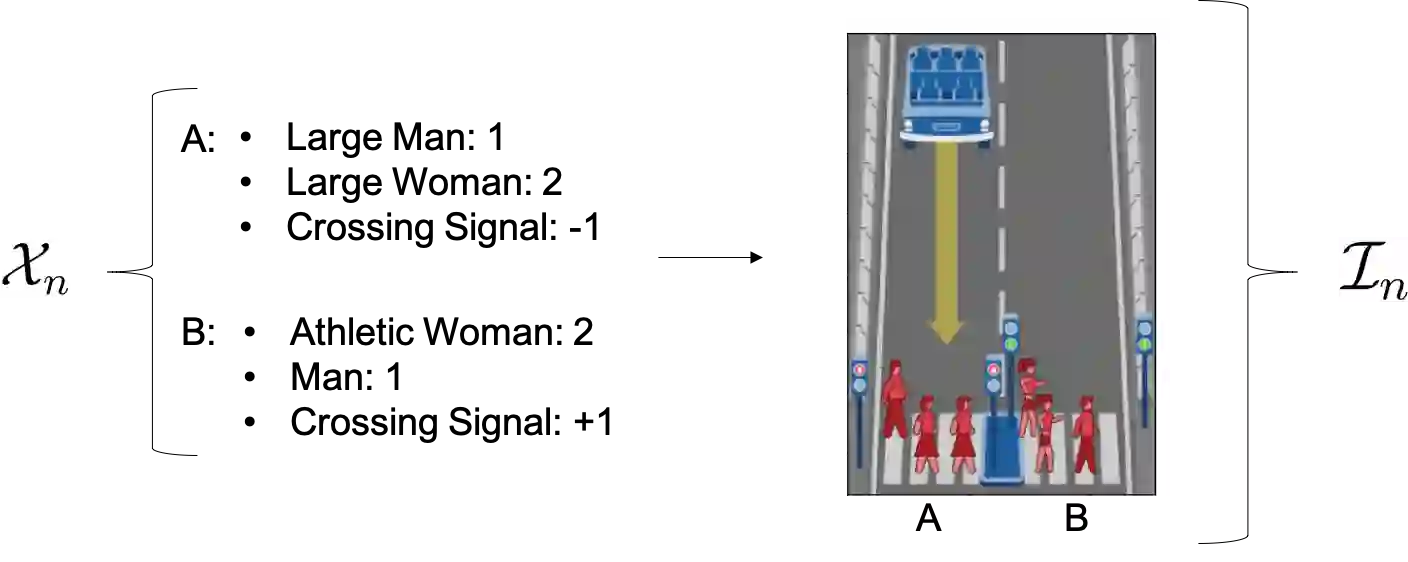
This paper explores the intersection of Discrete Choice Modeling (DCM) and machine learning, focusing on the integration of image data into DCM's utility functions and its impact on model interpretability. We investigate the consequences of embedding high-dimensional image data that shares isomorphic information with traditional tabular inputs within a DCM framework. Our study reveals that neural network (NN) components learn and replicate tabular variable representations from images when co-occurrences exist, thereby compromising the interpretability of DCM parameters. We propose and benchmark two methodologies to address this challenge: architectural design adjustments to segregate redundant information, and isomorphic information mitigation through source information masking and inpainting. Our experiments, conducted on a semi-synthetic dataset, demonstrate that while architectural modifications prove inconclusive, direct mitigation at the data source shows to be a more effective strategy in maintaining the integrity of DCM's interpretable parameters. The paper concludes with insights into the applicability of our findings in real-world settings and discusses the implications for future research in hybrid modeling that combines complex data modalities. Full control of tabular and image data congruence is attained by using the MIT moral machine dataset, and both inputs are merged into a choice model by deploying the Learning Multinomial Logit (L-MNL) framework.
翻译:本文探讨了离散选择建模(DCM)与机器学习的交叉领域,重点关注图像数据在DCM效用函数中的集成及其对模型可解释性的影响。我们研究了在DCM框架中嵌入与结构化表格输入共享同构信息的高维图像数据所引发的后果。研究表明,当神经网络(NN)组件与表格变量存在共现关系时,它们会从图像中学习并复现表格变量表征,从而损害DCM参数的可解释性。我们提出并评估了两种应对方法:通过架构设计调整来分离冗余信息,以及通过源信息掩码和修复技术缓解数据同构性。在基于半合成数据的实验中,我们发现架构修改的效果尚不明确,而直接在数据源层面进行缓解的策略能更有效地维护DCM可解释参数的完整性。本文最后阐述了研究发现在现实场景中的适用性,并探讨了对融合复杂数据模态的混合建模未来研究的启示。通过利用MIT道德机器数据集实现表格数据与图像数据一致性的完全控制,并采用学习型多项Logit(L-MNL)框架将两种输入整合到选择模型中。




相关内容





 微信扫码咨询专知VIP会员