

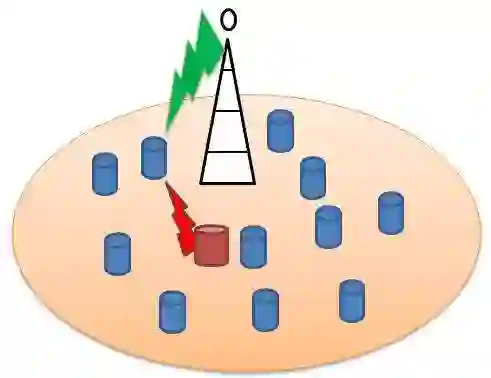
We consider a communication system where a base station (BS) transmits update packets to $N$ users, one user at a time, over a wireless channel. We investigate the age of this status updating system with an adversary that jams the update packets in the downlink. We consider two system models: with diversity and without diversity. In the model without diversity, we show that if the BS schedules the users with a stationary randomized policy, then the optimal choice for the adversary is to block the user which has the lowest probability of getting scheduled by the BS, at the middle of the time horizon, consecutively for $\alpha T$ time slots. In the model with diversity, we show that for large $T$, the uniform user scheduling algorithm together with the uniform sub-carrier choosing algorithm is $\frac{2 N_{sub}}{N_{sub}-1}$ optimal. Next, we investigate the game theoretic equilibrium points of this status updating system. For the model without diversity, we show that a Nash equilibrium does not exist, however, a Stackelberg equilibrium exists when the scheduling algorithm of the BS acts as the leader and the adversary acts as the follower. For the model with diversity, we show that a Nash equilibrium exists and identify the Nash equilibrium. Finally, we extend the model without diversity to the case where the BS can serve multiple users and the adversary can jam multiple users, at a time.
翻译:我们考虑一个通信系统,其中基站(BS)通过无线信道每次向一个用户传输更新数据包。我们研究存在对手干扰下行链路更新数据包时的状态更新系统时效性。考虑两种系统模型:含分集与不含分集。在不含分集模型中,我们证明:若基站采用平稳随机化策略调度用户,则对手的最优选择是在时间范围中间连续干扰被基站调度概率最低的用户,持续αT个时隙。在含分集模型中,我们证明:当T足够大时,均匀用户调度算法与均匀子载波选择算法的联合策略能达到2N_sub/(N_sub-1)最优性。进一步,我们探究该状态更新系统的博弈论均衡点。针对不含分集模型,我们证明纳什均衡不存在,但存在以基站调度算法为领导者、对手为跟随者的斯塔克尔伯格均衡。针对含分集模型,我们证明纳什均衡存在并给出具体解。最后,将不含分集模型扩展至基站可同时服务多个用户、对手可同时干扰多个用户的场景。




相关内容




 微信扫码咨询专知VIP会员