

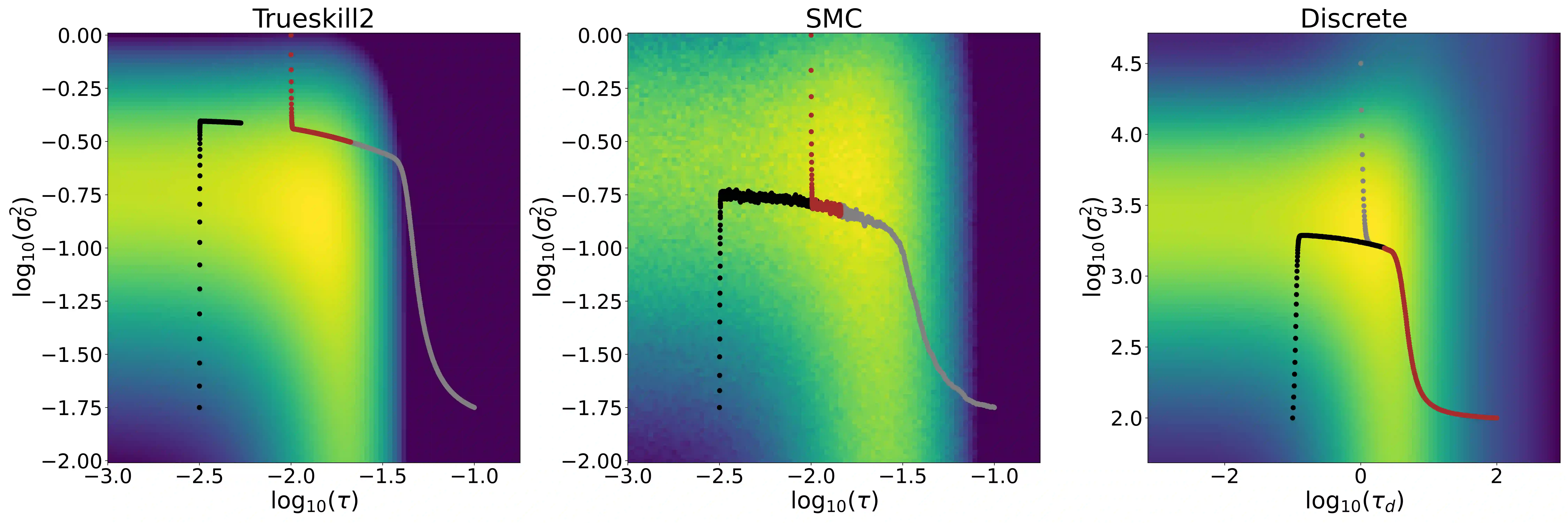
This paper offers a comprehensive review of the main methodologies used for skill rating in competitive sports. We advocate for a state-space model perspective, wherein players' skills are represented as time-varying, and match results serve as the sole observed quantities. The state-space model perspective facilitates the decoupling of modeling and inference, enabling a more focused approach highlighting model assumptions, while also fostering the development of general-purpose inference tools. We explore the essential steps involved in constructing a state-space model for skill rating before turning to a discussion on the three stages of inference: filtering, smoothing and parameter estimation. Throughout, we examine the computational challenges of scaling up to high-dimensional scenarios involving numerous players and matches, highlighting approximations and reductions used to address these challenges effectively. We provide concise summaries of popular methods documented in the literature, along with their inferential paradigms and introduce new approaches to skill rating inference based on sequential Monte Carlo and finite state-spaces. We close with numerical experiments demonstrating a practical workflow on real data across different sports.
翻译:本文系统综述了竞技体育中用于技能评分的主流方法论。我们倡导采用状态空间模型视角,将运动员技能表示为时变状态,并将比赛结果作为唯一观测变量。状态空间模型框架促进了建模与推理的解耦,既能通过聚焦于模型假设来突出核心要点,又推动了通用推理工具的发展。我们深入探讨了构建技能评分状态空间模型的必要步骤,进而论述推理的三个阶段:滤波、平滑与参数估计。全程重点分析了当涉及大量运动员与比赛时,向高维场景扩展所面临的计算挑战,并阐释了应对这些挑战的有效近似与降维方法。我们简明总结了文献中记载的经典方法及其推理范式,同时介绍了基于序贯蒙特卡洛与有限状态空间的新型技能评分推理方案。最后通过数值实验,展示了不同体育项目实际数据上的实践流程。




相关内容




 微信扫码咨询专知VIP会员