

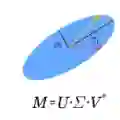
A new wave of work on covariance cleaning and nonlinear shrinkage has delivered asymptotically optimal analytical solutions for large covariance matrices. The same framework has been generalized to empirical cross-covariance matrices, whose singular value decomposition identifies canonical comovement modes between two asset sets, with singular values quantifying the strength of each mode and providing natural targets for shrinkage. Existing analytical cross-covariance cleaners are derived under strong stationarity and large-sample assumptions, and they typically rely on mesoscopic regularity conditions such as bounded spectra; macroscopic common modes (e.g., a global market factor) violate these conditions. When applied to real equity returns, where dependence structures drift over time and global modes are prominent, we find that these theoretically optimal formulas do not translate into robust out-of-sample performance. We address this gap by designing a random-matrix-inspired neural architecture that operates in the empirical singular-vector basis and learns a nonlinear mapping from empirical singular values to their corresponding cleaned values. By construction, the network can recover the analytical solution as a special case, yet it remains flexible enough to adapt to non-stationary dynamics and mode-driven distortions. Trained on a long history of equity returns, the proposed method achieves a more favorable bias-variance trade-off than purely analytical cleaners and delivers systematically lower out-of-sample cross-covariance prediction errors. Our results demonstrate that combining random-matrix theory with machine learning makes asymptotic theories practically effective in realistic time-varying markets.
翻译:协方差矩阵清洗与非线性收缩领域的新进展为大型协方差矩阵提供了渐近最优的解析解。该框架已推广至经验交叉协方差矩阵,其奇异值分解可识别两个资产集合间的典型联动模式——奇异值量化各模式的强度,并为收缩处理提供天然目标。现有解析型交叉协方差清洗器在强平稳性与大样本假设下推导,通常依赖有界谱等介观正则条件;而宏观共同模式(如全局市场因子)会违反这些条件。将其应用于实际股票收益数据时(其依赖结构随时间漂移且全局模式显著),我们发现这些理论最优公式并未转化为稳健的样本外性能。为弥补这一缺陷,我们设计了一种受随机矩阵理论启发的神经架构,该架构在经验奇异向量基上运行,并学习从经验奇异值到对应清洗值的非线性映射。该网络结构可特例化恢复解析解,同时保持足够灵活性以适应非平稳动态与模式驱动的畸变。通过在长期股票收益数据上训练,所提方法实现了比纯解析清洗器更优的偏差-方差权衡,并系统性地获得更低的样本外交叉协方差预测误差。我们的结果表明,将随机矩阵理论与机器学习相结合,可使渐近理论在实际时变市场中发挥实效。




相关内容



 微信扫码咨询专知VIP会员