

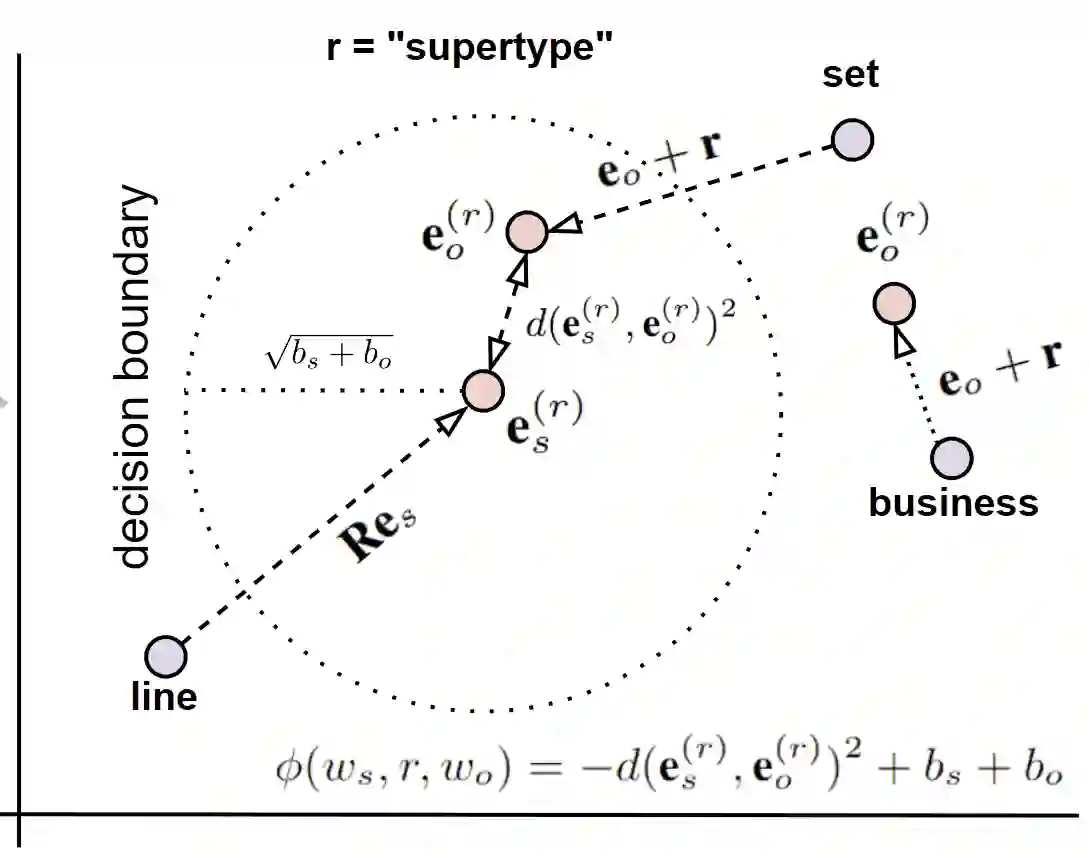
Natural language definitions possess a recursive, self-explanatory semantic structure that can support representation learning methods able to preserve explicit conceptual relations and constraints in the latent space. This paper presents a multi-relational model that explicitly leverages such a structure to derive word embeddings from definitions. By automatically extracting the relations linking defined and defining terms from dictionaries, we demonstrate how the problem of learning word embeddings can be formalised via a translational framework in Hyperbolic space and used as a proxy to capture the global semantic structure of definitions. An extensive empirical analysis demonstrates that the framework can help imposing the desired structural constraints while preserving the semantic mapping required for controllable and interpretable traversal. Moreover, the experiments reveal the superiority of the Hyperbolic word embeddings over the Euclidean counterparts and demonstrate that the multi-relational approach can obtain competitive results when compared to state-of-the-art neural models, with the advantage of being intrinsically more efficient and interpretable.
翻译:自然语言定义具有递归、自解释的语义结构,能够支持在潜在空间中保留显式概念关系与约束的表征学习方法。本文提出一种多关系模型,通过显式利用此类结构从定义中推导词嵌入。通过自动从词典中提取定义术语与被定义术语之间的关联关系,我们展示了如何将词嵌入学习问题形式化为双曲空间中的平移框架,并以此作为捕获定义全局语义结构的代理机制。广泛的实证分析表明,该框架有助于施加所需的结构约束,同时保留可控与可解释遍历所需的语义映射。此外,实验揭示了双曲词嵌入相较于欧几里得对应方法的优越性,并证明多关系方法在与当前最先进的神经模型对比时能获得具有竞争力的结果,且具备本质上更高的效率与可解释性。




相关内容




 微信扫码咨询专知VIP会员