

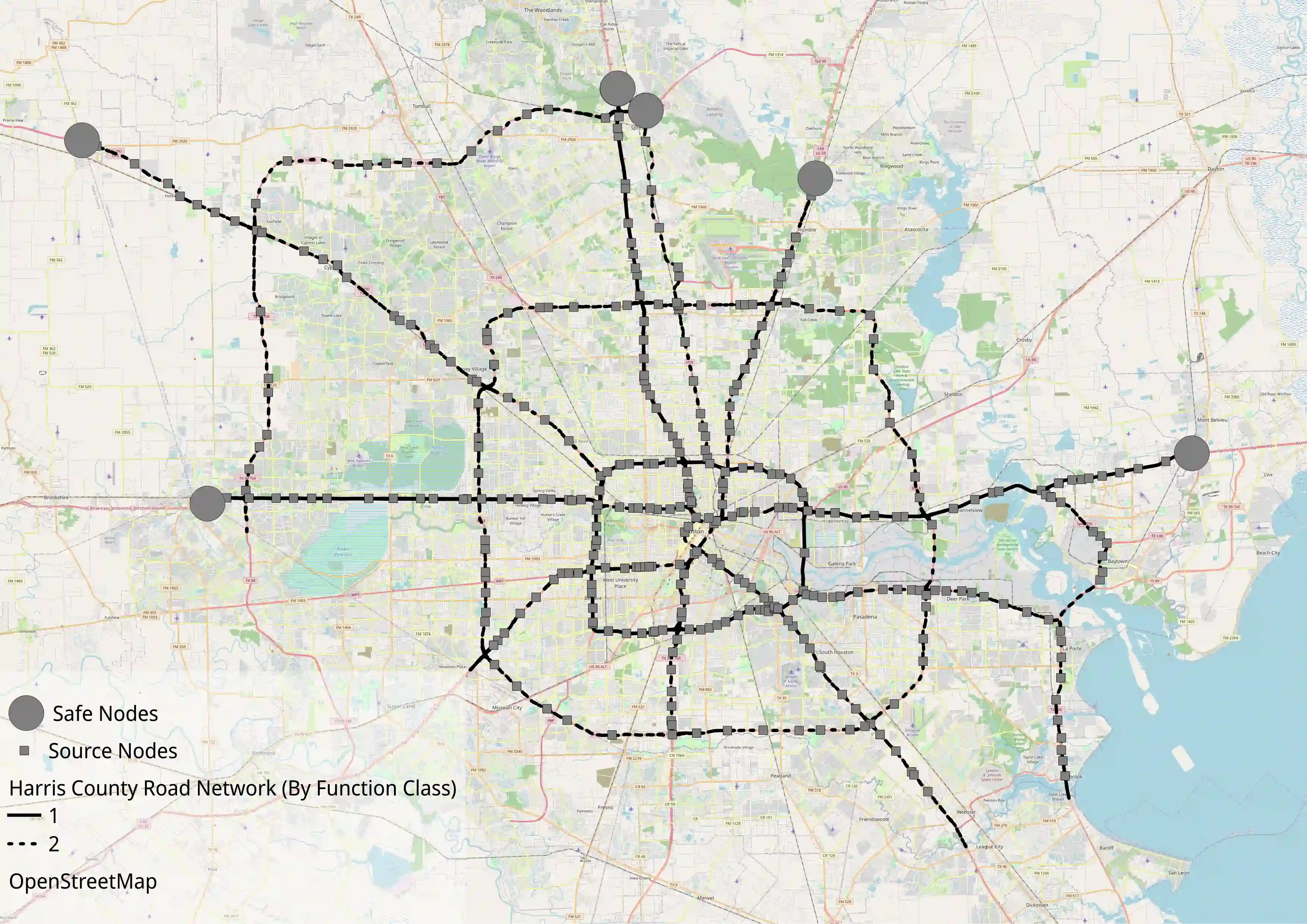
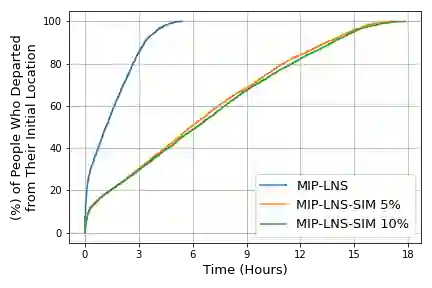
Evacuation planning is a crucial part of disaster management where the goal is to relocate people to safety and minimize casualties. Every evacuation plan has two essential components: routing and scheduling. However, joint optimization of these two components with objectives such as minimizing average evacuation time or evacuation completion time, is a computationally hard problem. To approach it, we present MIP-LNS, a scalable optimization method that utilizes heuristic search with mathematical optimization and can optimize a variety of objective functions. We also present the method MIP-LNS-SIM, where we further combine an agent-based model together with MIP-LNS to more accurately estimate the delay on roads due to congestion. We use real-world road network and population data from Harris County in Houston, Texas, and apply our methods to find evacuation routes and schedule for the area. We show that, within a given time limit, MIP-LNS finds better solutions than existing methods in terms of average evacuation time, evacuation completion time and optimality guarantee of the solutions. We also perform experiments with MIP-LNS-SIM to show its efficacy in estimating delays in the road network due to congestion by using an agent based model. Our results show that MIP-LNS-SIM can find efficient evacuation plans, and at the same time provide an estimate of the evacuation completion time for the given plan with a small percent error.
翻译:疏散规划是灾害管理中的关键环节,其目标是将人员转移至安全区域并最大限度减少伤亡。每项疏散计划包含两个核心组成部分:路径规划与时间调度。然而,以最小化平均疏散时间或疏散完成时间为目标,对这两个部分进行联合优化属于计算难题。为解决这一问题,我们提出MIP-LNS——一种可扩展的优化方法,该方法将启发式搜索与数学优化相结合,并能优化多种目标函数。此外,我们进一步提出MIP-LNS-SIM方法,该方法将智能体模型与MIP-LNS相结合,以更精确地估计道路拥堵导致的延误。我们采用得克萨斯州休斯顿哈里斯县的真实道路网络与人口数据,应用上述方法为该区域制定疏散路径与时间表。实验表明,在给定时间限制内,MIP-LNS在平均疏散时间、疏散完成时间及解的最优性保证方面均优于现有方法。我们还通过基于智能体模型模拟道路网络拥堵延误的实验,验证了MIP-LNS-SIM的有效性。结果表明,MIP-LNS-SIM能够制定高效的疏散计划,同时以较小百分比误差提供该计划的预估疏散完成时间。






相关内容





 微信扫码咨询专知VIP会员