

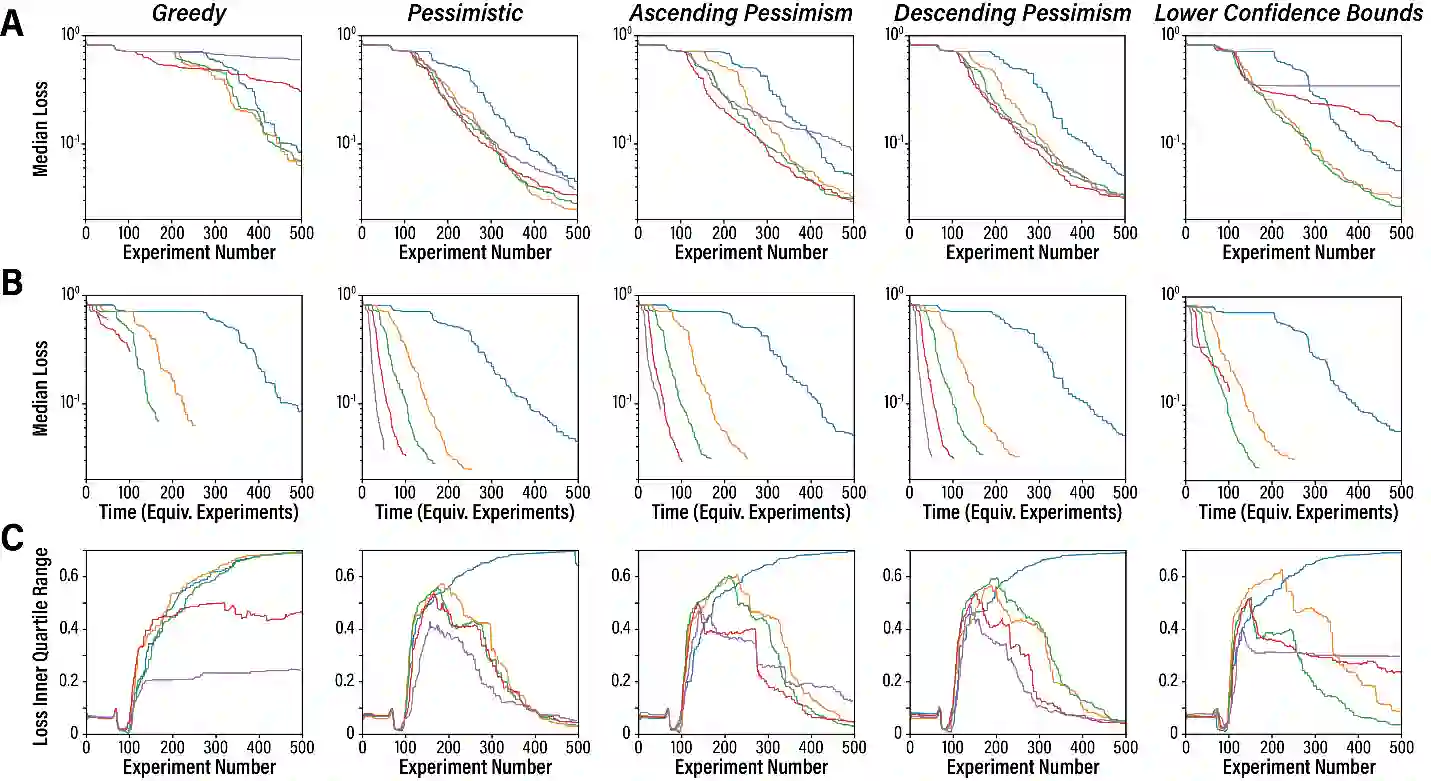
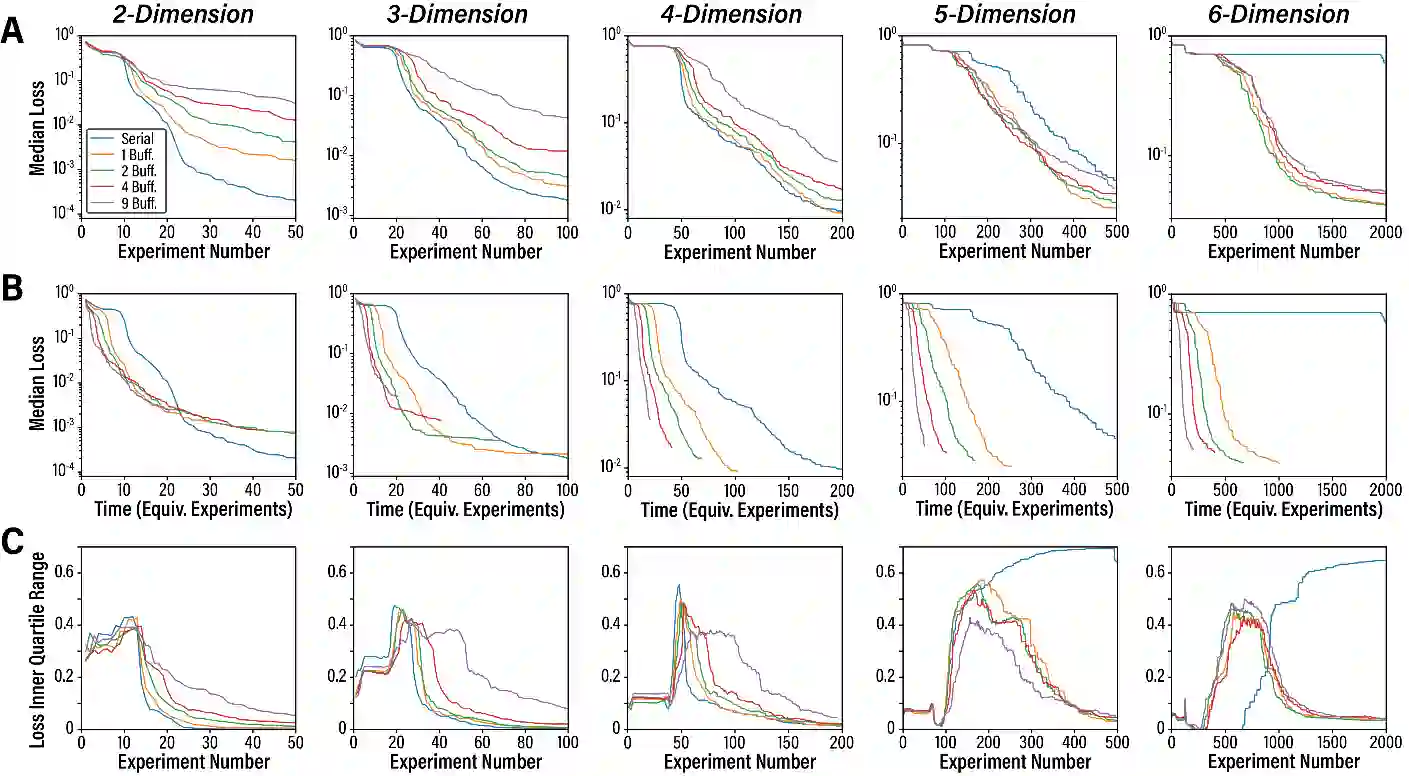
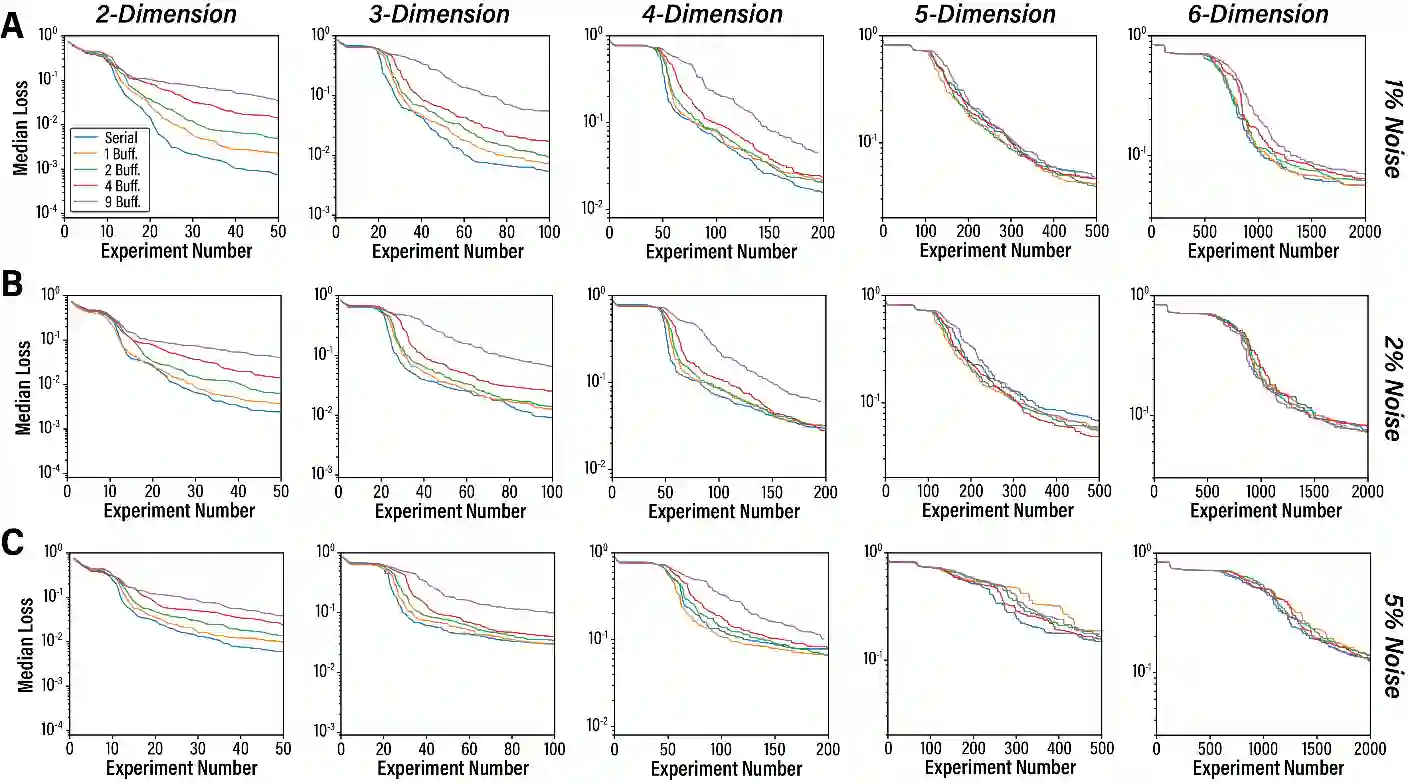
Asynchronous Bayesian optimization is a recently implemented technique that allows for parallel operation of experimental systems and disjointed workflows. Contrasting with serial Bayesian optimization which individually selects experiments one at a time after conducting a measurement for each experiment, asynchronous policies sequentially assign multiple experiments before measurements can be taken and evaluate new measurements continuously as they are made available. This technique allows for faster data generation and therefore faster optimization of an experimental space. This work extends the capabilities of asynchronous optimization methods beyond prior studies by evaluating four additional policies that incorporate pessimistic predictions in the training data set. Combined with a conventional greedy policy, the five total policies were evaluated in a simulated environment and benchmarked with serial sampling. Under some conditions and parameter space dimensionalities, the pessimistic asynchronous policy reached optimum experimental conditions in significantly fewer experiments than equivalent serial policies and proved to be less susceptible to convergence onto local optima at higher dimensions. Without accounting for the faster sampling rate, the pessimistic asynchronous algorithm presented in this work could result in more efficient algorithm driven optimization of high-cost experimental spaces. Accounting for sampling rate, the presented asynchronous algorithm could allow for faster optimization in experimental spaces where multiple experiments can be run before results are collected.
翻译:异步贝叶斯优化是近期实现的一种技术,它允许实验系统的并行运行和非连续工作流程。与串行贝叶斯优化(在完成每个实验测量后逐个选择实验)不同,异步策略在测量结果产生前顺序分配多个实验,并在新测量结果可用时持续进行评估。该技术能够加速数据生成,从而更快地实现实验空间的优化。本研究通过评估四种在训练数据集中融入悲观预测的新策略,将异步优化方法的能力扩展到现有研究之外。结合传统的贪婪策略,我们在模拟环境中对全部五种策略进行了评估,并以串行采样作为基准。在某些条件和参数空间维度下,悲观异步策略达到最优实验条件所需的实验次数显著少于等效串行策略,并在高维空间中表现出更不易陷入局部最优解的特性。若不考虑更快的采样速率,本研究所提出的悲观异步算法可在高成本实验空间中实现更高效的算法驱动优化。若考虑采样速率,该异步算法能够在允许先运行多个实验再收集结果的实验空间中实现更快速的优化。





相关内容


 微信扫码咨询专知VIP会员