

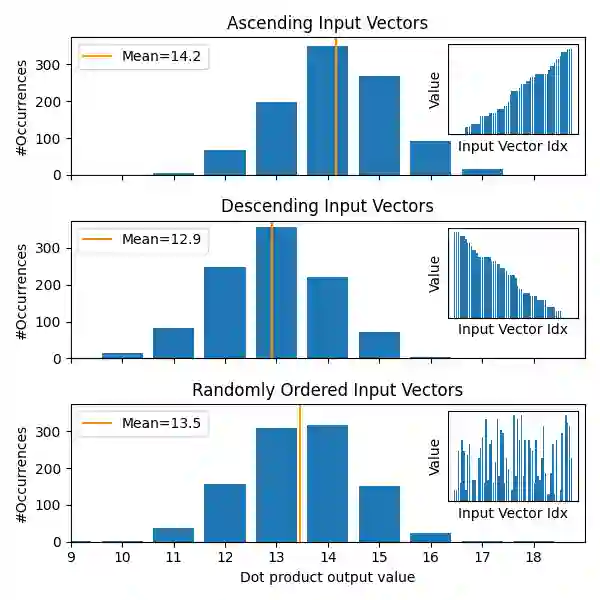
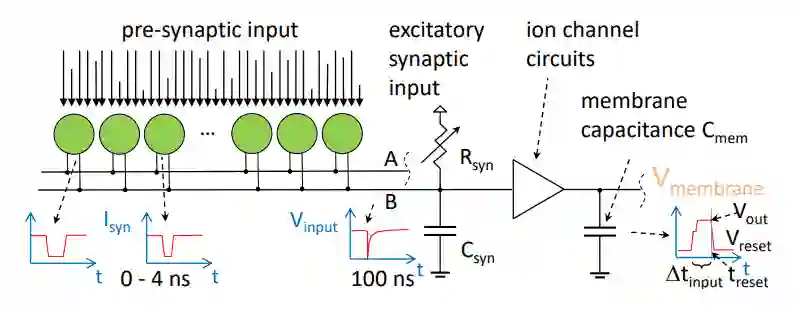
The energy efficiency of analog forms of computing makes it one of the most promising candidates to deploy resource-hungry machine learning tasks on resource-constrained system such as mobile or embedded devices. However, it is well known that for analog computations the safety net of discretization is missing, thus all analog computations are exposed to a variety of imperfections of corresponding implementations. Examples include non-linearities, saturation effect and various forms of noise. In this work, we observe that the ordering of input operands of an analog operation also has an impact on the output result, which essentially makes analog computations non-associative, even though the underlying operation might be mathematically associative. We conduct a simple test by creating a model of a real analog processor which captures such ordering effects. With this model we assess the importance of ordering by comparing the test accuracy of a neural network for keyword spotting, which is trained based either on an ordered model, on a non-ordered variant, and on real hardware. The results prove the existence of ordering effects as well as their high impact, as neglecting ordering results in substantial accuracy drops.
翻译:模拟计算形式的能效使其成为在资源受限系统(如移动或嵌入式设备)上部署资源密集型机器学习任务的最有前途的候选方案之一。然而,众所周知,模拟计算缺乏离散化的安全保障,因此所有模拟计算都暴露于相应实现的各种缺陷之下。这些缺陷包括非线性、饱和效应以及各种形式的噪声。在本工作中,我们观察到模拟操作中输入操作数的顺序也会对输出结果产生影响,这实质上使模拟计算变得非结合,即使底层操作在数学上是结合的。我们通过创建一个能够捕捉此类顺序效应的真实模拟处理器模型进行简单测试。利用该模型,我们通过比较基于顺序模型、非顺序变体以及真实硬件训练的用于关键词识别的神经网络的测试精度,评估了顺序的重要性。结果证明了顺序效应的存在及其高影响性,因为忽略顺序会导致精度显著下降。




相关内容




 微信扫码咨询专知VIP会员