

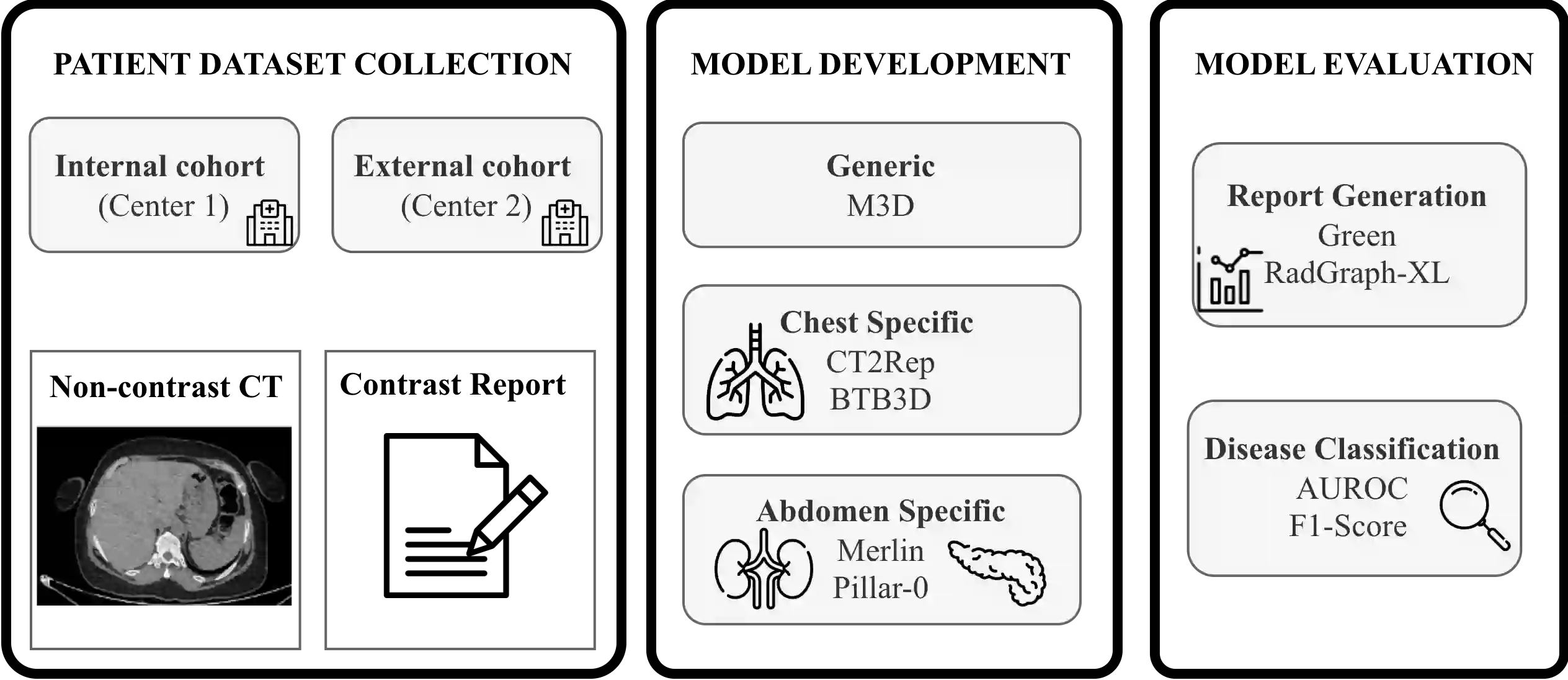
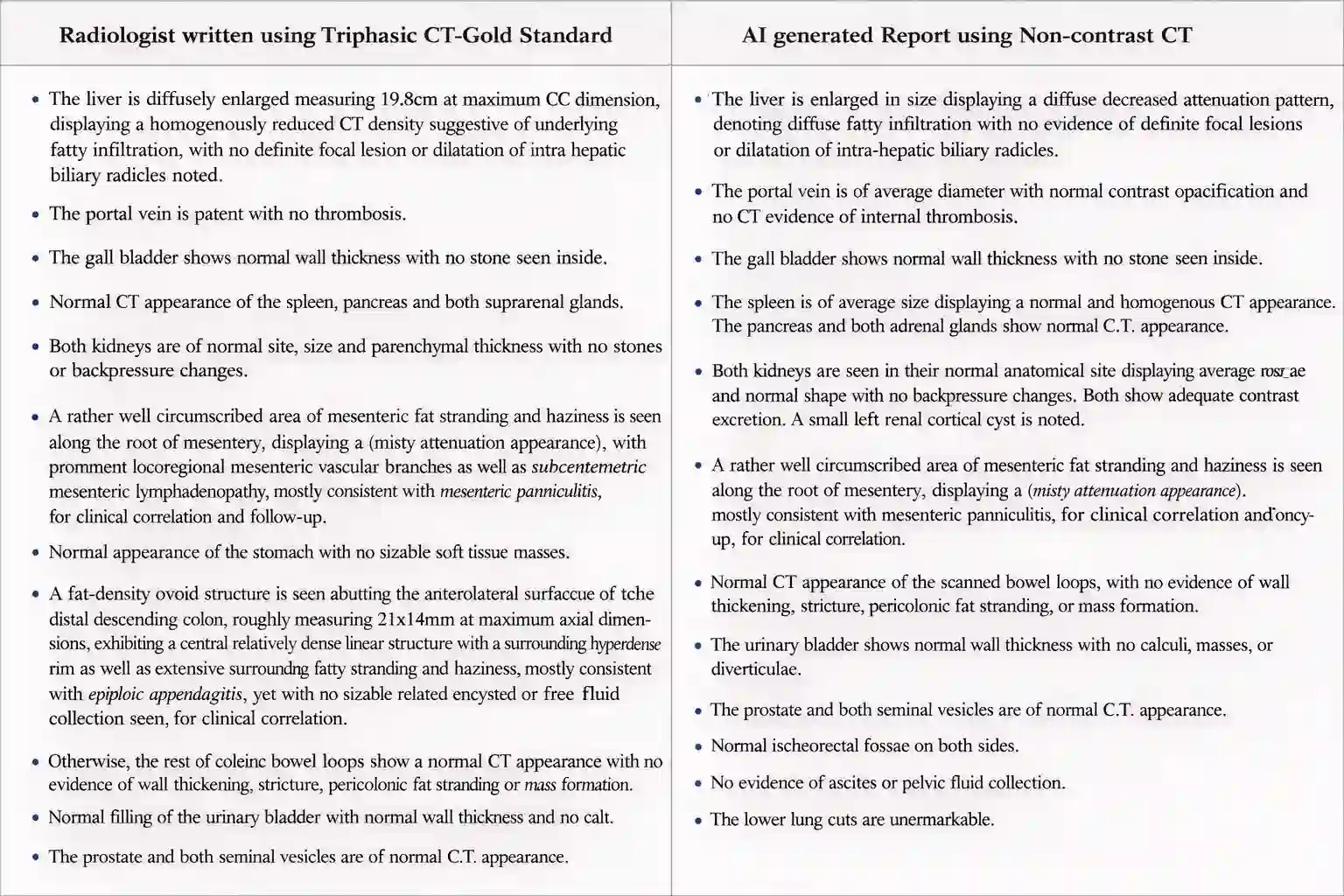
Multiphasic contrast-enhanced CT (CECT) is widely used for abdominal lesion characterization, yet it carries inherent risks of contrast-induced nephropathy, escalates acquisition burden, and heavily contributes to radiologist workload. To address these challenges, we introduce a novel multi-center benchmark for multi-organ abdominal disease diagnosis and automated radiology report generation, which learns to synthesize contrast-enhanced findings from single-phase non-contrast CT (NCCT). To support this, we curated a large-scale dataset of paired NCCT-CECT studies and their corresponding contrast-enhanced radiology reports from two centers, partitioned into internal sets and an external validation cohort. Under a unified evaluation protocol, we benchmarked five contemporary deep learning architectures encompassing chest-specific, abdomen-specific, and general-purpose multimodal domains. Extensive experiments demonstrate that NCCT retains diagnostic signals, achieving an average multi-organ AUC of 69.1% on the internal cohort and 63.1% on the external cohort, respectively. By releasing this dataset and standardized benchmark publicly, this study aims to catalyze future research into safer, resource-efficient, and globally accessible contrast-free abdominal imaging workflows. Code is available at: https://github.com/xmed-lab/TriALS-Report.
翻译:多期增强CT(CECT)广泛用于腹部病灶定性,但存在造影剂肾病风险、增加采集负担并显著加重放射科医师工作量。为应对这些挑战,我们提出一种新的多中心基准,用于多器官腹部疾病诊断与自动化放射报告生成,该基准学习从单期非增强CT(NCCT)合成增强检查所见。为此,我们从两个中心收集了配对NCCT-CECT研究及其对应增强放射报告的大规模数据集,划分为内部验证集和外部验证队列。在统一评估协议下,我们对五种涵盖胸部专用、腹部专用及通用多模态领域的当代深度学习架构进行了基准测试。大量实验表明,NCCT保留了诊断信号,在内部队列和外部队列中分别实现了平均多器官AUC为69.1%和63.1%。通过公开此数据集与标准化基准,本研究旨在推动更安全、资源高效且全球可及的免造影剂腹部影像工作流的未来研究。代码地址:https://github.com/xmed-lab/TriALS-Report




相关内容




 微信扫码咨询专知VIP会员