

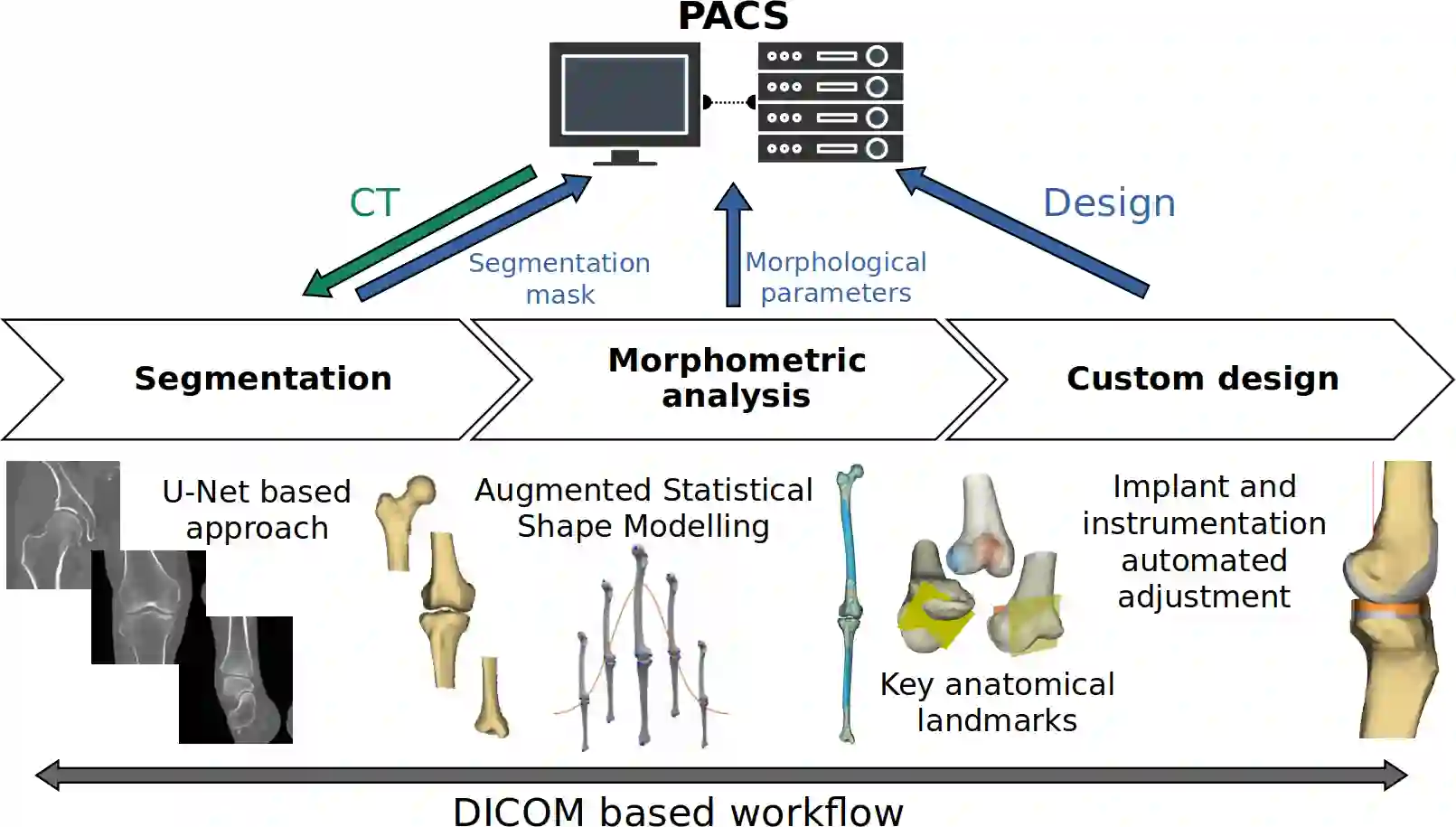
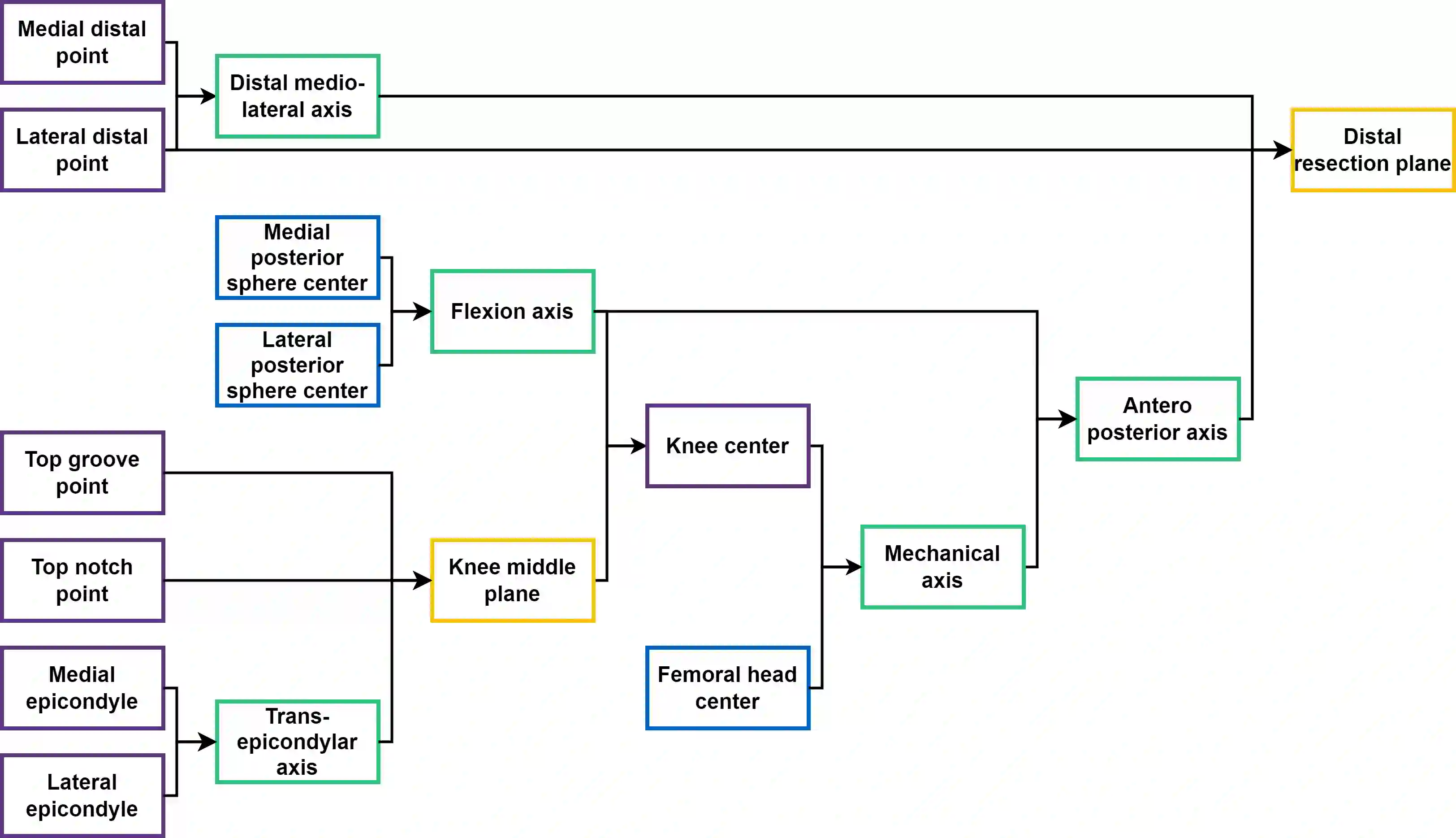
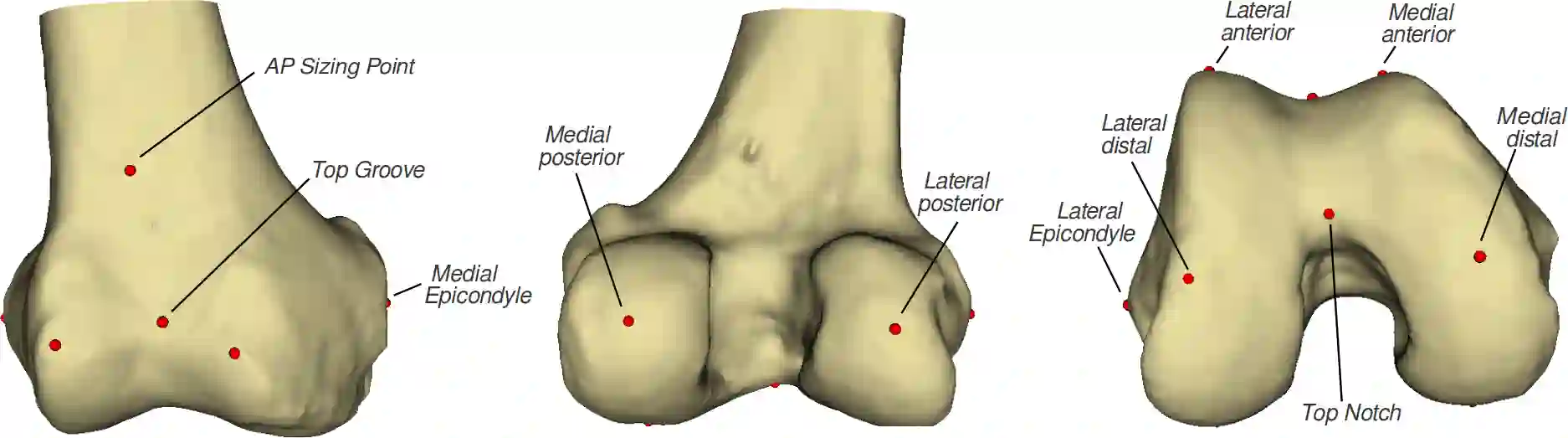
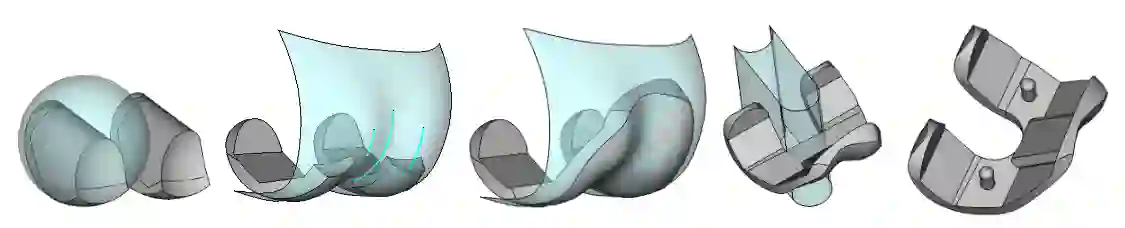
Arthroplasty is commonly performed to treat joint osteoarthritis, reducing pain and improving mobility. While arthroplasty has known several technical improvements, a significant share of patients are still unsatisfied with their surgery. Personalised arthroplasty improves surgical outcomes however current solutions require delays, making it difficult to integrate in clinical routine. We propose a fully automated workflow to design patient-specific implants, presented for total knee arthroplasty, the most widely performed arthroplasty in the world nowadays. The proposed pipeline first uses artificial neural networks to segment the proximal and distal extremities of the femur and tibia. Then the full bones are reconstructed using augmented statistical shape models, combining shape and landmarks information. Finally, 77 morphological parameters are computed to design patient-specific implants. The developed workflow has been trained using 91 CT scans of lower limb and evaluated on 41 CT scans manually segmented, in terms of accuracy and execution time. The workflow accuracy was $0.4\pm0.2mm$ for the segmentation, $1.2\pm0.4mm$ for the full bones reconstruction, and $2.8\pm2.2mm$ for the anatomical landmarks determination. The custom implants fitted the patients' anatomy with $0.6\pm0.2mm$ accuracy. The whole process from segmentation to implants' design lasted about 5 minutes. The proposed workflow allows for a fast and reliable personalisation of knee implants, directly from the patient CT image without requiring any manual intervention. It establishes a patient-specific pre-operative planning for TKA in a very short time making it easily available for all patients. Combined with efficient implant manufacturing techniques, this solution could help answer the growing number of arthroplasties while reducing complications and improving the patients' satisfaction.
翻译:关节成形术常用于治疗骨关节炎,以减轻疼痛并改善活动能力。尽管关节成形术已取得多项技术改进,但仍有相当比例的患者对手术效果不满意。个性化关节成形术可改善手术结果,然而现有解决方案耗时较长,难以融入临床常规流程。我们提出了一种全自动工作流,用于设计患者特异性植入物,并以当前全球实施最广泛的全膝关节置换术为例进行展示。该流程首先利用人工神经网络分割股骨和胫骨的近端与远端边缘,随后通过增强统计形状模型(融合形状与标志点信息)重建完整骨骼,最终计算77项形态学参数以设计患者特异性植入物。该工作流使用91例下肢CT扫描数据训练,并在41例手动分割的CT扫描上从精度和执行时间两方面进行评估。结果显示:分割精度为$0.4\pm0.2mm$,骨骼完整重建精度为$1.2\pm0.4mm$,解剖标志点确定精度为$2.8\pm2.2mm$。定制植入物与患者解剖结构的拟合精度达$0.6\pm0.2mm$。从分割到植入物设计的完整流程耗时约5分钟。本工作流可直接基于患者CT图像,无需任何人工干预即可实现快速可靠的膝关节植入物个性化设计,在极短时间内建立TKA的术前规划,使其易于普及所有患者。结合高效植入物制造技术,该方案有助于应对日益增长的关节成形术需求,同时减少并发症并提升患者满意度。




相关内容





 微信扫码咨询专知VIP会员