

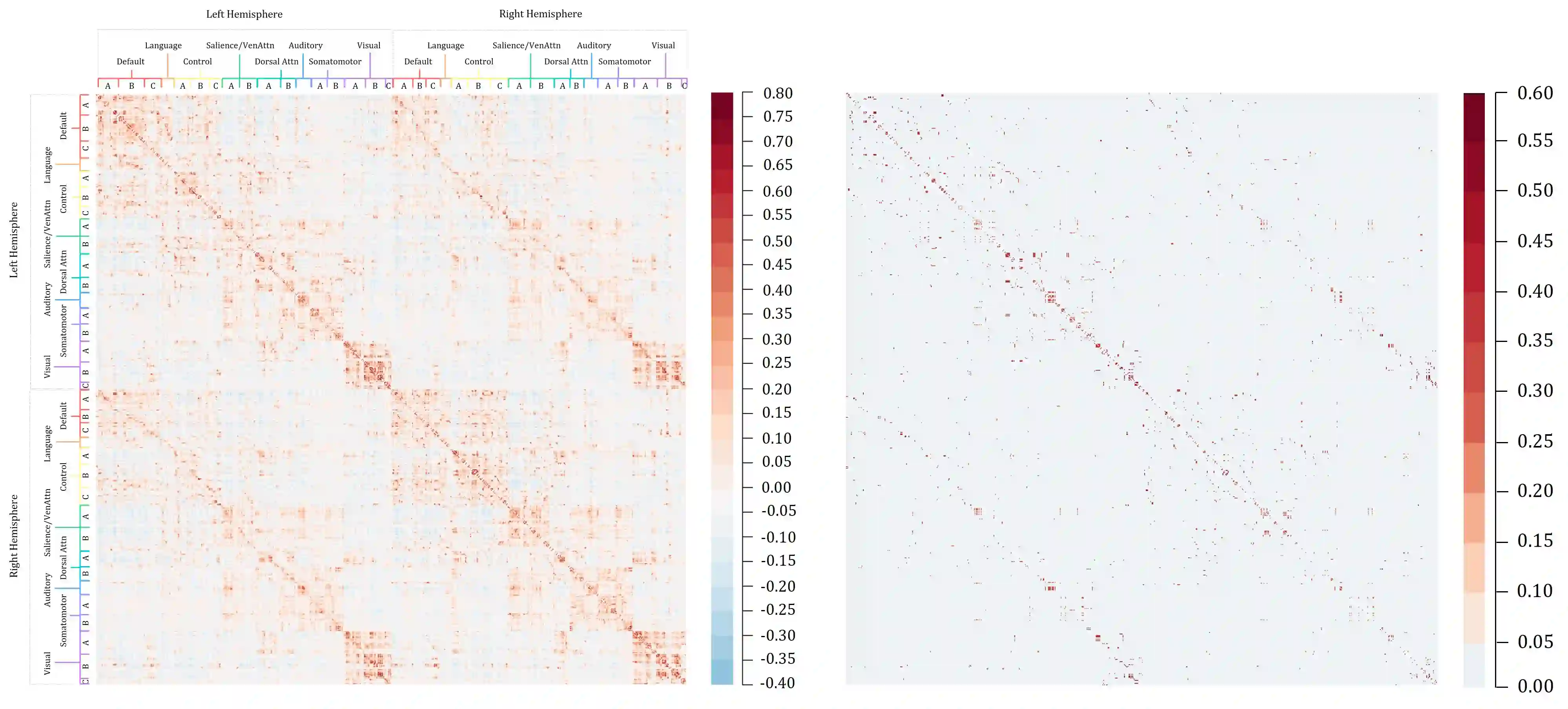
Motivated by the need to model the dependence between regions of interest in functional neuroconnectivity for efficient inference, we propose a new sampling-based Bayesian clustering approach for covariance structures of high-dimensional Gaussian outcomes. The key technique is based on a Dirichlet process that clusters covariance sub-matrices into independent groups of outcomes, thereby naturally inducing sparsity in the whole brain connectivity matrix. A new split-merge algorithm is employed to achieve convergence of the Markov chain that is shown empirically to recover both uniform and Dirichlet partitions with high accuracy. We investigate the empirical performance of the proposed method through extensive simulations. Finally, the proposed approach is used to group regions of interest into functionally independent groups in the Autism Brain Imaging Data Exchange participants with autism spectrum disorder and and co-occurring attention-deficit/hyperactivity disorder.
翻译:受功能性神经连接中感兴趣区域间依赖关系建模以实现高效推断的需求驱动,我们提出一种新的基于采样的贝叶斯聚类方法,用于高维高斯结果的协方差结构。关键技术基于狄利克雷过程,该过程将协方差子矩阵聚为独立的结果组,从而自然地在全脑连接矩阵中引入稀疏性。我们采用一种新的分裂-合并算法,以实现马尔可夫链的收敛,经验证明该算法能以高精度恢复均匀划分和狄利克雷划分。通过大量模拟实验,我们考察了所提方法的实证性能。最后,将该方法应用于自闭症脑成像数据交换项目中患有自闭症谱系障碍及共病注意力缺陷/多动障碍的参与者,将感兴趣区域划分为功能独立的组。




相关内容


 微信扫码咨询专知VIP会员