

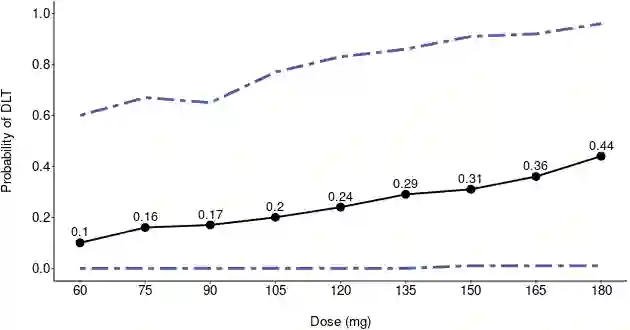
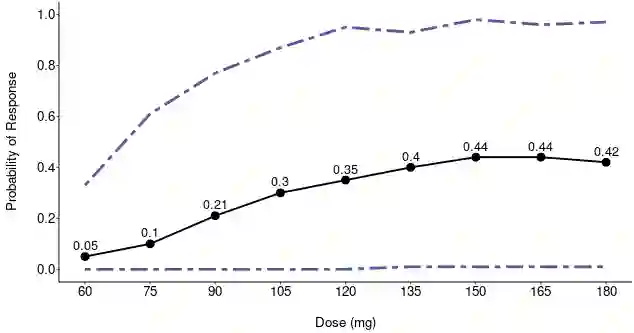
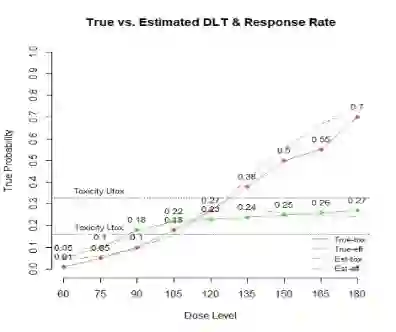
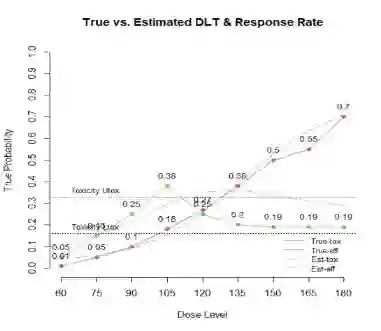
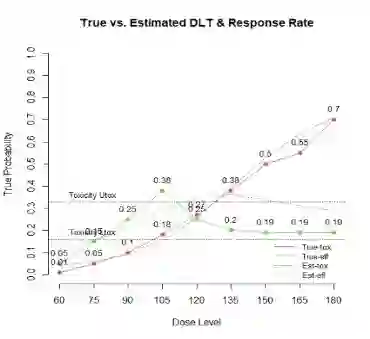
The primary objective of phase I oncology studies is to establish the safety profile of a new treatment and determine the maximum tolerated dose (MTD). This is motivated by the development of cytotoxic agents based on the underlying assumption that the higher the dose, the greater the likelihood of efficacy and toxicity. However, evidence from the recent development of cancer immunotherapies that aim to stimulate patients' immune systems to fight cancer challenges this assumption, particularly further escalation after a certain dose level might not necessarily increase the efficacy. Dose escalation study of molecular targeted agents (MTA) often does not only rely on the safety profile. In this paper, we propose a simple and flexible model that uses multivariate Gaussian latent variables to integrate toxicity endpoint and efficacy biomarker. This model can be easily extended to incorporate additional immune biomarkers. By simultaneously considering multiple outcomes, the proposed method is better at identifying the biologically optimal dose, which results in better decision-making. Simulation studies showed that the proposed method has desirable operating characteristics by determining the target dose with an optimal risk-benefit trade-off. We have also implemented our proposed method in a user-friendly R Shiny tool.
翻译:I期肿瘤学研究的主要目标是评估新疗法的安全性并确定最大耐受剂量(MTD)。这一目标源于细胞毒性药物的开发范式,其基本假设是剂量越高,疗效和毒性发生的可能性越大。然而,近期旨在通过刺激患者免疫系统对抗癌症的免疫疗法临床证据对该假设提出了挑战——特别是当剂量达到一定水平后继续递增可能不会显著提升疗效。分子靶向药物(MTA)的剂量递增研究通常不仅依赖安全性数据。本文提出了一种简洁且灵活的模型,该模型采用多元高斯潜变量整合毒性终点与疗效生物标志物,并可便捷地扩展纳入其他免疫生物标志物。通过同时考量多重结局,所提方法能更精准地识别具有最佳风险-收益平衡的生物最佳剂量,从而优化决策过程。模拟研究表明,该方法在确定目标剂量时能实现最优风险收益权衡,展现出理想的操作特性。此外,我们已将该方法部署为具有用户友好界面的R Shiny工具。




相关内容



 微信扫码咨询专知VIP会员