

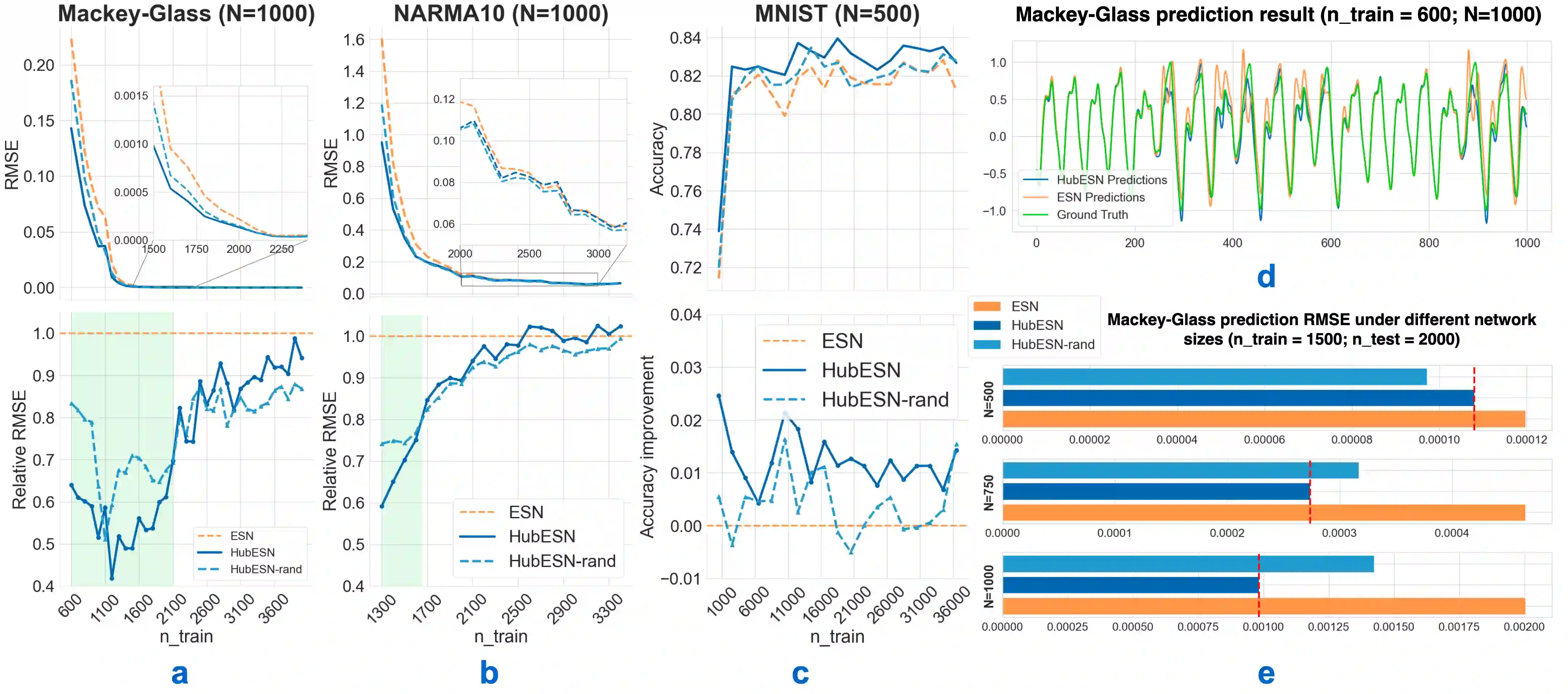
Hub structure, characterized by a few highly interconnected nodes surrounded by a larger number of nodes with fewer connections, is a prominent topological feature of biological brains, contributing to efficient information transfer and cognitive processing across various species. In this paper, a mathematical model of hub structure is presented. The proposed method is versatile and can be broadly applied to both computational neuroscience and Recurrent Neural Networks (RNNs) research. We employ the Echo State Network (ESN) as a means to investigate the mechanistic underpinnings of hub structures. Our findings demonstrate a substantial enhancement in performance upon incorporating the hub structure. Through comprehensive mechanistic analyses, we show that the hub structure improves model performance by facilitating efficient information processing and better feature extractions.
翻译:枢纽结构是生物大脑的一个显著拓扑特征,其特点是由少数高度互连的节点与大量连接较少的节点组成,有助于不同物种间的高效信息传递和认知处理。本文提出了一种枢纽结构的数学模型,该方法具有通用性,可广泛应用于计算神经科学和递归神经网络研究。我们采用回声状态网络作为研究枢纽结构机制基础的工具。研究结果表明,引入枢纽结构后,模型性能得到显著提升。通过全面的机制分析,我们证明枢纽结构通过促进高效信息处理和更好的特征提取来改善模型性能。






相关内容





 微信扫码咨询专知VIP会员