

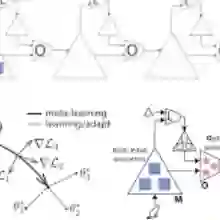
Meta-learning owns unique effectiveness and swiftness in tackling emerging tasks with limited data. Its broad applicability is revealed by viewing it as a bi-level optimization problem. The resultant algorithmic viewpoint however, faces scalability issues when the inner-level optimization relies on gradient-based iterations. Implicit differentiation has been considered to alleviate this challenge, but it is restricted to an isotropic Gaussian prior, and only favors deterministic meta-learning approaches. This work markedly mitigates the scalability bottleneck by cross-fertilizing the benefits of implicit differentiation to probabilistic Bayesian meta-learning. The novel implicit Bayesian meta-learning (iBaML) method not only broadens the scope of learnable priors, but also quantifies the associated uncertainty. Furthermore, the ultimate complexity is well controlled regardless of the inner-level optimization trajectory. Analytical error bounds are established to demonstrate the precision and efficiency of the generalized implicit gradient over the explicit one. Extensive numerical tests are also carried out to empirically validate the performance of the proposed method.
翻译:元学习在处理具有有限数据的新任务时展现出独特的有效性和快速性。通过将其视为双层优化问题,可以揭示其广泛适用性。然而,由此得出的算法观点在内层优化依赖于基于梯度的迭代时会面临可扩展性问题。隐式微分已被考虑用于缓解这一挑战,但它局限于各向同性高斯先验,且仅适用于确定性元学习方法。本研究通过将隐式微分的优势与概率贝叶斯元学习交叉融合,显著缓解了可扩展性瓶颈。所提出的新型隐式贝叶斯元学习方法不仅拓宽了可学习先验的范围,还能量化相关的不确定性。此外,无论内层优化轨迹如何,最终复杂度都得到了良好控制。建立了分析误差界以证明广义隐式梯度相比显式梯度的精确性和高效性。还开展了大量数值实验,以实证验证所提方法的性能。




相关内容


 微信扫码咨询专知VIP会员