

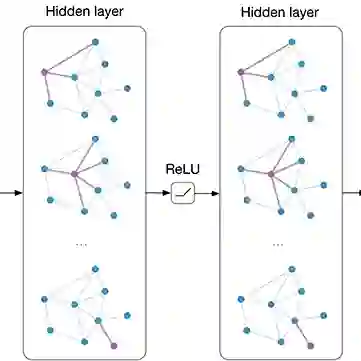
Graph Neural Networks (GNNs) are limited in their propagation operators. In many cases, these operators often contain non-negative elements only and are shared across channels, limiting the expressiveness of GNNs. Moreover, some GNNs suffer from over-smoothing, limiting their depth. On the other hand, Convolutional Neural Networks (CNNs) can learn diverse propagation filters, and phenomena like over-smoothing are typically not apparent in CNNs. In this paper, we bridge these gaps by incorporating trainable channel-wise weighting factors $\omega$ to learn and mix multiple smoothing and sharpening propagation operators at each layer. Our generic method is called $\omega$GNN, and is easy to implement. We study two variants: $\omega$GCN and $\omega$GAT. For $\omega$GCN, we theoretically analyse its behaviour and the impact of $\omega$ on the obtained node features. Our experiments confirm these findings, demonstrating and explaining how both variants do not over-smooth. Additionally, we experiment with 15 real-world datasets on node- and graph-classification tasks, where our $\omega$GCN and $\omega$GAT perform on par with state-of-the-art methods.
翻译:图神经网络(GNN)在其传播算子方面存在局限性。在许多情况下,这些算子通常仅包含非负元素并在通道间共享,从而限制了GNN的表达能力。此外,部分GNN存在过平滑问题,限制了网络深度。相比之下,卷积神经网络(CNN)能够学习多样化的传播滤波器,且过平滑等现象在CNN中通常不显著。本文通过引入可训练的通道级权重因子$\omega$,在每一层中学习并混合多个平滑与锐化传播算子,从而弥合这些差距。我们的通用方法名为$\omega$GNN,易于实现。我们研究了两种变体:$\omega$GCN和$\omega$GAT。对于$\omega$GCN,我们从理论上分析了其行为及$\omega$对节点特征的影响。实验验证了这些理论发现,并展示和解释了两种变体如何避免过平滑。此外,我们在15个真实世界数据集上进行了节点分类和图分类任务实验,结果表明我们的$\omega$GCN和$\omega$GAT性能与最先进方法相当。




相关内容




 微信扫码咨询专知VIP会员