

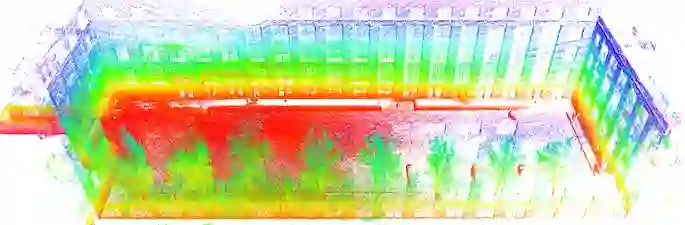
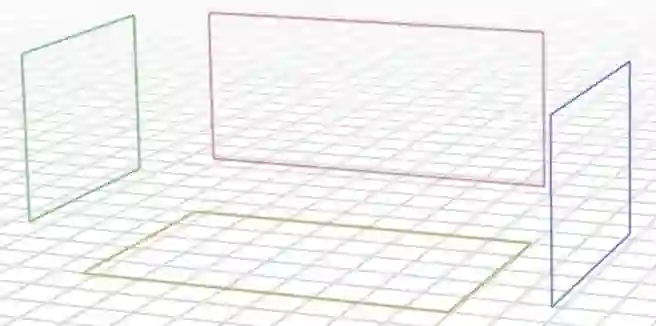
As a crucial infrastructure of intelligent mobile robots, LiDAR-Inertial odometry (LIO) provides the basic capability of state estimation by tracking LiDAR scans. The high-accuracy tracking generally involves the kNN search, which is used with minimizing the point-to-plane distance. The cost for this, however, is maintaining a large local map and performing kNN plane fit for each point. In this work, we reduce both time and space complexity of LIO by saving these unnecessary costs. Technically, we design a plane pre-fitting (PPF) pipeline to track the basic skeleton of the 3D scene. In PPF, planes are not fitted individually for each scan, let alone for each point, but are updated incrementally as the scene 'flows'. Unlike kNN, the PPF is more robust to noisy and non-strict planes with our iterative Principal Component Analyse (iPCA) refinement. Moreover, a simple yet effective sandwich layer is introduced to eliminate false point-to-plane matches. Our method was extensively tested on a total number of 22 sequences across 5 open datasets, and evaluated in 3 existing state-of-the-art LIO systems. By contrast, LIO-PPF can consume only 36% of the original local map size to achieve up to 4x faster residual computing and 1.92x overall FPS, while maintaining the same level of accuracy. We fully open source our implementation at https://github.com/xingyuuchen/LIO-PPF.
翻译:作为智能移动机器人的关键基础设施,LiDAR-惯性里程计(LIO)通过跟踪LiDAR扫描提供状态估计的基本能力。高精度跟踪通常涉及kNN搜索,并结合最小化点到平面距离使用。然而,其代价是维护大型局部地图并对每个点执行kNN平面拟合。本研究通过节省这些不必要的开销,降低了LIO的时间与空间复杂度。具体技术上,我们设计了一种平面预拟合(PPF)管线,用于跟踪三维场景的基本骨架。在PPF中,平面并非为每次扫描单独拟合(更非针对每个点),而是随着场景“流动”增量更新。与kNN不同,PPF凭借我们的迭代主成分分析(iPCA)细化方法,对含噪声及非严格平面具有更强的鲁棒性。此外,我们引入了一种简单而有效的夹层结构,用于消除错误的点到平面匹配。我们的方法在5个开放数据集共22个序列上进行了广泛测试,并在3个现有最先进LIO系统中进行了评估。相比较而言,LIO-PPF仅需消耗原始局部地图大小的36%,即可实现高达4倍的残差计算加速和1.92倍的整体帧率提升,同时保持同等精度。我们已在https://github.com/xingyuuchen/LIO-PPF 完全开源实现代码。






相关内容





 微信扫码咨询专知VIP会员