

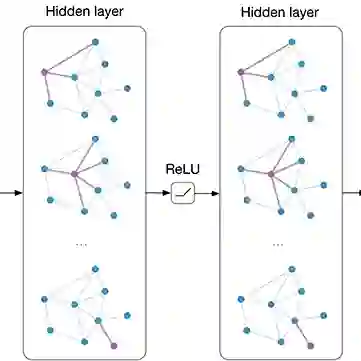
Storm surge forecasting remains a critical challenge in mitigating the impacts of tropical cyclones on coastal regions, particularly given recent trends of rapid intensification and increasing nearshore storm activity. Traditional high fidelity numerical models such as ADCIRC, while robust, are often hindered by inevitable uncertainties arising from various sources. To address these challenges, this study introduces StormNet, a spatio-temporal graph neural network (GNN) designed for bias correction of storm surge forecasts. StormNet integrates graph convolutional (GCN) and graph attention (GAT) mechanisms with long short-term memory (LSTM) components to capture complex spatial and temporal dependencies among water-level gauge stations. The model was trained using historical hurricane data from the U.S. Gulf Coast and evaluated on Hurricane Idalia (2023). Results demonstrate that StormNet can effectively reduce the root mean square error (RMSE) in water-level predictions by more than 70\% for 48-hour forecasts and above 50\% for 72-hour forecasts, as well as outperform a sequential LSTM baseline, particularly for longer prediction horizons. The model also exhibits low training time, enhancing its applicability in real-time operational forecasting systems. Overall, StormNet provides a computationally efficient and physically meaningful framework for improving storm surge prediction accuracy and reliability during extreme weather events.
翻译:风暴潮预报在减轻热带气旋对沿海地区的影响方面仍是一项关键挑战,尤其是近年来热带气旋快速增强和近岸活动增加的趋势下。传统的ADCIRC等高保真数值模型虽然稳健,但常受多种来源的不可避免的不确定性所困扰。为应对这些挑战,本研究提出了StormNet——一种用于风暴潮预报偏差校正的时空图神经网络。StormNet将图卷积和图注意力机制与长短期记忆组件相融合,以捕捉水位监测站之间复杂的时空依赖关系。该模型利用美国墨西哥湾沿岸的历史飓风数据进行训练,并在飓风伊达利亚(2023年)上进行了评估。结果表明,StormNet能有效降低水位预测的均方根误差,48小时预报降低超过70%,72小时预报降低超过50%,且优于序列化LSTM基线模型,尤其是在较长预测时间范围内。该模型训练时间短,增强了其在实时业务化预报系统中的适用性。总体而言,StormNet为提升极端天气事件期间风暴潮预报的准确性与可靠性提供了一种计算高效且具有物理意义的框架。




相关内容



 微信扫码咨询专知VIP会员