

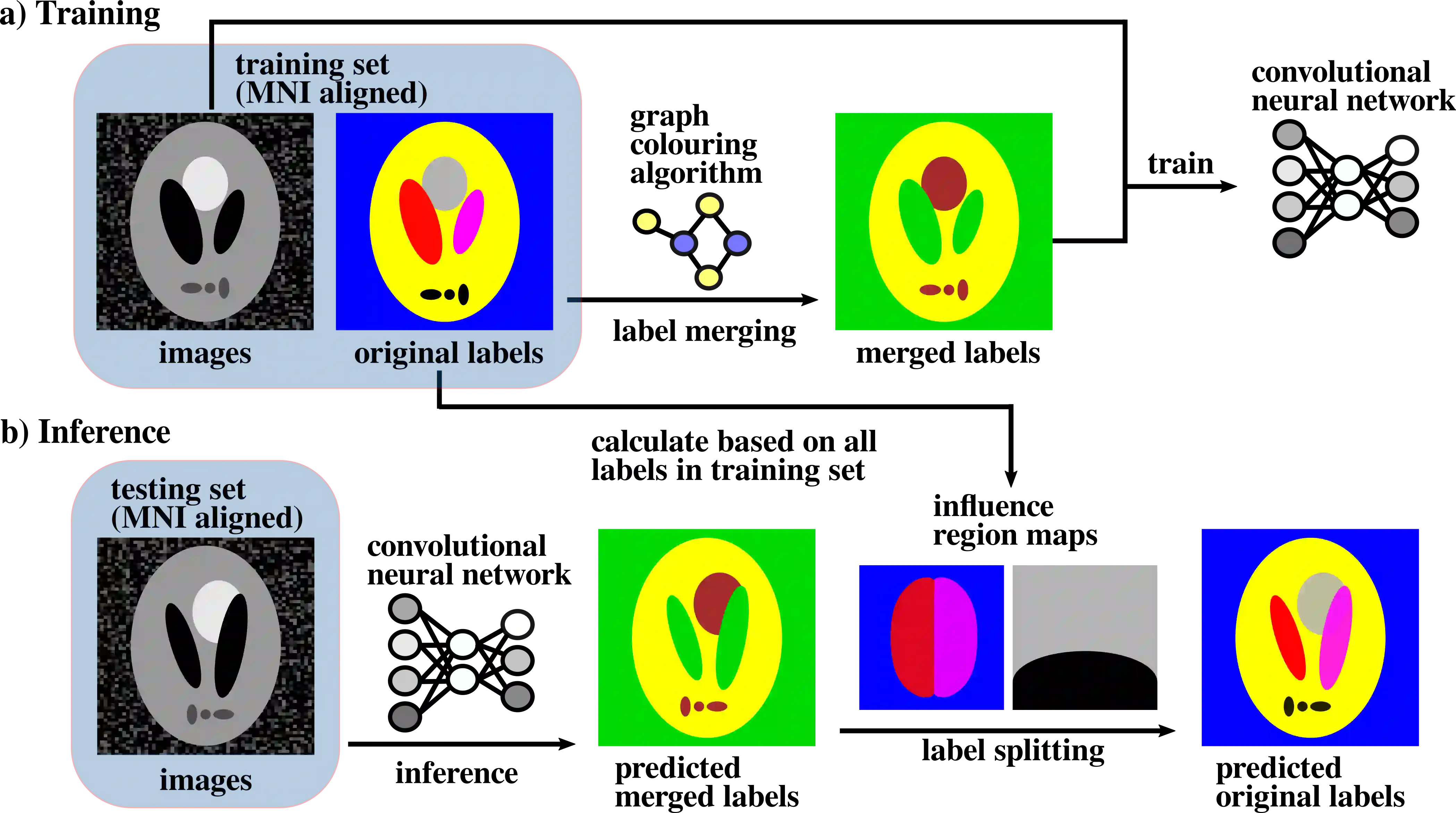
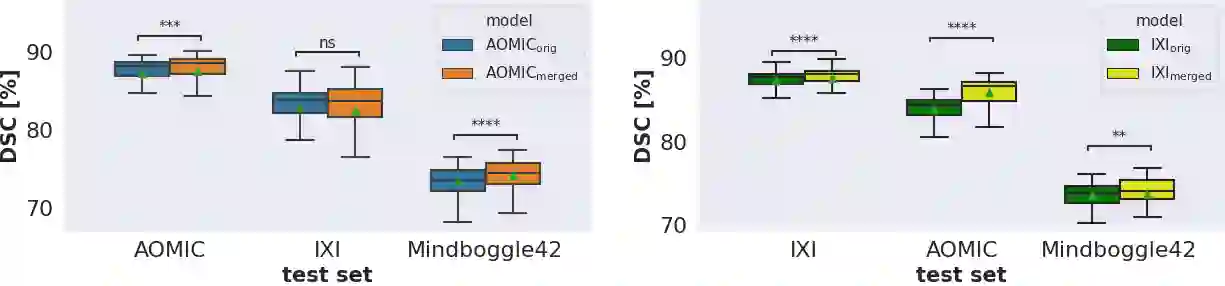
Whole brain parcellation requires inferring hundreds of segmentation labels in large image volumes and thus presents significant practical challenges for deep learning approaches. We introduce label merge-and-split, a method that first greatly reduces the effective number of labels required for learning-based whole brain parcellation and then recovers original labels. Using a greedy graph colouring algorithm, our method automatically groups and merges multiple spatially separate labels prior to model training and inference. The merged labels may be semantically unrelated. A deep learning model is trained to predict merged labels. At inference time, original labels are restored using atlas-based influence regions. In our experiments, the proposed approach reduces the number of labels by up to 68% while achieving segmentation accuracy comparable to the baseline method without label merging and splitting. Moreover, model training and inference times as well as GPU memory requirements were reduced significantly. The proposed method can be applied to all semantic segmentation tasks with a large number of spatially separate classes within an atlas-based prior.
翻译:全脑分割需要在大型图像体积中推断数百个分割标签,因此对深度学习方法提出了重大的实际挑战。我们提出标签合并与分割方法,该方法首先大幅减少基于学习的全脑分割所需的有效标签数量,随后恢复原始标签。通过使用贪心图着色算法,我们的方法在模型训练与推理前自动对多个空间分离的标签进行分组与合并。合并后的标签在语义上可能无关。训练深度学习模型以预测合并后的标签。在推理阶段,通过基于图谱的影响区域恢复原始标签。实验结果表明,所提方法在保持与未进行标签合并分割的基线方法相当的分割精度的同时,将标签数量减少了最高达68%。此外,模型训练与推理时间以及GPU内存需求均显著降低。该方法可应用于所有具有基于图谱先验、且包含大量空间分离类别的语义分割任务。






相关内容



 微信扫码咨询专知VIP会员