

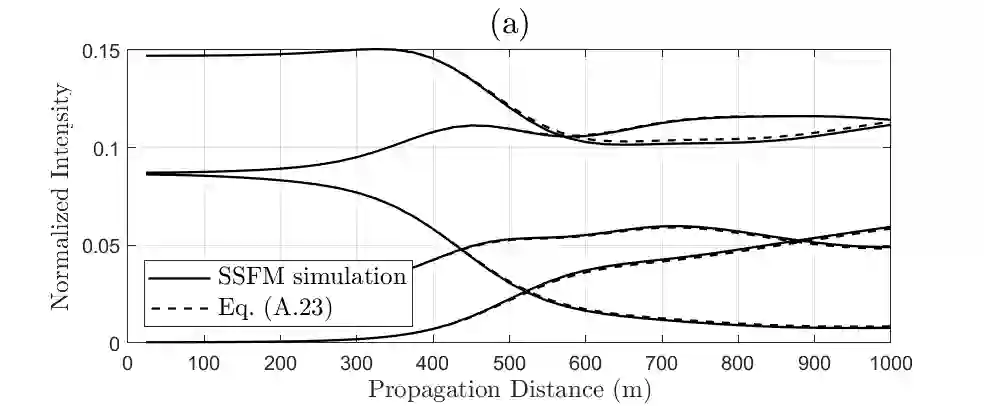
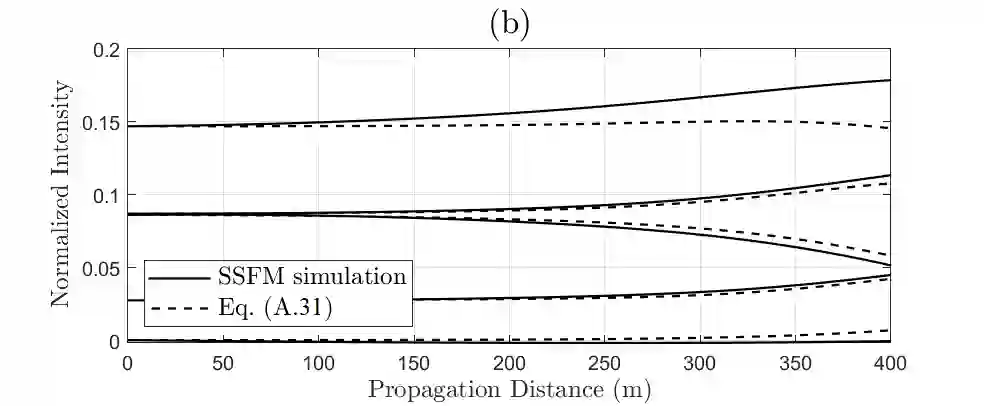
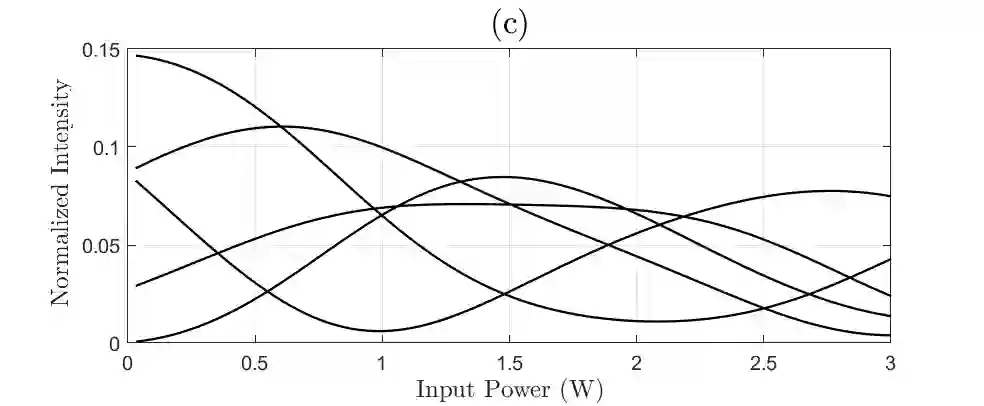
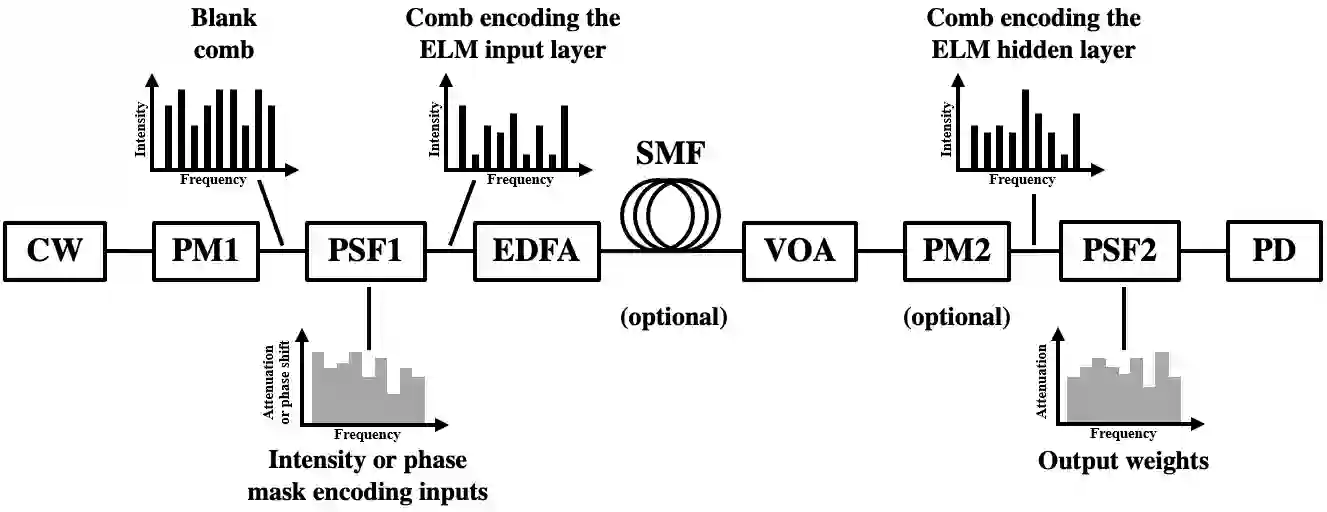
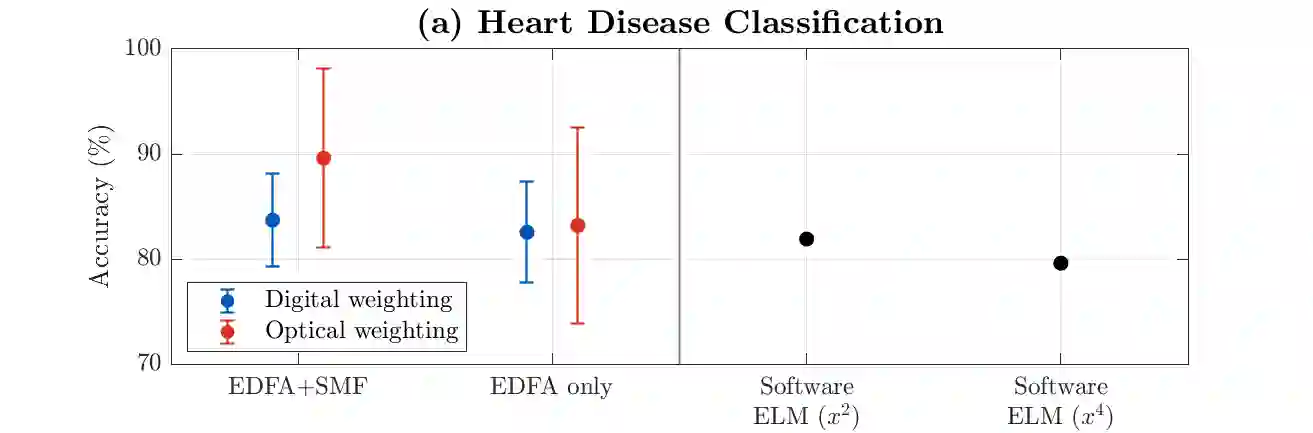
We provide a theoretical, numerical, and experimental investigation of the Kerr nonlinearity impact on the performance of a frequency-multiplexed Extreme Learning Machine (ELM). In such ELM, the neuron signals are encoded in the lines of a frequency comb. The Kerr nonlinearity facilitates the randomized neuron connections allowing for efficient information mixing. A programmable spectral filter applies the output weights. The system operates in a continuous-wave regime. Even at low input peak powers, the resulting weak Kerr nonlinearity is sufficient to significantly boost the performance on several tasks. This boost already arises when one uses only the very small Kerr nonlinearity present in a 20-meter long erbium-doped fiber amplifier. In contrast, a subsequent propagation in 540 meters of a single-mode fiber improves the performance only slightly, whereas additional information mixing with a phase modulator does not result in a further improvement at all. We introduce a model to show that, in frequency-multiplexed ELMs, the Kerr nonlinearity mixes information via four-wave mixing, rather than via self- or cross-phase modulation. At low powers, this effect is quartic in the comb-line amplitudes. Numerical simulations validate our experimental results and interpretation.
翻译:我们从理论、数值模拟和实验三个维度研究了克尔非线性对频率复用极端学习机(ELM)性能的影响。在该ELM中,神经元信号编码于频率梳的梳齿线上。克尔非线性促进了随机神经元连接,实现了高效的信息混合。可编程光谱滤波器施加输出权重。系统工作在连续波模式下。即使在较低的输入峰值功率下,产生的弱克尔非线性也足以显著提升多项任务的性能。仅利用20米长掺铒光纤放大器中极小的克尔非线性即可获得这种性能提升。相比之下,随后在540米单模光纤中传输仅能略微改善性能,而使用相位调制器进行额外信息混合则完全无法带来进一步改善。我们建立了一个模型表明,在频率复用ELM中,克尔非线性通过四波混频(而非自相位调制或交叉相位调制)实现信息混合。在低功率条件下,该效应与频率梳梳齿幅度的四次方成正比。数值模拟验证了我们的实验结果和物理诠释。




相关内容




 微信扫码咨询专知VIP会员