

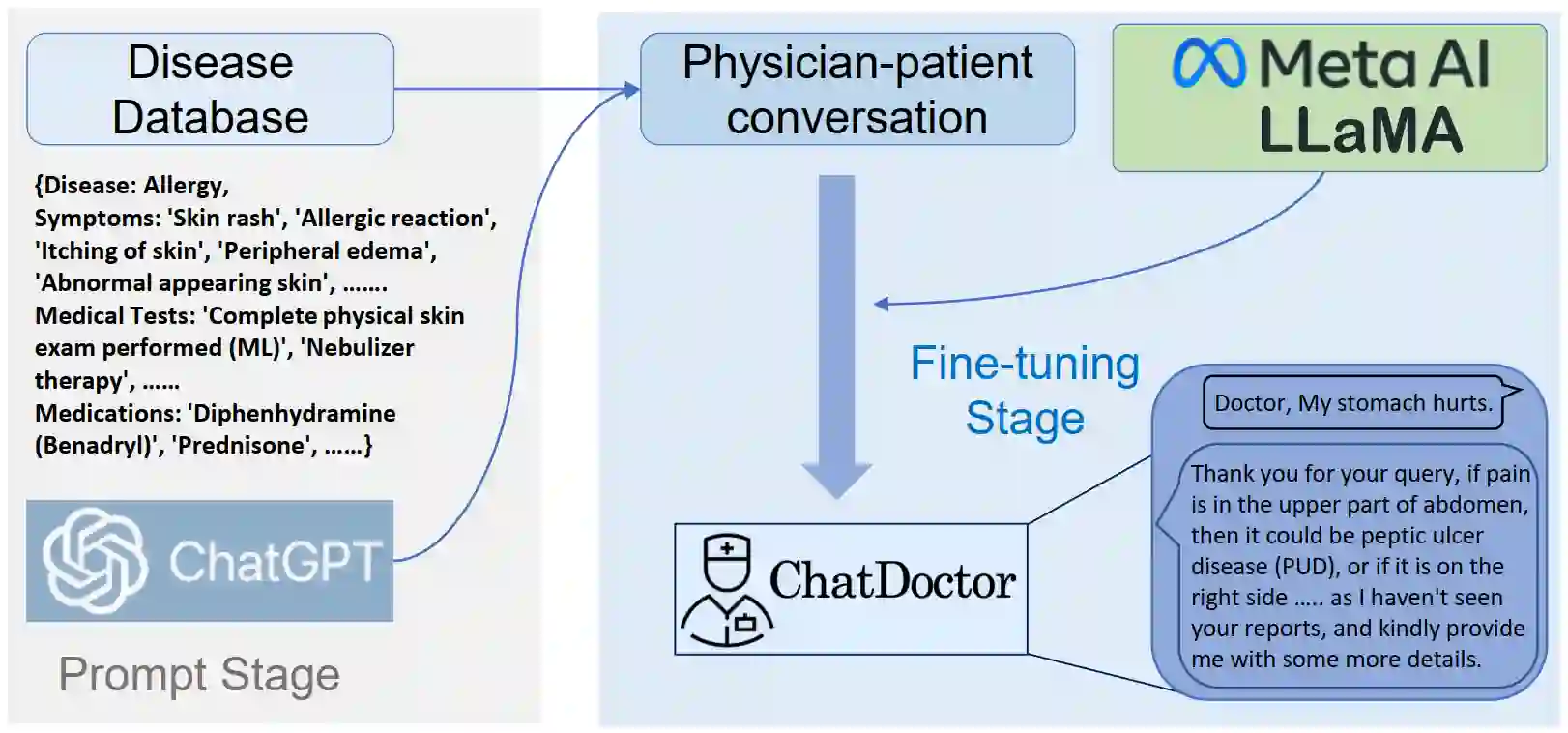
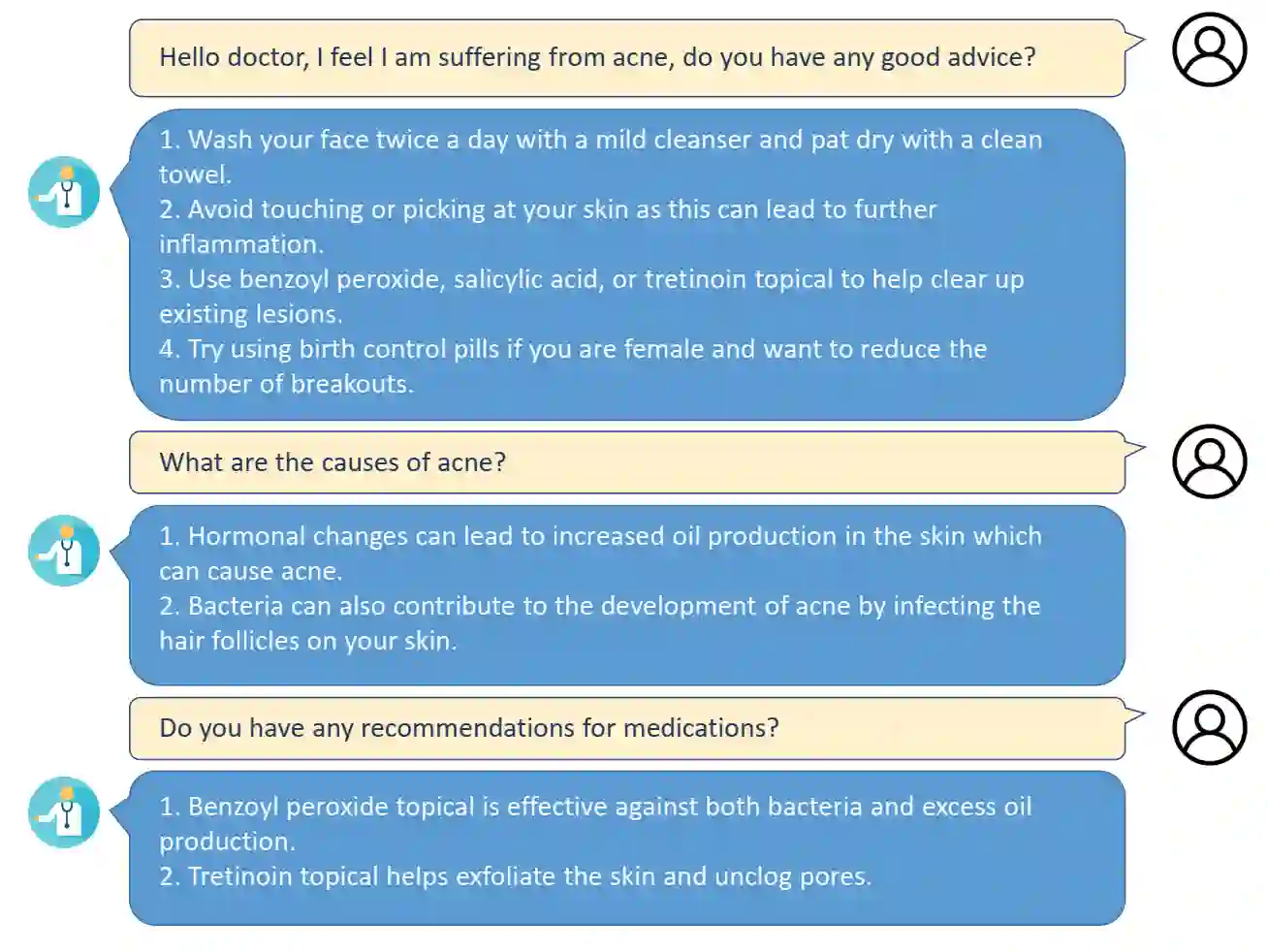
Recent large language models (LLMs) in the general domain, such as ChatGPT, have shown remarkable success in following instructions and producing human-like responses. However, such language models have not been tailored to the medical domain, resulting in poor answer accuracy and inability to give plausible recommendations for medical diagnosis, medications, etc. To address this issue, we collected more than 700 diseases and their corresponding symptoms, required medical tests, and recommended medications, from which we generated 5K doctor-patient conversations. By fine-tuning LLMs using these tailored doctor-patient conversations, the resulting models emerge with great potential to understand patients' needs, provide informed advice, and offer valuable assistance in a variety of medical-related fields. The integration of these advanced language models into healthcare can revolutionize the way healthcare professionals and patients communicate, ultimately improving the overall efficiency and quality of patient care and outcomes. In addition, we made public all the source codes, datasets, and model weights to facilitate the further development of dialogue models in the medical field. The training data, codes, and weights of this project are available at: https://github.com/Kent0n-Li/ChatDoctor.
翻译:近期通用领域的的大规模语言模型(如ChatGPT)在遵循指令和生成类人响应方面取得了显著成功。然而,这类语言模型尚未针对医学领域进行定制化调整,导致其答案准确性不足,且无法在医疗诊断、药物推荐等方面给出合理建议。为解决该问题,我们收集了700余种疾病及其对应症状、所需医学检查及推荐药物,由此生成了5000条医患对话。通过利用这些定制化医患对话对大规模语言模型进行微调,所得模型展现出理解患者需求、提供专业建议以及在多种医学相关领域提供宝贵辅助的巨大潜力。将这些先进语言模型整合到医疗体系中,有望彻底改变医护人员与患者的沟通方式,最终提升患者护理的整体效率、质量及预后效果。此外,我们公开了所有源代码、数据集及模型权重,以促进医学领域对话模型的进一步发展。本项目的训练数据、代码及权重可通过以下链接获取:https://github.com/Kent0n-Li/ChatDoctor。




相关内容

 微信扫码咨询专知VIP会员