

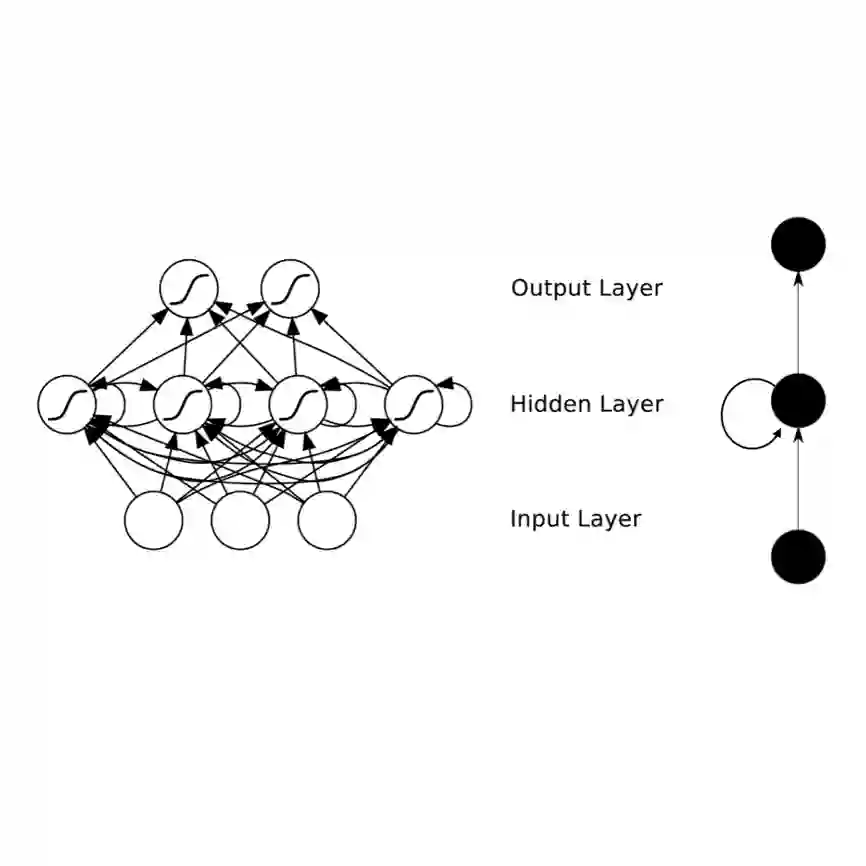
Recurrent Neural Networks (RNNs) are frequently used to model aspects of brain function and structure. In this work, we trained small fully-connected RNNs to perform temporal and flow control tasks with time-varying stimuli. Our results show that different RNNs can solve the same task by converging to different underlying dynamics and also how the performance gracefully degrades as either network size is decreased, interval duration is increased, or connectivity damage is increased. For the considered tasks, we explored how robust the network obtained after training can be according to task parameterization. In the process, we developed a framework that can be useful to parameterize other tasks of interest in computational neuroscience. Our results are useful to quantify different aspects of the models, which are normally used as black boxes and need to be understood in order to model the biological response of cerebral cortex areas.
翻译:循环神经网络(RNN)常被用于模拟脑功能与结构的相关特性。本研究训练了小型全连接RNN,使其在时变刺激条件下执行时间处理与流程控制任务。结果表明,不同RNN可通过收敛至不同底层动力学来求解同一任务,同时揭示了网络性能随网络规模缩减、时间间隔延长或连接性损伤增加而优雅退化的规律。针对所考察任务,我们探索了经训练的网络在不同任务参数化条件下的鲁棒性。在此过程中,我们构建了一个可用于参数化计算神经科学领域其他感兴趣任务的通用框架。本研究结果有助于量化通常被视为黑箱模型的多种特性,这对理解模型以模拟大脑皮层区域的生物响应具有重要意义。




相关内容



 微信扫码咨询专知VIP会员