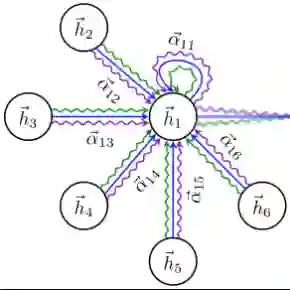
In the industrial Internet of Things, condition monitoring sensor signals from complex systems often exhibit strong nonlinear and stochastic spatial-temporal dynamics under varying operating conditions. Such complex dynamics make fault detection particularly challenging. Although previously proposed methods effectively model these dynamics, they often neglect the dynamic evolution of relationships between sensor signals. Undetected shifts in these relationships can potentially result in significant system failures. Another limitation is their inability to effectively distinguish between novel operating conditions and actual faults. To address this gap, we propose DyEdgeGAT (Dynamic Edge via Graph Attention), a novel approach capable of detecting various faults, especially those characterized by relationship changes at early stages, while distinguishing faults from novel operating conditions. DyEdgeGAT is a graph-based framework that provides a novel graph inference scheme for multivariate time series that dynamically constructs edges to represent and track the evolution of relationships between time series. Additionally, it addresses a commonly overlooked aspect: the cause-and-effect relationships within the system, such as between control inputs and measurements. By incorporating system-independent variables as contexts of operating conditions into node dynamics extraction, DyEdgeGAT enhances its robustness against novel operating conditions. We rigorously evaluate DyEdgeGAT's performance using both a synthetic dataset, designed to simulate varying levels of fault severity and a real-world industrial-scale benchmark containing a variety of fault types with different detection complexities. Our findings demonstrate that DyEdgeGAT is highly effective in fault detection, showing particular strength in early fault detection while maintaining robustness under novel operating conditions.


翻译:在工业物联网中,来自复杂系统的状态监测传感器信号在变化的运行条件下常表现出强非线性和随机时空动态特性。此类复杂动态特性使故障检测极具挑战性。尽管现有方法能有效建模这些动态特性,但往往忽视了传感器信号之间关系的动态演化。未被检测到的关系变化可能最终导致重大系统故障。另一局限性在于它们难以有效区分新型运行条件与实际故障。为弥补这一不足,我们提出DyEdgeGAT(基于图注意力的动态边),这是一种新颖方法,能够检测各类故障(尤其是早期阶段表现为关系变化的故障),同时区分故障与新型运行条件。DyEdgeGAT作为基于图的框架,为多元时间序列提供了新型图推理方案,通过动态构建边来表征并追踪时间序列关系的演化。此外,该方法解决了常被忽视的方面:系统内因果关系(如控制输入与测量值之间)。通过将系统无关变量作为运行条件上下文融入节点动态提取,DyEdgeGAT增强了对新型运行条件的鲁棒性。我们使用合成数据集(设计用于模拟不同故障严重程度)和包含多种故障类型及检测复杂度的真实工业级基准数据集,严格评估了DyEdgeGAT的性能。实验结果表明,DyEdgeGAT在故障检测中表现出色,尤其在早期故障检测方面具有突出优势,同时能在新型运行条件下保持鲁棒性。


0
下载
关闭预览

相关内容

图注意力网络(Graph Attention Network,GAT),它通过注意力机制(Attention Mechanism)来对邻居节点做聚合操作,实现了对不同邻居权重的自适应分配,从而大大提高了图神经网络模型的表达能力。
FlowQA: Grasping Flow in History for Conversational Machine Comprehension
专知会员服务
34+阅读 · 2019年10月18日
Stabilizing Transformers for Reinforcement Learning
专知会员服务
60+阅读 · 2019年10月17日
《DeepGCNs: Making GCNs Go as Deep as CNNs》
专知会员服务
32+阅读 · 2019年10月17日
Keras François Chollet 《Deep Learning with Python 》, 386页pdf
专知会员服务
164+阅读 · 2019年10月12日
【SIGGRAPH2019】TensorFlow 2.0深度学习计算机图形学应用
专知会员服务
41+阅读 · 2019年10月9日
Hierarchically Structured Meta-learning
CreateAMind
27+阅读 · 2019年5月22日
Transferring Knowledge across Learning Processes
CreateAMind
29+阅读 · 2019年5月18日
强化学习的Unsupervised Meta-Learning
CreateAMind
18+阅读 · 2019年1月7日
Unsupervised Learning via Meta-Learning
CreateAMind
44+阅读 · 2019年1月3日
meta learning 17年:MAML SNAIL
CreateAMind
11+阅读 · 2019年1月2日
A Technical Overview of AI & ML in 2018 & Trends for 2019
待字闺中
18+阅读 · 2018年12月24日
STRCF for Visual Object Tracking
统计学习与视觉计算组
15+阅读 · 2018年5月29日
Focal Loss for Dense Object Detection
统计学习与视觉计算组
12+阅读 · 2018年3月15日
IJCAI | Cascade Dynamics Modeling with Attention-based RNN
KingsGarden
13+阅读 · 2017年7月16日
From Softmax to Sparsemax-ICML16(1)
KingsGarden
74+阅读 · 2016年11月26日
国家自然科学基金
2+阅读 · 2017年12月31日
国家自然科学基金
13+阅读 · 2017年12月31日
国家自然科学基金
2+阅读 · 2015年12月31日
国家自然科学基金
0+阅读 · 2015年12月31日
国家自然科学基金
47+阅读 · 2015年12月31日
国家自然科学基金
2+阅读 · 2015年12月31日
国家自然科学基金
3+阅读 · 2015年12月31日
国家自然科学基金
0+阅读 · 2014年12月31日
国家自然科学基金
0+阅读 · 2014年12月31日
Deep Learning in Video Multi-Object Tracking: A Survey
Arxiv
58+阅读 · 2019年7月31日
VIP会员
最新内容
《基于深度强化学习的反无人机技术研究》178页
“史诗怒火”行动与“AI中心战”模式的浮现
专知会员服务
3+阅读 · 6月10日
【CVPR2026教程】扩散模型的解析理解
专知会员服务
0+阅读 · 6月10日
马赛克战:俄乌战场透析
专知会员服务
13+阅读 · 6月10日
《利用人工智能增强军事决策》
专知会员服务
5+阅读 · 6月10日
《自动机器学习在军事数据耕耘法中的应用》
专知会员服务
7+阅读 · 6月10日
为何指挥所生存能力要求范式转变
专知会员服务
5+阅读 · 6月10日
打造“新蛛网”模式与高科技动员
专知会员服务
4+阅读 · 6月10日
“蛛网”行动一周年:远程无人机战争
专知会员服务
3+阅读 · 6月10日
【剑桥博士论文】智能体-环境协同优化
专知会员服务
8+阅读 · 6月9日
相关VIP内容
FlowQA: Grasping Flow in History for Conversational Machine Comprehension
专知会员服务
34+阅读 · 2019年10月18日
Stabilizing Transformers for Reinforcement Learning
专知会员服务
60+阅读 · 2019年10月17日
《DeepGCNs: Making GCNs Go as Deep as CNNs》
专知会员服务
32+阅读 · 2019年10月17日
Keras François Chollet 《Deep Learning with Python 》, 386页pdf
专知会员服务
164+阅读 · 2019年10月12日
【SIGGRAPH2019】TensorFlow 2.0深度学习计算机图形学应用
专知会员服务
41+阅读 · 2019年10月9日
相关资讯
Hierarchically Structured Meta-learning
CreateAMind
27+阅读 · 2019年5月22日
Transferring Knowledge across Learning Processes
CreateAMind
29+阅读 · 2019年5月18日
强化学习的Unsupervised Meta-Learning
CreateAMind
18+阅读 · 2019年1月7日
Unsupervised Learning via Meta-Learning
CreateAMind
44+阅读 · 2019年1月3日
meta learning 17年:MAML SNAIL
CreateAMind
11+阅读 · 2019年1月2日
A Technical Overview of AI & ML in 2018 & Trends for 2019
待字闺中
18+阅读 · 2018年12月24日
STRCF for Visual Object Tracking
统计学习与视觉计算组
15+阅读 · 2018年5月29日
Focal Loss for Dense Object Detection
统计学习与视觉计算组
12+阅读 · 2018年3月15日
IJCAI | Cascade Dynamics Modeling with Attention-based RNN
KingsGarden
13+阅读 · 2017年7月16日
From Softmax to Sparsemax-ICML16(1)
KingsGarden
74+阅读 · 2016年11月26日
相关基金
国家自然科学基金
2+阅读 · 2017年12月31日
国家自然科学基金
13+阅读 · 2017年12月31日
国家自然科学基金
2+阅读 · 2015年12月31日
国家自然科学基金
0+阅读 · 2015年12月31日
国家自然科学基金
47+阅读 · 2015年12月31日
国家自然科学基金
2+阅读 · 2015年12月31日
国家自然科学基金
3+阅读 · 2015年12月31日
国家自然科学基金
0+阅读 · 2014年12月31日
国家自然科学基金
0+阅读 · 2014年12月31日
Top
微信扫码咨询专知VIP会员