

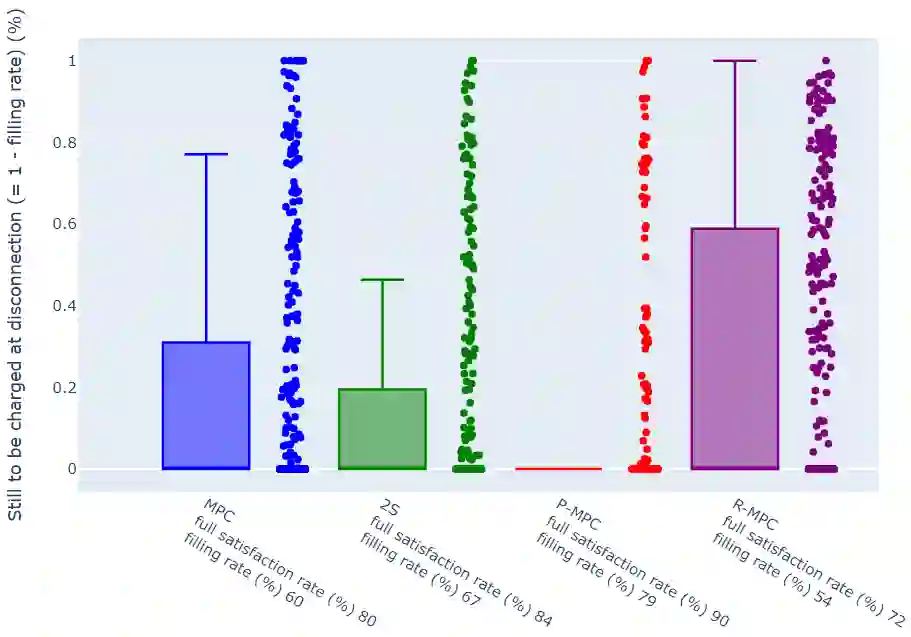
This paper introduces an Electric Vehicle Charging Station (EVCS) model that incorporates real-world constraints, such as slot power limitations, contract threshold overruns penalties, or early disconnections of electric vehicles (EVs). We propose a formulation of the problem of EVCS control under uncertainty, and implement two Multi-Stage Stochastic Programming approaches that leverage user-provided information, namely, Model Predictive Control and Two-Stage Stochastic Programming. The model addresses uncertainties in charging session start and end times, as well as in energy demand. A user's behavior model based on a sojourn-time-dependent stochastic process enhances cost reduction while maintaining customer satisfaction. The benefits of the two proposed methods are showcased against two baselines over a 22-day simulation using a real-world dataset. The two-stage approach proves robust against early disconnections, considering a more significant number of uncertainty scenarios for optimization. The algorithm prioritizing user satisfaction over electricity cost achieves a 20% and 36% improvement in two user satisfaction metrics compared to an industry-standard baseline. Additionally, the algorithm striking the best balance between cost and user satisfaction exhibits a mere 3% relative cost increase compared to the theoretically optimal baseline - for which the nonanticipativity constraint is relaxed - while attaining 94% and 84% of the user satisfaction performance in the two used satisfaction metrics.
翻译:本文提出了一种电动汽车充电站模型,该模型融合了实际约束条件,如充电桩功率限制、合同阈值超额罚款或电动汽车的提前断开链接。我们提出了在不确定性条件下控制充电站问题的公式化表述,并实现了两种利用用户提供信息的多阶段随机规划方法,即模型预测控制和两阶段随机规划。该模型应对了充电会话开始与结束时间以及能量需求的不确定性。一种基于驻留时间相关随机过程的用户行为模型在保持客户满意度的同时降低了成本。通过使用真实数据集进行22天模拟,我们展示了所提出的两种方法相比两个基线方案的优势。两阶段方法考虑了更多的不确定性场景进行优化,能有效应对提前断开链接。优先考虑用户满意度而非电费的算法,在两项用户满意度指标上相比行业标准基线分别提升了20%和36%。此外,在成本与用户满意度之间取得最佳平衡的算法,其相对成本仅比理论上放松了非预期约束的最优基线高出3%,而在所采用的两个满意度指标中,其用户满意度表现分别达到了94%和84%。




相关内容



 微信扫码咨询专知VIP会员