

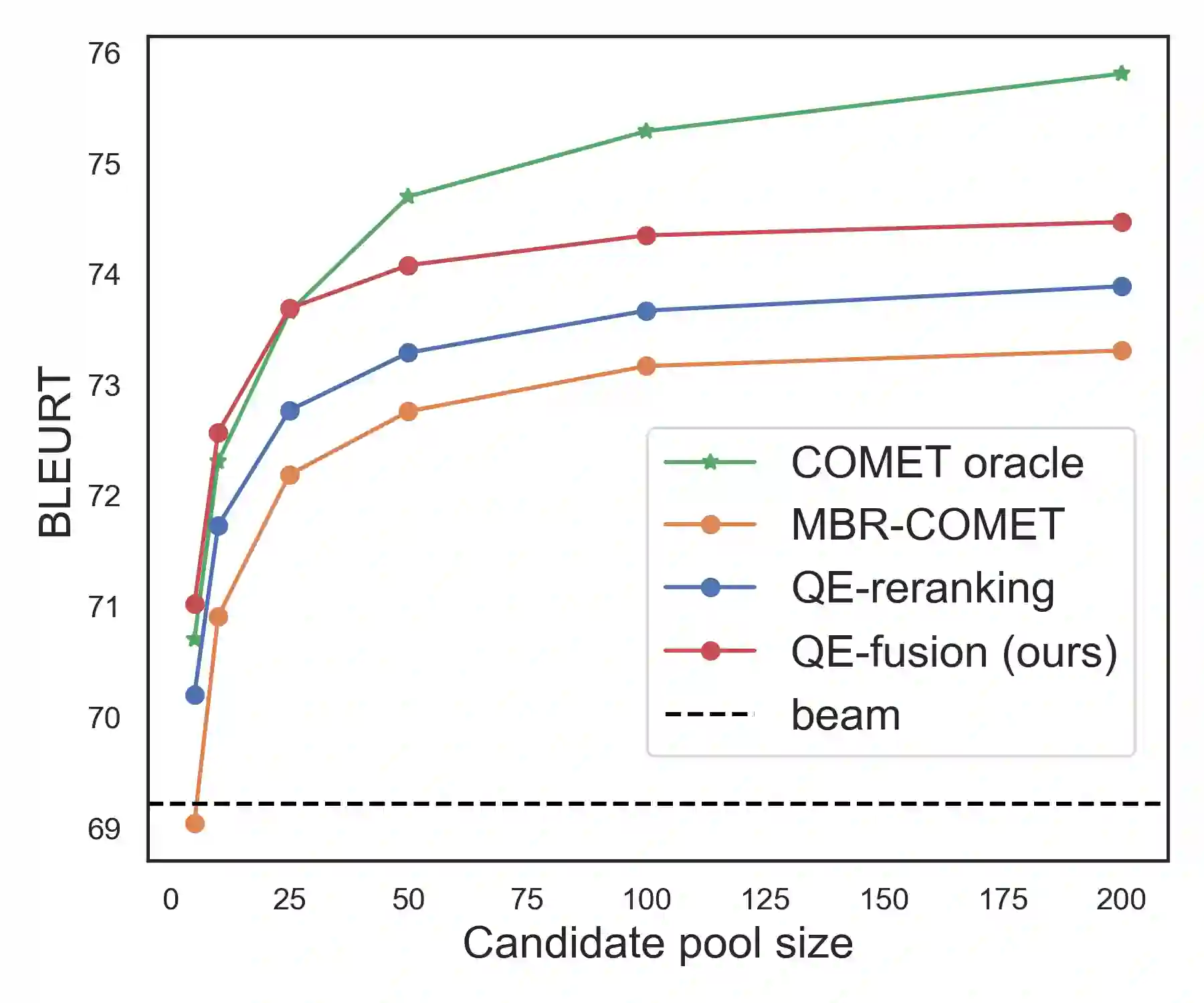
Neural machine translation systems estimate probabilities of target sentences given source sentences, yet these estimates may not align with human preferences. This work introduces QE-fusion, a method utilizing a quality estimation metric (QE) that better correlates with human judgments to synthesize improved translations. QE-fusion leverages a candidate pool sampled from a model, combining spans from different candidates using QE metrics such as CometKiwi. We compare QE-fusion against beam search and recent reranking techniques, such as Minimum Bayes Risk decoding or QE-reranking. Our method consistently improves translation quality in terms of COMET and BLEURT scores when applied to large language models (LLMs) used for translation (PolyLM, XGLM, Llama2, and Mistral) and to multilingual translation models (NLLB), over five language pairs. Notably, QE-fusion exhibits larger improvements for LLMs due to their ability to generate diverse outputs. We demonstrate that our approach generates novel translations in over half of the cases and consistently outperforms other methods across varying numbers of candidates (5-200). Furthermore, we empirically establish that QE-fusion scales linearly with the number of candidates in the pool. QE-fusion proves effective in enhancing LLM-based translation without the need for costly retraining of LLMs.
翻译:神经网络机器翻译系统根据源句估计目标句的概率,然而这些估计可能与人类偏好不一致。本文提出QE-fusion方法,利用与人类判断更相关的质量估计指标(QE)来合成改进的翻译结果。QE-fusion从模型采样得到的候选池出发,使用诸如CometKiwi等QE指标组合不同候选片段。我们将QE-fusion与束搜索及近期重排序技术(如最小贝叶斯风险解码或QE重排序)进行比较。在应用于翻译任务的大型语言模型(LLMs)(包括PolyLM、XGLM、Llama2和Mistral)以及多语言翻译模型(NLLB)时,我们的方法在五个语言对上均持续提升了COMET和BLEURT分数所衡量的翻译质量。值得注意的是,由于LLMs能够生成多样化的输出,QE-fusion对其提升效果更为显著。我们证明,该方法在超过一半的案例中生成了全新的翻译,并在不同候选数量(5-200个)下始终优于其他方法。此外,我们通过实验确立,QE-fusion与候选池中的候选数量呈线性扩展关系。QE-fusion在不需对LLMs进行昂贵重训练的前提下,有效提升了基于LLM的翻译性能。







相关内容



 微信扫码咨询专知VIP会员