

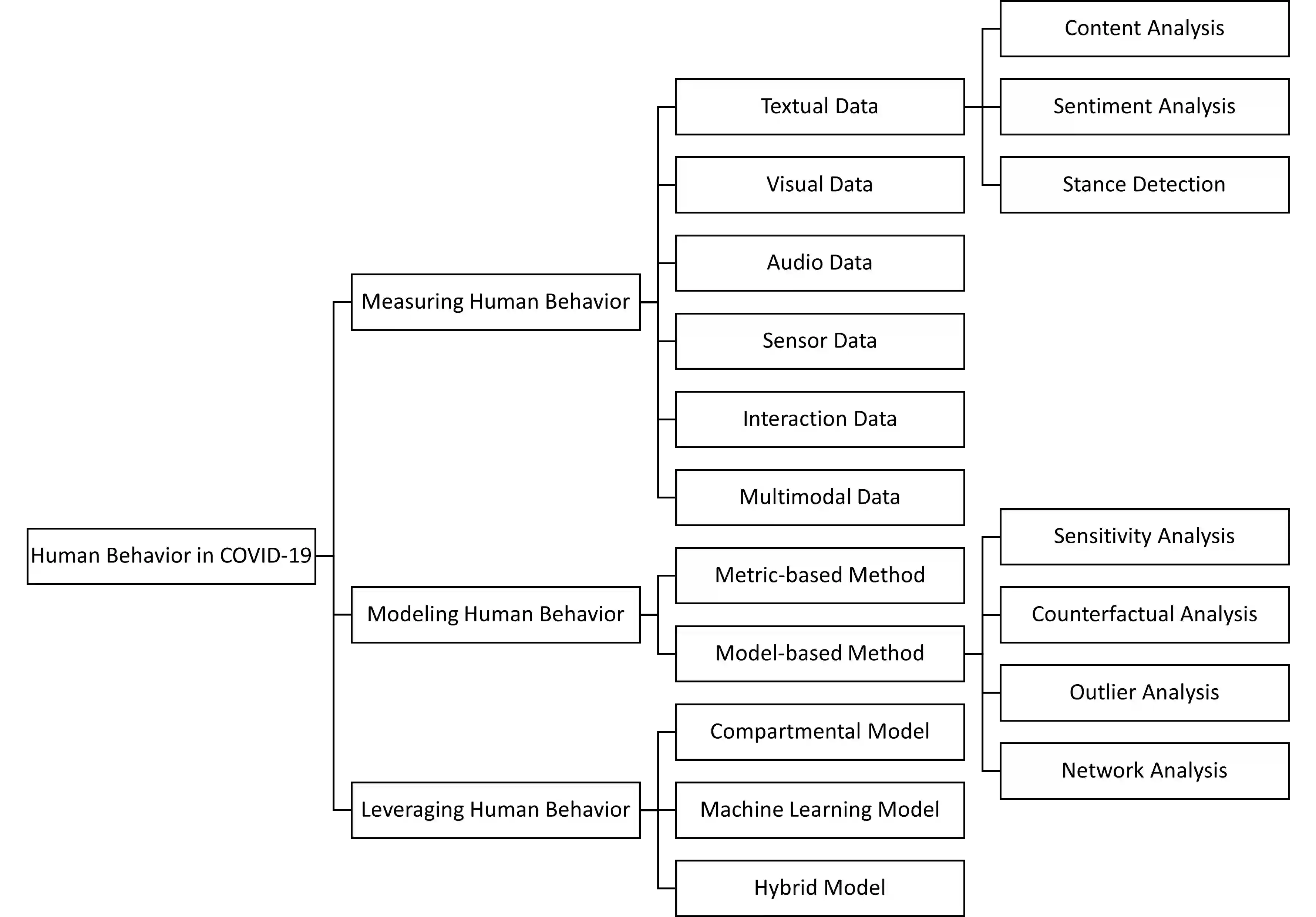
Since the World Health Organization (WHO) characterized COVID-19 as a pandemic in March 2020, there have been over 600 million confirmed cases of COVID-19 and more than six million deaths as of October 2022. The relationship between the COVID-19 pandemic and human behavior is complicated. On one hand, human behavior is found to shape the spread of the disease. On the other hand, the pandemic has impacted and even changed human behavior in almost every aspect. To provide a holistic understanding of the complex interplay between human behavior and the COVID-19 pandemic, researchers have been employing big data techniques such as natural language processing, computer vision, audio signal processing, frequent pattern mining, and machine learning. In this study, we present an overview of the existing studies on using big data techniques to study human behavior in the time of the COVID-19 pandemic. In particular, we categorize these studies into three groups - using big data to measure, model, and leverage human behavior, respectively. The related tasks, data, and methods are summarized accordingly. To provide more insights into how to fight the COVID-19 pandemic and future global catastrophes, we further discuss challenges and potential opportunities.
翻译:自世界卫生组织(WHO)于2020年3月将COVID-19定性为大流行以来,截至2022年10月,全球已有超过6亿例确诊病例和600多万例死亡病例。COVID-19大流行与人类行为之间的关系是复杂的。一方面,研究发现人类行为影响疾病的传播;另一方面,大流行在几乎每个方面都影响甚至改变了人类行为。为了全面理解人类行为与COVID-19大流行之间的复杂相互作用,研究人员一直采用自然语言处理、计算机视觉、音频信号处理、频繁模式挖掘和机器学习等大数据技术。在本研究中,我们概述了使用大数据技术研究COVID-19大流行期间人类行为的现有研究。具体而言,我们将这些研究分为三类——分别利用大数据来测量、建模和利用人类行为。相应地总结了相关任务、数据和方法。为了为抗击COVID-19大流行及未来的全球灾难提供更多见解,我们进一步讨论了挑战和潜在机遇。




相关内容




 微信扫码咨询专知VIP会员