

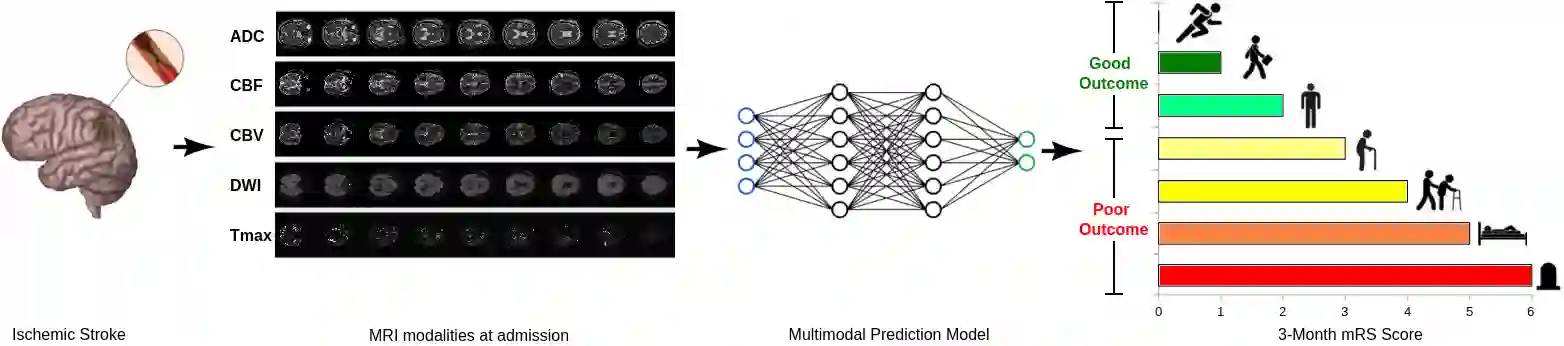
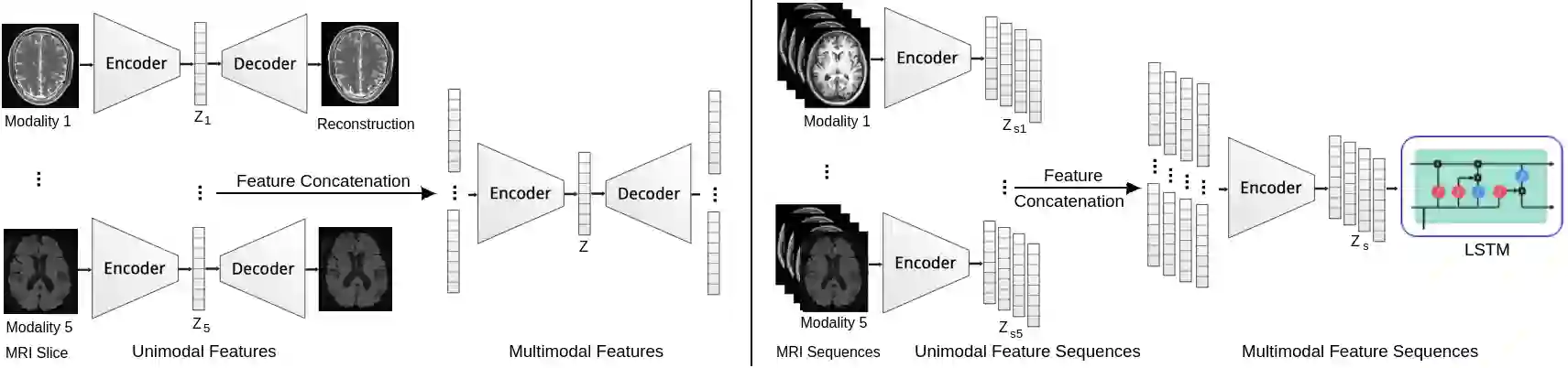
Patient outcome prediction is critical in management of ischemic stroke. In this paper, a novel machine learning model is proposed for stroke outcome prediction using multimodal Magnetic Resonance Imaging (MRI). The proposed model consists of two serial levels of Autoencoders (AEs), where different AEs at level 1 are used for learning unimodal features from different MRI modalities and a AE at level 2 is used to combine the unimodal features into compressed multimodal features. The sequences of multimodal features of a given patient are then used by an LSTM network for predicting outcome score. The proposed AE2-LSTM model is proved to be an effective approach for better addressing the multimodality and volumetric nature of MRI data. Experimental results show that the proposed AE2-LSTM outperforms the existing state-of-the art models by achieving highest AUC=0.71 and lowest MAE=0.34.
翻译:患者预后预测在缺血性中风治疗管理中至关重要。本文提出了一种基于多模态磁共振成像(MRI)的新型机器学习模型用于中风预后预测。该模型包含两个串联的自编码器层级:第一层采用不同自编码器分别学习各MRI模态的单模态特征,第二层自编码器将单模态特征融合为压缩的多模态特征。随后,利用长短期记忆网络处理患者的多模态特征序列以预测预后评分。实验证明,所提出的AE2-LSTM模型能有效应对MRI数据的多模态性与三维体素特性。实验结果表明,该模型取得了最高AUC=0.71、最低MAE=0.34的优异性能,优于当前最先进模型。




相关内容




 微信扫码咨询专知VIP会员